Paul Dirac
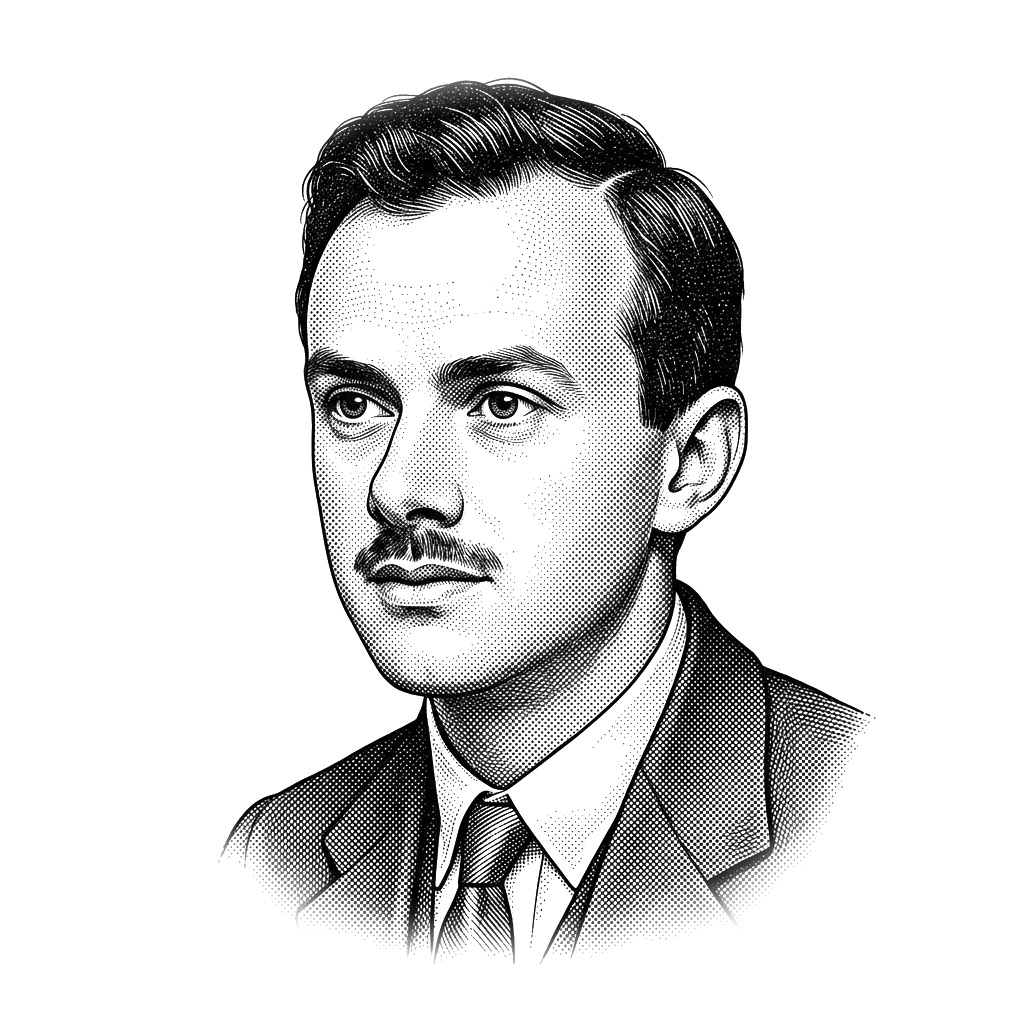
In the quiet rooms of St John's College, Cambridge, in the late autumn of 1927, a painfully laconic twenty-five-year-old electrical engineer turned mathematical physicist sat staring into the coal fire. Paul Adrien Maurice Dirac was notorious throughout the university for his near-total silence. In the physics laboratories, colleagues had invented a unit of measurement for speech—the "dirac"—defined as exactly one word per hour. Dirac never engaged in academic small talk, never wasted a gesture, and believed that any sentence that did not convey precise logical information was an assault upon reality. Yet behind that terrifying, granite reticence lived an aesthetic intuition of supreme mathematical purity: Dirac believed with absolute religious intensity that the fundamental laws of nature must be formulated in equations of breathtaking mathematical beauty.
Born in Bristol in 1902 to a tyrannically strict Swiss father who forced the boy to speak only French at dinner—punishing any grammatical error with forced silence—Dirac had retreated into the sanctuary of mathematics. Trained first in practical electrical engineering, he had developed an instinctive feel for physical approximations before absorbing the quantum mechanics of Bohr, Heisenberg, and Schrödinger. In 1925, upon reading Heisenberg's first matrix mechanics paper, Dirac had realized what everyone else had missed: the non-commutative commutator of quantum mechanics ($AB - BA$) was mathematically identical to the classical Poisson brackets of Hamiltonian mechanics. In a single stroke of genius, Dirac unified matrix mechanics and wave mechanics into a single abstract transformation theory.
Yet the great frontier remained unconquered: quantum mechanics was non-relativistic. Schrödinger's wave equation was strictly Galilean, assuming that space and time were separate, while Albert Einstein’s Special Theory of Relativity demanded that space and time be unified into four-dimensional spacetime. Other physicists had attempted to formulate relativistic wave equations—notably the Klein-Gordon equation—but because it was quadratic in time, it yielded physically nonsensical negative probabilities. Nature could not accept negative probabilities; an event either happens or it does not.
In his Cambridge study, Dirac sought a linear differential equation: first-order in both time and space. To make the equation invariant under Lorentz transformations while remaining first-order, Dirac realized that the coefficients could not be ordinary numbers; they had to be four-by-four non-commuting matrices—now known as the Dirac matrices ($\gamma^\mu$). Writing down the four-component equation, Dirac observed: $(i \gamma^\mu \partial_\mu - m) \psi = 0$. The equation was astonishingly compact, symmetrical, and elegant. When Dirac solved it for the hydrogen atom, it yielded without any ad-hoc tinkering the exact anomalous magnetic moment of the electron and its intrinsic spin of one-half ($\hbar / 2$). Spin was not a mechanical sphere spinning like a billiard ball; it was an unavoidable, necessary consequence of combining quantum mechanics with special relativity.
Yet the equation held a terrifying secret: it contained two sets of solutions, one with positive energy and one with negative energy. In classical physics, negative energy solutions could be dismissed as unphysical mathematical artifacts. But in quantum physics, an electron in a positive energy state should inevitably emit a photon and cascade downward into an infinite abyss of negative energy states, causing all matter in the universe to instantly collapse into radiation.
Dirac refused to alter his beautiful equation. Instead, in 1930, he proposed an outrageous, audacious physical hypothesis: the "Dirac Sea." The entire universe, he posited, is a sea of negative energy states that is already completely filled with an infinite density of electrons, obeying the Pauli Exclusion Principle. Because every negative state is occupied, positive energy electrons are prevented from falling into the abyss. If, however, a high-energy gamma-ray photon strikes this negative energy sea, it can kick an electron out of the sea into a positive state, leaving behind an empty "hole." This empty bubble in the sea of negative charge would behave physically as a particle of identical mass, but with a positive electric charge. Dirac had predicted antimatter: the positron.
The physics world was deeply skeptical. Eminent masters like Wolfgang Pauli and Werner Heisenberg mocked the "hole theory" as science fiction. Yet on August 2, 1932, at Caltech, Carl Anderson, examining cloud chamber photographs of cosmic rays in a strong magnetic field, observed the unmistakable track of a particle curving in the opposite direction of an electron, but with identical mass and ionization density. The positron was real. For the first time in human history, pure mathematical aesthetics had predicted the existence of an entirely new form of matter before any experimental instrument had ever detected it.
In 1933, at the age of thirty-one, Dirac was awarded the Nobel Prize in Physics, sharing it with Erwin Schrödinger. When he learned of the prize, his immediate instinct was to refuse it because he dreaded the publicity and newspaper interviews; he accepted only when Ernest Rutherford pointed out that refusing the prize would generate a thousand times more publicity than accepting it. At the award ceremony, accompanied by his mother, Dirac was the youngest theoretical physicist ever to receive the honor.
Dirac spent thirty-seven years as the Lucasian Professor of Mathematics at Cambridge—the chair once held by Isaac Newton. In his later years, he formulated the path integral approach that Richard Feynman would later expand into quantum electrodynamics, pioneered the concept of magnetic monopoles, and developed the Dirac delta function ($\delta(x)$). In 1969, he retired from Cambridge and moved to Tallahassee, Florida, where he spent his final years walking through the subtropical pine forests around Florida State University.
He died in Tallahassee on October 20, 1984. In Westminster Abbey, his memorial stone is inscribed with his relativistic wave equation, placed alongside the graves of Isaac Newton and Charles Darwin. Paul Dirac taught the human mind that nature's deepest secrets are written in the language of pure mathematical harmony. As he famously declared: "It is more important to have beauty in one's equations than to have them fit experiment... because discrepancies may be due to minor features that will get cleared up with further developments, whereas if an equation is not beautiful, it can never be fundamentally right." In Dirac’s silence, the universe revealed its symmetry.
“It is more important to have beauty in one's equations than to have them fit experiment.”
“God used beautiful mathematics in creating the world.”
“In science one tries to tell people, in such a way as to be understood by everyone, something that no one ever knew before. But in poetry, it's the exact opposite.”
“A great deal of my work is just playing with equations and seeing what they lead to.”
“The measure of a theory is its ability to reveal unseen harmony.”
- The Quantum Theory of the Electron 1928
- The Principles of Quantum Mechanics 1930
- The Quantum Theory of Emission and Absorption of Radiation 1927
- Quantised Singularities in the Electromagnetic Field 1931
- The Lagrangian in Quantum Mechanics 1933