Nikola Tesla
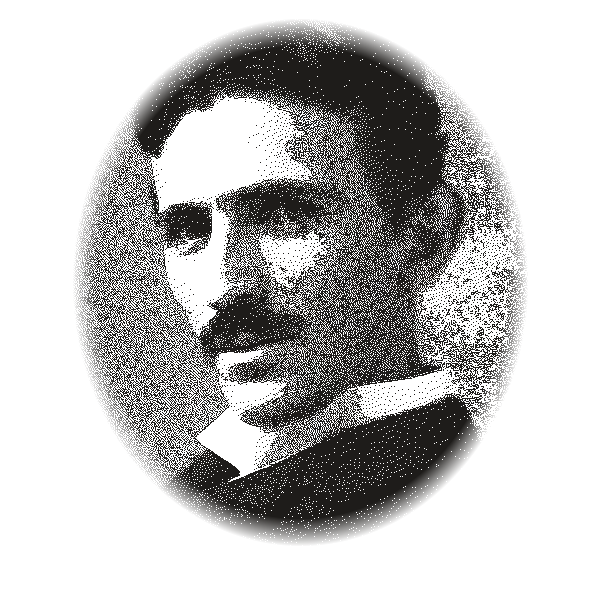
At midnight on July 10, 1856, in the mountain village of Smiljan on the Austro-Hungarian military frontier, a child was born during a violent summer thunderstorm that illuminated the Dinaric Alps in jagged sheets of electric blue. According to family legend, the terrified midwife wrung her hands as thunder shook the timber roof and whispered that the infant was a child of darkness, a son of the storm. The mother, Djuka Mandić—an illiterate inventor of ingenious household weavers who could recite thousands of lines of Serbian epic poetry from memory—replied quietly: "No, he will be a child of light."
From early childhood, Nikola Tesla was haunted by a peculiar mental affliction that bordered on neurological ecstasy. Whenever a word or concept was spoken, blinding flashes of light erupted before his eyes, followed by tangible, three-dimensional physical hallucinations of objects floating in midair. To preserve his sanity, the boy learned to discipline these intrusive visions into a terrifyingly potent cognitive simulator. He did not build experimental prototypes out of wood, iron, or brass; he constructed them entirely within the chambers of his mind. He would assemble an imaginary electric motor, set it spinning in his imagination, let it run undisturbed for three weeks, and then mentally dismantle it to inspect the bearings for microscopic wear. When he finally walked into a workshop to machine metal, the physical machine invariably performed exactly as its mental phantom had dictated.
In February 1882, while walking through the City Park of Budapest with a university friend named Anthony Szigeti, the twenty-five-year-old engineer was watching the sunset and reciting verses from Goethe’s Faust: "The glow retreats, done is the day of toil; it hastens hence, famed new fields of life to foil... Ah, that no wing can lift me from the ground, on his track to follow, ever follow!" He suddenly froze in mid-stride. A vision of blinding clarity struck his consciousness like a lightning bolt. Snatching a wooden stick from the path, he began frantically drawing a diagram in the sandy soil.
"Watch me!" he cried to his bewildered companion. "Watch me reverse it!"
What Tesla had drawn in the dirt was the rotating magnetic field—the foundational breakthrough of modern electrical power. For a century, inventors had been paralyzed by the direct-current dynamo, whose spinning armatures required mechanical commutators and copper carbon brushes. These brushes sparked, overheated, wore down, and severely limited voltage and speed. Tesla saw that mechanical commutation was a crude, barbaric solution to an invisible geometric problem. Instead of using mechanical switches to reverse current, one could feed multiple alternating currents out of phase with one another into stationary stator coils. Two currents, oscillating as pure sine waves separated by ninety degrees, or three separated by one hundred and twenty degrees, generated a continuous, smoothly rotating magnetic vortex in the air gap. A solid metal rotor suspended within this invisible whirlwind would be dragged along by induced magnetic eddy currents without a single wire touching it, without sparks, without brushes, and without mechanical wear. He had replaced physical friction with pure mathematical phase geometry.
In 1884, Tesla stepped off the immigrant steamer at the port of New York with four cents in his pocket, a book of his own poetry, and a letter of recommendation addressed to Thomas Alva Edison written by Charles Batchelor: "I know two great men and you are one of them; the other is this young man." But the meeting between the two titans was an immediate, irreconcilable collision of civilizations. Edison was a relentless, empirical tinkerer who tested thousands of charred filaments until one worked—a pragmatic businessman committed body and soul to his low-voltage Direct Current (DC) system. Tesla was a fastidious, theoretical purist who designed machines through Maxwellian field equations and despised Edison's blind trial-and-error methodology. When Edison allegedly promised Tesla fifty thousand dollars if he could redesign the inefficient dynamos at the Edison Machine Works, Tesla worked eighteen hours a day for months and delivered twenty-four complete redesigns. When he asked for the promised payment, Edison laughed and told him: "Tesla, you don't understand our American humor."
Tesla resigned on the spot. In the brutal winter of 1886, unable to find engineering employment, the greatest electrical mind of the nineteenth century survived by digging drainage ditches through the frozen mud of Manhattan for two dollars a day.
Yet his humiliation was brief. In 1888, his lectures at the American Institute of Electrical Engineers caught the attention of the industrialist George Westinghouse, who instantly recognized the revolutionary superiority of Tesla’s alternating current patents. Westinghouse purchased the polyphase patents for sixty thousand dollars in cash, stock, and a royalty of two dollars and fifty cents per horsepower, launching the epic "War of the Currents" against the Edison General Electric empire.
Edison fought back with a ruthless, desperate propaganda campaign, electrocuting stray cats, dogs, calves, and even an elephant named Topsy with alternating current to convince the public that AC was lethal. He financed the design of the first electric chair in New York state prison using Westinghouse AC generators, attempting to brand death by alternating current as being "Westinghoused."
Tesla responded not with fear, but with theatrical spectacle. In public lectures, he dressed in white tie and tails, stood atop rubber-soled shoes, and passed hundreds of thousands of volts of high-frequency alternating current directly through his own body, leaving his fingertips crowned with glowing blue coronas of St. Elmo’s fire and melting lead wires in his hands while remaining completely unharmed.
The War of the Currents was decided definitively in 1893 at the World's Columbian Exposition in Chicago. Lit by nearly one hundred thousand Westinghouse polyphase incandescent lamps, the "White City" shone across Lake Michigan like an ethereal jewel, proving that alternating current was both breathtakingly beautiful and completely safe. Two years later, in 1895, the Adams Power Plant at Niagara Falls opened, utilizing Tesla’s massive polyphase generators to harness the mechanical fury of the cataract. By stepping the voltage up through transformers to twenty-two thousand volts, Tesla transmitted electricity twenty-six miles across northern New York to Buffalo with negligible heat loss. Direct current, limited to a one-mile radius, was dead. The polyphase alternating grid became the universal central nervous system of human civilization.
In the second half of his life, Tesla slipped beyond the comprehension of his contemporaries into the high-frequency and resonant domain. In his wooden laboratory in Colorado Springs in 1899, he constructed a gargantuan magnifying transmitter, generating twelve-million-volt artificial lightning bolts that shook the ground for fifteen miles and made horses bolt in their stalls. He claimed to have observed stationary terrestrial electrical waves, convincing him that the Earth itself could be tuned like a gargantuan violin string to transmit unlimited power and messages wirelessly across the oceans.
He returned to Long Island to build Wardenclyffe Tower—a one-hundred-and-eighty-seven-foot wooden transmission spire anchored by a deep iron shaft into the earth, financed by J. Pierpont Morgan. But when Guglielmo Marconi sent the letter S across the Atlantic in 1901 using a crude spark transmitter based on seventeen of Tesla’s own radio patents, Morgan realized that Tesla’s dream of universal, free wireless power could not be metered. Morgan withdrew his capital, and the uncompleted tower was dismantled for scrap during the First World War.
Tesla spent his final decades in solitary eccentric seclusion in Midtown Manhattan hotels, obsessively washing his hands, calculating the cubic volume of his food before eating, and nursing injured urban pigeons on his windowsill in Bryant Park. When he died alone in Room 3327 of the Hotel New Yorker on Orthodox Christmas in 1943 at the age of eighty-six, the FBI promptly seized his trunks of research papers. He had died penniless, having voluntarily torn up his multi-million-dollar Westinghouse royalty contract decades earlier to save his patron from bankruptcy. Yet every time an alternating-current motor spins in an industrial plant, every time a switch flips on a lamp in a dark room, and every time high-voltage transmission lines hum across the dark continent, the world is moving through the invisible, rotating architecture conceived by the son of light in the dust of Budapest.
“The present is theirs; the future, for which I really worked, is mine.”
“If you want to find the secrets of the universe, think in terms of energy, frequency and vibration.”
“Our virtues and our failings are inseparable, like force and matter. When they separate, man is no more.”
“My method is different. I do not rush into actual work. When I get an idea I start at once building it up in my imagination.”
“The day science begins to study non-physical phenomena, it will make more progress in one decade than in all the previous centuries of its existence.”
- A New System of Alternate Current Motors and Transformers 1888
- Experiments with Alternate Currents of Very High Frequency 1891
- Light and Other High Frequency Phenomena 1893
- The Problem of Increasing Human Energy 1900
- The Transmission of Electrical Energy Without Wires 1904
- My Inventions: The Autobiography of Nikola Tesla 1919