Niels Bohr
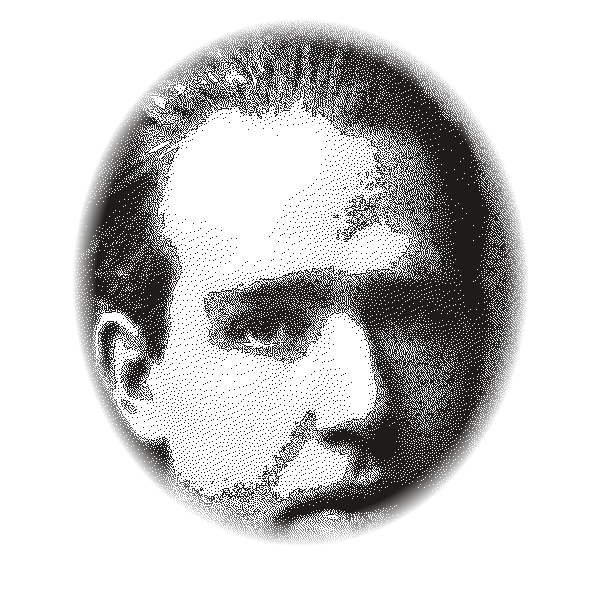
In the spring of 1913, in Manchester, a soft-spoken twenty-seven-year-old Danish postdoctoral researcher looked at Ernest Rutherford's newly discovered planetary model of the atom and confronted an impossible paradox. Rutherford had demonstrated that the positive charge and almost all the mass of the atom was concentrated in a miniscule central nucleus, with light negative electrons orbiting it like planets circling a sun. But classical physics rendered this picture suicidal. According to James Clerk Maxwell's electrodynamics, any charged particle undergoing circular acceleration must continuously radiate electromagnetic energy into space. An orbiting electron should hemorrhage energy, spiral into the nucleus within a hundred-millionth of a second, and collapse all stable matter in the universe into a dense atomic heap.
Niels Bohr did not attempt to patch the classical equations. With audacious intellectual heresy, he imposed Max Planck's quantum constraint directly onto the electron's orbit. He decreed that an electron inside an atom can only inhabit discrete, non-radiating 'stationary states' where its orbital angular momentum is an integer multiple of $\hbar = h/2\pi$. Within these privileged orbits, the electron is magically immune to classical radiation. Radiation occurs only when the electron undergoes an instantaneous, uncaused transition—a 'quantum leap'—from one stationary orbit to another, emitting or absorbing a single photon whose frequency is determined by the exact energy difference: $\Delta E = h\nu$.
When Bohr applied this crude, hybrid model to the hydrogen atom, the result was miraculous. The mysterious, precise numerical series of spectral lines discovered empirically by Johann Balmer and Johannes Rydberg in the late nineteenth century suddenly fell out of Bohr's pencil with absolute mathematical necessity. The Rydberg constant was no longer an arbitrary empirical number; it was a derived composite of fundamental physical constants: the mass of the electron, its charge, Planck's constant, and the speed of light. The spectral colors of glowing hydrogen gas were the visible musical chords of quantum orbits.
Yet Bohr knew that his 1913 model was a provisional scaffold, a bizarre amalgam of classical Newtonian trajectories and arbitrary quantum decrees. For the next fifteen years, from his newly established Institute for Theoretical Physics in Copenhagen, Bohr functioned as the Socrates of modern physics. He gathered around him the brilliant youth of Europe—Werner Heisenberg, Wolfgang Pauli, Paul Dirac, Lev Landau—subjecting every idea to relentless, agonizing philosophical dialogue. He was not a rapid mathematical technician like Heisenberg or Dirac; he was a deep, slow conceptual thinker who wrestled with language itself, convinced that the greatest crisis of modern science was not mathematical, but epistemological.
In 1927, in the Italian resort town of Como, Bohr unveiled the philosophical capstone of the Copenhagen interpretation: the Principle of Complementarity. Confronted by Louis de Broglie's proof that matter behaves as both waves and particles, and Heisenberg's discovery of the Uncertainty Principle, Bohr recognized that these contradictory descriptions are not mutually exclusive defects of measurement. They are complementary aspects of a single, deeper reality. An electron can be observed as a localized particle, or it can be observed as a spread-out wave; but it can never be observed as both in the very same experimental arrangement. The choice of apparatus dictates which aspect of reality manifests.
This was a profound epistemic revolution. Classical physics had assumed an objective, detached universe that could be observed from the outside without disturbing its state. Bohr demolished this spectator illusion: we are both actors and spectators in the great drama of existence. There is no quantum world out there waiting to be discovered behind the curtain; there is only an abstract quantum physical description. It is wrong to think that the task of physics is to find out how nature is; physics concerns what we can say about nature. When Albert Einstein resisted this indeterminacy at the Solvay Conferences, famously protesting that 'God does not play dice with the universe,' Bohr gently replied: 'Einstein, stop telling God what to do.'
Through historic intellectual duels at the 1927 and 1930 Solvay Conferences, Bohr defended the completeness of quantum mechanics against Einstein's ingenious thought experiments. When Einstein designed a photon box suspended on a spring scale, purporting to measure both the energy of an escaping photon and its emission time simultaneously—violating the uncertainty relation $\Delta E \Delta t \ge \hbar/2$—Bohr spent a sleepless night pacing the corridors of Brussels. By morning, he returned with a devastating counter-argument: to weigh the box, it must move in a gravitational field, which according to Einstein's own General Relativity alters the rate of the internal clock, restoring the exact uncertainty relation Einstein had sought to evade.
In 1939, as war descended upon Europe, Bohr turned his intuition to nuclear structure. With John Archibald Wheeler, he developed the Liquid Drop Model of the atomic nucleus, treating the heavy uranium nucleus as a droplet of charged liquid. When a slow neutron strikes the droplet, it induces mechanical oscillations; if the electrostatic repulsion between protons overcomes the nuclear surface tension, the droplet deforms into an hourglass shape and splits apart: nuclear fission. Bohr's model explained why uranium-235 fissions with thermal neutrons while uranium-238 does not, unlocking the physics of the atomic bomb.
During the Second World War, Bohr escaped occupied Denmark in the bomb bay of a British Mosquito aircraft, eventually reaching Los Alamos to serve as an elder statesman on the Manhattan Project under the code name 'Nicholas Baker.' But his mind was already fixed on the catastrophic political consequences of the weapon. He met with Winston Churchill and Franklin Roosevelt to plead for an open, international sharing of atomic secrets with the Soviet Union to prevent an apocalyptic nuclear arms race. Churchill dismissed him as a dangerous visionary; yet history would vindicate Bohr's foresight.
Niels Bohr died in Copenhagen in November 1962 at the age of seventy-seven. On the blackboard of his study, preserved just as he left it the night before he died, was a drawing of Einstein's photon box—the paradox he had wrestled with for over thirty years.
Today, every concept of modern quantum information, quantum entanglement, and quantum computing operates within the philosophical clearing Bohr carved out. He taught humanity that reality does not conform to the cozy mechanical prejudices of our macroscopic senses. In an era that demanded simple mechanical certainties, Niels Bohr had the supreme courage to embrace paradox, proving that the deepest truths of nature are found where complementary opposites meet.
“An expert is a person who has made all the mistakes that can be made in a very narrow field.”
“Prediction is very difficult, especially if it's about the future.”
“How wonderful that we have met with a paradox. Now we have some hope of making progress.”
“There are trivial truths and the great truths. The opposite of a trivial truth is plainly false. The opposite of a great truth is also true.”
“Everything we call real is made of things that cannot be regarded as real.”
- On the Constitution of Atoms and Molecules (Trilogy) 1913
- The Quantum Postulate and the Recent Development of Atomic Theory 1928
- Atomic Theory and the Description of Nature 1934
- Can Quantum-Mechanical Description of Physical Reality be Considered Complete? 1935
- The Mechanism of Nuclear Fission (with John Wheeler) 1939
- Atomic Physics and Human Knowledge 1958