Nicolaus Copernicus
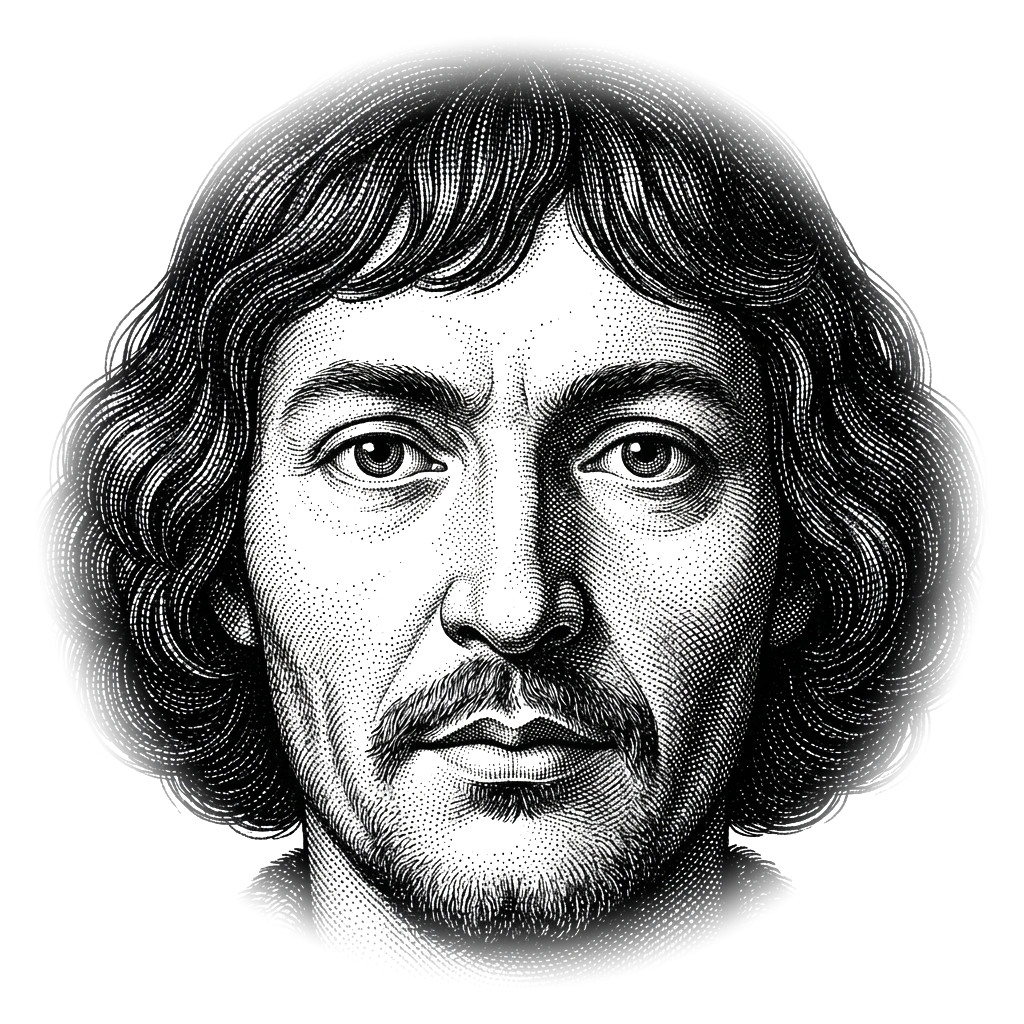
In the windswept northern tower of Frombork Cathedral, overlooking the frozen gray waters of the Vistula Lagoon on the Baltic coast, a solitary Polish canon spent three decades engaged in a quiet mathematical insurrection. Nicolaus Copernicus was not a radical iconoclast seeking to shatter the medieval heavens; he was a devout Catholic canon, a physician, a lawyer, and an economist who managed cathedral grain rents and wrote treatises on currency debasement. Yet every clear night, he climbed the stone steps to his observation turret, armed with crude wooden triquetrums and quadrants, and peered through the biting salt air at the wandering planets. What troubled him was not that the heavens were mysterious, but that the official mathematical model of Christendom—the geocentric cosmology of Claudius Ptolemy—was an aesthetic and mechanical monster.
For fourteen centuries, Ptolemy's Almagest had reigned supreme. To explain why planets occasionally slowed down, stopped, and moved backward across the night sky in retrograde loops, Ptolemy had constructed an intricate geometric labyrinth: planets spun upon small circular epicycles, which in turn rolled along immense deferent circles centered near the Earth. But when simple circles failed to match observations, Ptolemy had introduced the equant: an arbitrary mathematical point off-center from which a planet's motion appeared uniform, even though its physical speed through space varied wildly. To Copernicus, the equant was an unforgivable philosophical cheat. It violated the ancient Aristotelian decree that celestial motion must be uniform and circular around a true physical center. Ptolemy had not built a coherent celestial machine; he had assembled a creature whose head, hands, and feet were borrowed from different bodies, stitched together without common proportion.
Copernicus resolved to heal this monstrous anatomy by performing the most consequential coordinate transformation in human history. What if the Earth was not the motionless anchor of the cosmos? What if the terrestrial sphere, which seemed so solid and stationary beneath human feet, was itself a planet, spinning upon its axis once every twenty-four hours and hurtling through the void around a stationary Sun in an annual orbit? In his early anonymous manuscript, the Commentariolus, drafted around 1514 and circulated privately among trusted scholars, he laid down the revolutionary axiom: all the spheres revolve about the Sun as their mid-point, and therefore the Sun is the center of the universe.
In an instant of geometric clarity, the tangled knots of Ptolemaic astronomy untied themselves. Retrograde motion—the bizarre backward loop that had haunted astronomers for millennia—was revealed as an optical illusion of perspective, a parallax effect. When an observer in a fast carriage overtakes a slower carriage, the slower vehicle appears for a few moments to move backward against the distant horizon. Just so, when the fast-moving inner Earth overtakes the slower, outer orbits of Mars, Jupiter, or Saturn, the outer planets appear to reverse their course against the backdrop of the fixed stars. Retrograde motion was not an intricate mechanical epicycle built into the heavens; it was the signature of Earth's own motion reflected upon the cosmos.
Furthermore, the heliocentric geometry established for the first time the true physical scale and ordering of the solar system. In the Ptolemaic system, each planet's epicycle was mathematically independent; one could scale Mars or Venus up or down without affecting the other spheres. In the Copernican architecture, by contrast, the planets were locked into a strict, harmonic progression determined by their orbital periods: the closer a planet stood to the Sun, the faster it raced around its orbit. Mercury completed its journey in three months, Venus in nine, Earth in a year, Mars in two, Jupiter in twelve, and Saturn in thirty. As Copernicus wrote in one of the most sublime passages of scientific literature: 'At rest, however, in the middle of everything is the sun. For in this most beautiful temple, who would place this lamp in another or better position than that from which it can illuminate the whole at once?'
Yet Copernicus was paralyzed by fear of ridicule and theological condemnation. If the Earth was spinning at terrifying speed, why were objects dropped from towers not left miles behind? Why did a stone thrown straight up fall back to the thrower's hand? If the Earth orbited an immense circle millions of miles wide, why did the angles of the fixed stars not shift over the course of the seasons? To this last objection, Copernicus made an audacious leap of scale: the sphere of the fixed stars was so unimaginably vast that the entire orbit of the Earth shrank to an imperceptible, dimensionless point in comparison. The universe was orders of magnitude larger than antiquity had ever dreamed.
For decades, the manuscript of De revolutionibus orbium coelestium remained locked in his study, known only through whisper and rumor. It was not until 1539, when a young Protestant mathematics professor from Wittenberg named Georg Joachim Rheticus arrived at Frombork, that Copernicus was persuaded to allow his masterpiece to be published. The printing was overseen in Nuremberg by the Lutheran theologian Andreas Osiander. Fearing theological backlash, Osiander inserted an anonymous preface without Copernicus's consent, claiming that the heliocentric model was merely a convenient mathematical fiction for calculating tables, not a literal physical description of reality.
Legend holds that the first printed copy of De revolutionibus was placed into Copernicus's trembling hands on May 24, 1543, as he lay dying in Frombork Cathedral, having suffered a cerebral hemorrhage that left him blind and paralyzed. He stroked the fresh ink on the title page, lapsed into unconsciousness, and died hours later.
Osiander's evasive preface failed to tame the intellectual explosion. Within two generations, Johannes Kepler would discover that the planets trace ellipses rather than perfect circles, Galileo Galilei would turn his telescope toward Jupiter to see moons orbiting another world, and Isaac Newton would formulate universal gravitation, unifying terrestrial mechanics with the Copernican heavens. The Copernican Revolution was not merely an astronomical correction; it was a profound transformation of human consciousness. By displacing the Earth from the center of creation, Copernicus stripped humanity of its cosmic narcissism, forcing our species to realize that we inhabit a fragile, rotating sphere drifting through an ocean of stars.
Today, Nicolaus Copernicus stands as the prime symbol of intellectual courage: the quiet churchman who dared to stop the Sun and set the Earth in motion, proving that the supreme beauty of nature is revealed only when human reason dares to look beyond the illusions of its own vantage point.
“At rest, however, in the middle of everything is the sun.”
“To know the mighty works of God, to comprehend His wisdom and majesty and power... this must be a pleasing and acceptable mode of worship to the Most High.”
“Finally we shall place the Sun himself at the center of the Universe.”
“Mathematics is written for mathematicians.”
“For I am not so enamored of my own opinions that I disregard what others may think of them.”
- Commentariolus (Little Commentary) c. 1514
- Monetae cudendae ratio (On the Minting of Coin) 1526
- De revolutionibus orbium coelestium (On the Revolutions of the Heavenly Spheres) 1543