Ludwig van Beethoven
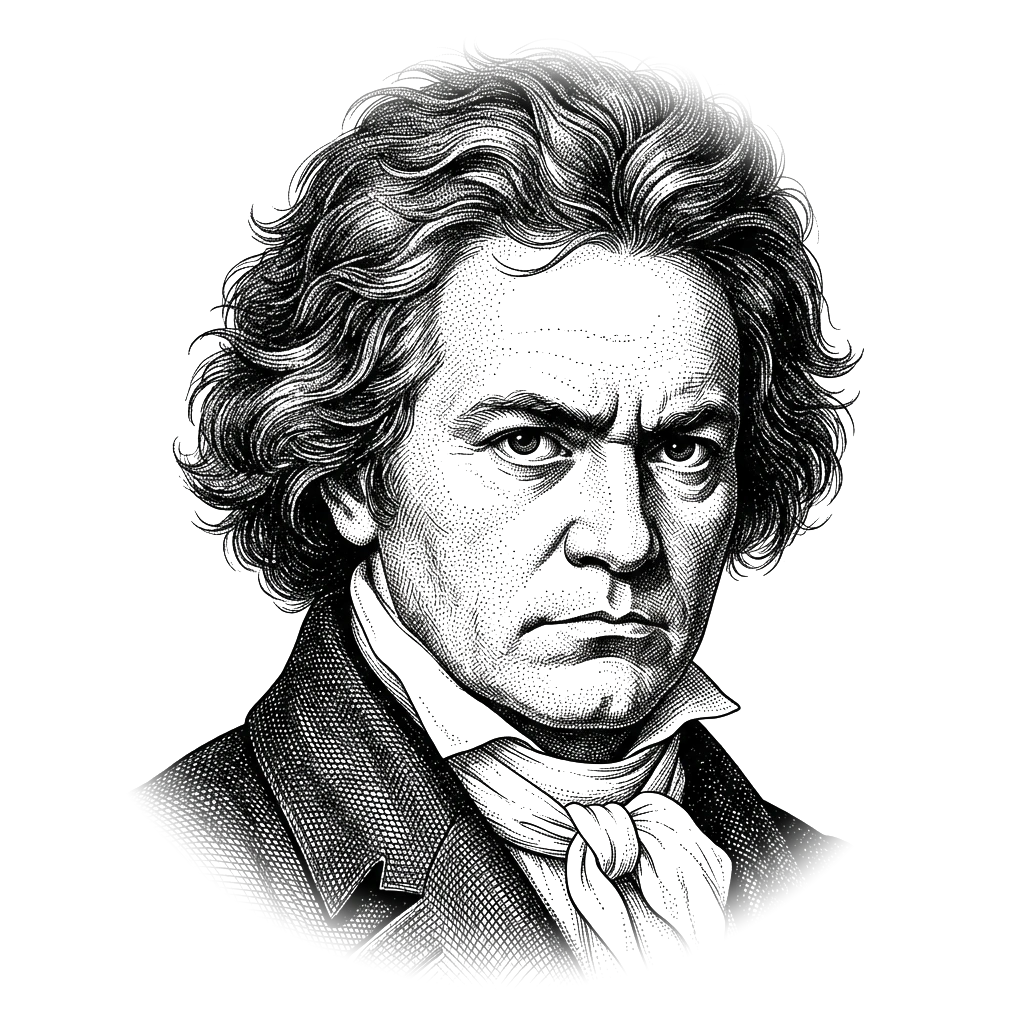
In the Heiligenstadt countryside outside Vienna, in the late autumn of 1802, a thirty-one-year-old German composer penned a desperate, agonized document to his brothers, intending it to be read only after his death. Ludwig van Beethoven had conquered the imperial capital of music as the undisputed sovereign virtuoso of the pianoforte, dazzling the Viennese aristocracy with his volcanic improvisations and tempestuous sonatas. Yet for six years, an unspeakable physical terror had been closing in around him: his hearing was deteriorating into a ceaseless internal roaring and buzzing. He could no longer hear the high piping of a shepherd's flute in the meadows; he leaned forward in theater boxes to read the lips of actors; and in society, he was forced to adopt the posture of an eccentric, misanthropic recluse to conceal the humiliating reality that the greatest musician of his age was going deaf.
In the Heiligenstadt Testament, Beethoven confessed that he had contemplated suicide: "A little more of that and I would have ended my life—it was only my art that held me back. Ah, it seemed to me impossible to leave the world until I had brought forth all that I felt was within me." In that lonely country cottage, Beethoven made a historic, Faustian pact: he rejected despair and resolved to "seize Fate by the throat." Returning to Vienna, he announced to his friends that he was setting out upon an entirely "new path." In doing so, he shattered the courtly, aristocratic elegance of eighteenth-century Classicism and dragged Western music into the fiery heroic modern era.
The first monument of this new path was the Third Symphony, the Eroica (1803–1804). Originally dedicated to Napoleon Bonaparte as the champion of republican liberty, Beethoven famously tore the title page in two upon hearing that Napoleon had crowned himself Emperor, furiously exclaiming: "So he too is nothing more than an ordinary man!" The Eroica was an architectural cataclysm: twice as long as any symphony by Mozart or Haydn, it discarded musical decorum for unprecedented dissonance, syncopation, and rhythmic violence. In the first movement, the developmental crisis culminates in an agonizing, crashing discord that shocked contemporary ears; yet out of that crisis emerges an inexorable heroic renewal.
Beethoven’s revolutionary breakthrough was the radical economy of thematic development. In the Fifth Symphony (1808), the entire four-movement symphonic cathedral—from the opening four-note motto ("Fate knocking at the door") to the blazing C-major triumphant finale—is constructed from a single, four-note rhythmic cell: three short notes and a long. Beethoven proved that musical greatness does not depend on a sweet proliferation of endless melodic tunes, but on the dialectical transformation of a minimal motivic seed. Like a master logician, he dismantled, inverted, elongated, and recombined his theme, demonstrating that struggle, catastrophe, and victory are connected by musical necessity.
As the silence deepened around him, Beethoven’s exterior life crumbled into squalor and chaotic isolation. Completely deaf by 1818, unable to hear the sound of the piano strings he battered so violently that hammers snapped and wires curled into iron bird’s nests, he communicated with friends and visitors through blank paper "Conversation Books." Landlords evicted him from over thirty Viennese apartments because he paced the floor at midnight, howling, stomping his feet, and pouring jugs of water over his head while composing.
Yet as the physical world fell silent, Beethoven’s inner ear opened into transcendent realms of sonic architecture that no human being had ever heard. In the late period—the Missa Solemnis, the Hammerklavier Sonata, the Ninth Symphony, and the final string quartets—Beethoven abandoned all concessions to public taste and performance convenience. In the Ninth Symphony (1824), he performed an unprecedented architectural transgression: introducing the human voice into the purely instrumental domain of the symphony, setting Friedrich Schiller's Ode to Joy (An die Freude) as a universal secular hymn to human brotherhood. At the premiere in Vienna, when the final movement concluded in thunderous applause, the contralto Caroline Unger gently took the totally deaf master by the shoulders and turned him around so he could see the audience waving handkerchiefs and standing in five standing ovations.
In his final two years, bedridden with cirrhosis, pneumonia, and dropsy, Beethoven retreated to the ultimate frontier of musical thought: the Late String Quartets (Opuses 127, 130, 131, 132, 133, and 135). In the Heiliger Dankgesang of Opus 132, written after recovering from a life-threatening illness, Beethoven composed a hymn of thanksgiving in the ancient Lydian church mode, oscillating between frail, tender convalescence and bursting vital energy. In the Große Fuge (Opus 133), he pushed counterpoint to the edge of sonic madness: a terrifying, dissonant fugue that stunned his contemporaries, causing Igor Stravinsky a century later to declare it "an absolutely contemporary piece of music that will be contemporary forever."
On March 26, 1827, during a violent late-afternoon thunderstorm that shook the rooftops of Vienna with thunder and hail, Beethoven died at the age of fifty-six. Eyewitnesses recorded that as a massive flash of lightning illuminated his room, the dying composer opened his eyes, raised his clenched right fist into the air for several seconds, and fell back dead. Over twenty thousand citizens lined the streets of Vienna for his funeral, and the poet Franz Grillparzer delivered the oration: "He was an artist, but a man as well, a man in every sense, in the highest sense... he withdrew from mankind only because he could find no weapon wherewith to resist it."
Ludwig van Beethoven permanently transformed the definition of what art is. Before him, composers were court servants in powdered wigs writing entertainment for prince-bishops and aristocratic salons; after him, the composer was a heroic titan, an autonomous prophet wrestling with destiny and speaking directly to all humanity. In his fierce refusal to surrender to physical limitation, Beethoven gave civilization its supreme musical symbol of courage, proving that through suffering, the human spirit can wrest joy from the silence of fate.
“I will seize fate by the throat; it shall certainly not bend and crush me completely.”
“Music is a higher revelation than all wisdom and philosophy.”
“To play a wrong note is insignificant; to play without passion is inexcusable.”
“It seemed to me impossible to leave the world until I had brought forth all that I felt was within me.”
“Don't only practice your art, but force your way into its secrets; for it and knowledge can raise man to the divine.”
- Symphony No. 9 in D Minor (Choral) 1824
- Symphony No. 5 in C Minor 1808
- Symphony No. 3 in E-flat Major (Eroica) 1804
- Late String Quartets (Opp. 127–135) 1825–1826
- Piano Sonata No. 29 in B-flat Major (Hammerklavier) 1818