Louis Pasteur
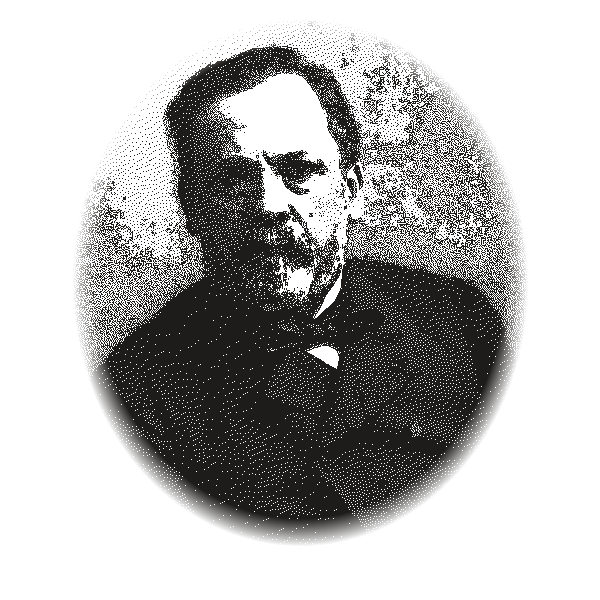
In the spring of 1848, in a drafty chemistry laboratory at the École Normale Supérieure in Paris, a twenty-five-year-old son of a tanner bent over a brass microscope with a pair of fine watchmaker's tweezers. Louis Pasteur was examining tiny, translucent crystals of paratartaric acid deposited on the inside of wine fermentation vats. Chemically, the crystals were identical to ordinary tartaric acid; yet when dissolved in water, tartaric acid rotated the plane of polarized light to the right, while paratartaric acid left the light completely undisturbed. Other chemists had dismissed this as an inexplicable physical anomaly. Pasteur did not dismiss it. Looking through his lens, he noticed something no one had ever seen: the paratartaric crystals were not uniform. They existed in two distinct morphological forms, asymmetrical mirror images of each other, like a left hand and a right hand.
Working with infinite patience, grain by grain, Pasteur separated the left-handed crystals from the right-handed crystals into two separate piles. When he dissolved them independently and passed polarized light through the solutions, his intuition was vindicated: the right-handed crystals rotated light to the right; the left-handed crystals rotated light to the left by the exact same angular magnitude. When mixed together in equal quantities, their optical effects canceled out into optical inactivity. In that moment of crystalline sorting, stereochemistry and molecular chirality were born. More profoundly, Pasteur realized that this optical asymmetry was the unique, unmistakable signature of living processes: life alone possessed the power to synthesize asymmetric molecules.
This molecular insight propelled Pasteur from chemistry into the messy, industrial world of nineteenth-century French fermentation. The vintners of Arbois and the beet-sugar distillers of Lille were facing financial ruin: vast vats of beer, wine, and milk were inexplicably souring into foul, acidic sludge. The dominant chemical orthodoxy of the day, led by Justus von Liebig, held that fermentation was a purely inorganic, decomposing chemical breakdown—a dying vibration of dead organic matter communicating itself to sugar. Microorganisms seen through microscopes were dismissed by Liebig as secondary scavengers feeding upon the decay.
Pasteur sampled the souring vats and showed that fermentation was not a chemical death, but a biological birth. In healthy vats, round, budding yeast cells flourished, converting sugar into alcohol. In the spoiled, sour vats, long, rod-shaped microorganisms—lactic and butyric acid bacteria—had invaded, outcompeting the yeast. Fermentation was a metabolic physiological act of specific living organisms. To rescue the French wine and silk industries, Pasteur designed a simple, elegant thermal protocol: heating the liquid to between 55 and 60 degrees Celsius for a few minutes destroyed the pathogenic microbes without altering the flavor or boiling away the alcohol. The process of pasteurization had arrived, permanently transforming the preservation of human food.
Yet the old guard resisted, clinging to the ancient doctrine of spontaneous generation: the belief that life could emerge spontaneously from decaying matter, that maggots generated from meat and microbes materialized out of thin air. In 1859, the Académie des Sciences offered the prestigious Alhumbert Prize to anyone who could solve the controversy through decisive experiments. Pasteur entered the lists with an apparatus of breathtaking simplicity: the swan-neck flask. He boiled nutrient broths inside glass flasks, heating them until all internal microbial life was destroyed. Then, with a blowpipe, he drew the neck of each flask out into a long, curving, S-shaped horizontal tube, open to the outside atmosphere.
Air could freely enter and leave the flask, neutralizing the critics' objection that a 'vital force' in fresh air was excluded. But dust particles and airborne microbes carrying fungal spores were trapped by gravity and condensation on the wet interior walls of the curving glass neck. The broths inside the swan-neck flasks remained pristine, clear, and sterile for months—and in some cases, for decades. Only when the glass neck was snapped off, allowing atmospheric dust to fall directly into the broth, did the liquid swarm with microbial life within forty-eight hours. Before a packed amphitheater at the Sorbonne in 1864, Pasteur delivered the death blow to spontaneous generation: 'Never will the doctrine of spontaneous generation recover from the mortal blow struck by this simple experiment.'
Having proved that microbes come only from other microbes, Pasteur directed his germ theory of disease toward the conquest of infection. Working closely with physicians like Joseph Lister—who applied carbolic acid sprays to surgical wounds based directly on Pasteur's papers—he demonstrated that surgical gangrene, puerperal fever, and wound sepsis were not caused by mysterious miasmas or bad air, but by the physical transmission of microscopic pathogens carried on unwashed hands, unsterilized scalpels, and dirty bandages. He entered maternity wards where one in five mothers died of childbed fever, seized the chalk from the blackboard, and sketched the chain-like streptococcus bacteria responsible for the slaughter.
In 1879, studying chicken cholera, Pasteur made the accidental discovery that would unlock modern immunology. Leaving a culture of virulent cholera bacteria on his laboratory bench while taking a summer vacation, he returned to find that the aged culture had lost its lethality: chickens injected with the stale bacteria became mildly ill but rapidly recovered. When he subsequently injected those same chickens with a fresh, lethal batch of virulent cholera, the birds remained completely healthy, while freshly injected control chickens died within hours. The attenuated pathogen had conferred active biological immunity. Pasteur immediately recognized the universal principle: by aging, heating, or chemically treating a deadly microbe, one could create a vaccine that taught the host's immune system to defend itself without inducing the disease.
The culmination of his life arrived in July 1885, when a nine-year-old Alsatian boy named Joseph Meister was carried into his laboratory, mauled by a rabid dog and facing an agonized, inevitable death. Rabies was the terror of nineteenth-century Europe: an invisible pathogen (a virus too small to be seen by optical microscopes) that traveled slowly along peripheral nerves to ignite inflammation in the brain. Pasteur had developed an experimental rabies vaccine by drying the spinal cords of infected rabbits, but he had never tested it on a human being. Haunted by the agonizing prospect of killing the child, yet knowing the boy was doomed without intervention, Pasteur administered twelve successive injections of increasingly virulent spinal tissue over ten days. Joseph Meister survived without a symptom.
When the Pasteur Institute was inaugurated in Paris in 1888, subscriptions poured in from all over the world, from the Tsar of Russia to impoverished French peasants. Pasteur, aged and partially paralyzed by strokes, looked out upon the assembly of international scientists and wept.
Today, every operating room sterilized against bacterial contamination, every needle administering an attenuated vaccine, every carton of pasteurized milk, and every sterile pharmaceutical vial stands as a monument to Louis Pasteur. He banished the phantom of spontaneous generation, founded the modern germ theory of disease, and proved that the smallest creatures in nature wield the power of life and death over the greatest empires on Earth.
“Fortune favors the prepared mind.”
“Life is the germ and the germ is life.”
“There does not exist a category of science to which one can give the name applied science. There are sciences and the applications of science, bound together as the fruit of the tree which bears it.”
“Do not let yourself be tainted by a barren skepticism.”
“Wine is the most healthful and most hygienic of beverages.”
- Mémoire sur la fermentation appelée lactique 1857
- Mémoire sur la fermentation alcoolique 1860
- Mémoire sur les corpuscules organisés qui existent dans l'atmosphère 1861
- Études sur le vin 1866
- Études sur le vinaigre 1868
- Études sur la maladie des vers à soie 1870
- Méthode pour prévenir la rage après morsure 1885