Isaac Newton
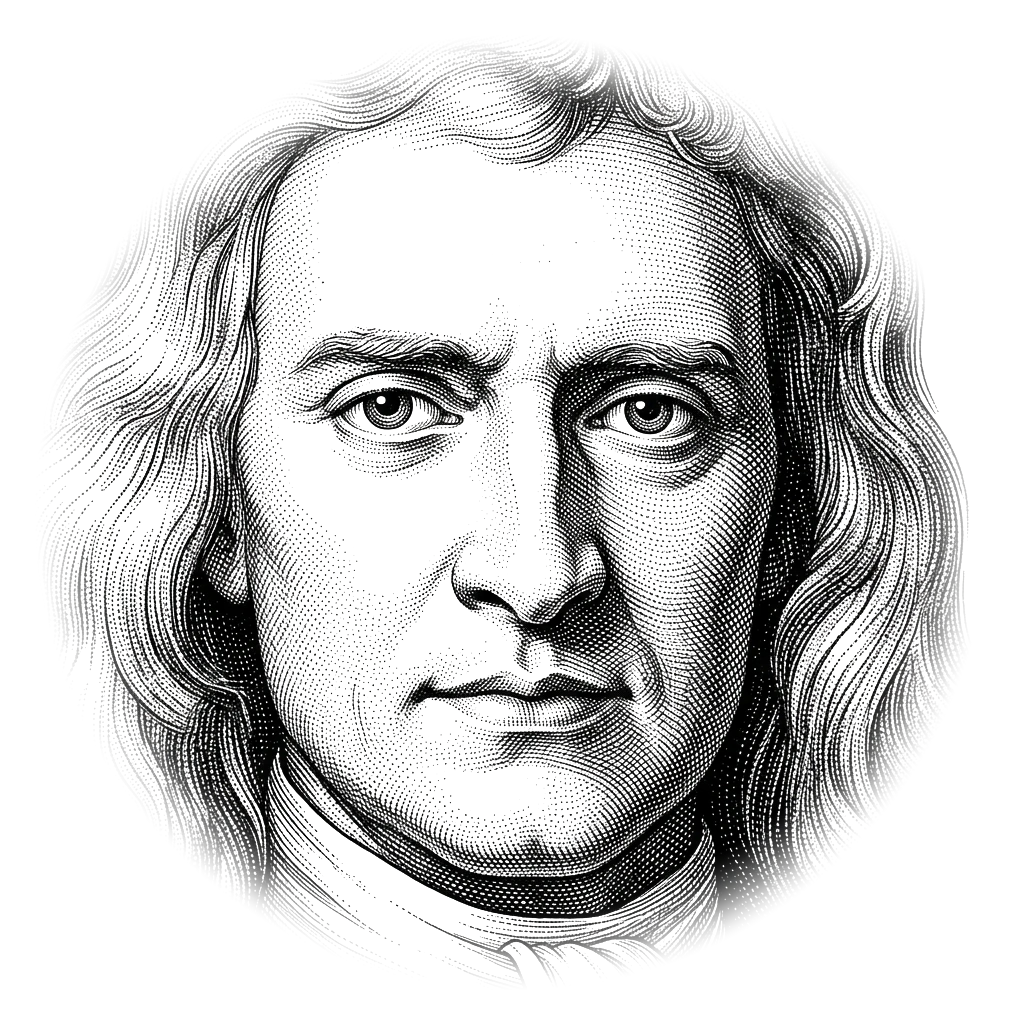
In the autumn of 1665, when the Great Plague shuttered the University of Cambridge and drove the young bachelor of arts back to his mother’s orchard in Woolsthorpe, natural philosophy was paralyzed by a dualistic universe. For two thousand years, human thought had divided the cosmos into two fundamentally incompatible realms: the sublunary and the celestial. Below the sphere of the Moon sat the terrestrial world—corruptible, heavy, imperfect, and governed by Aristotelian physics, where earthly bodies required a continuous push to move and naturally fell toward the center of the earth out of a vague desire for their natural resting place. Above the Moon revolved the celestial heavens—pure, eternal, frictionless, and governed by perfect circular geometry.
Natural philosophers had accumulated brilliant empirical measurements, yet they possessed no universal physical engine to bind them together. Johannes Kepler had determined that the planets traced ellipses rather than circles, and Galileo Galilei had measured the uniform acceleration of falling stones on earth, yet no one could bridge the metaphysical divide between them. Was the celestial motion of Jupiter’s moons related to the fall of an apple in Lincolnshire? The dominant Cartesian philosophy of the seventeenth century attempted to explain gravity through mechanical vortices: an invisible, whirling ether that physically pushed planets like corks in an oceanic whirlpool. But Descartes’s vortices were qualitative fables. They could not be calculated, they could not predict orbital periods, and they introduced turbulent friction where the solar system exhibited frictionless, clockwork precision.
In the rural solitude of Woolsthorpe, Isaac Newton obliterated the boundary between heaven and earth through a singular geometric thought experiment. He asked: how far does the power of gravity extend?
If gravity can reach to the top of the highest tree in his orchard, and to the summit of the highest mountain on earth, why should it stop at the atmosphere? Why should it not reach across the empty abyss of space to grasp the Moon itself?
Newton imagined a cannon mounted atop an imaginary mountain rising above the earth’s atmosphere. If the cannon fires a ball with modest gunpowder, the projectile traces a parabolic arc and falls to earth. If more powder is loaded, the ball flies further before striking the ground. If the velocity is increased to a critical threshold, the curvature of the ball’s fall matches the curvature of the earth beneath it. The projectile falls continuously, yet it never reaches the ground: it enters orbit.
In that single realization, the ancient dualism collapsed. The Moon was not a divine jewel pinned to a crystalline celestial sphere. The Moon was simply an earthly projectile in perpetual free fall, hurled forward with enough horizontal momentum that it continually fell around the curved shoulder of the earth. The celestial mechanics of the solar system and the weight of a dropped apple were identical physical phenomena, governed by one universal law.
Yet when Newton attempted to compute this universal attraction, he discovered that contemporary mathematics was impotent to describe it.
The universe was not a static collection of geometric lines; it was a dynamic choreography of continuous change. As a planet swoops inward toward perihelion, its distance from the Sun shrinks, its gravitational acceleration mounts, its velocity spikes, and its orbital curvature tightens continuously at every infinitesimal fraction of a second. Standard algebra and Euclidean geometry could measure static shapes, but they could not capture rates of change that were themselves changing continuously.
To resolve the problem of continuous physical variation, Newton invented the method of fluxions—the differential and integral calculus. He conceived quantities not as static aggregates of indivisible atoms, but as fluents generated by continuous motion. The velocity of a body was its fluxion, the instantaneous rate at which its spatial coordinate flowed through time. By calculating the ratio between vanishingly small increments of motion and time, Newton unlocked the ability to calculate instantaneous slope, acceleration, and accumulated area.
Armed with this mathematical engine, he proved that if planetary orbits are ellipses governed by Kepler’s laws, the gravitational force must fall off precisely as the square of the distance between their centers. The inverse-square law was not an arbitrary empirical conjecture; it was the exact geometric footprint of an attraction radiating into three-dimensional Euclidean space.
In 1687, under the gentle coaxing and financial patronage of the astronomer Edmond Halley, Newton published the masterwork of modern science: the Philosophiae Naturalis Principia Mathematica.
In the Principia, Newton erected the axiomatic foundation of classical physics upon three deterministic laws of motion: inertia, proportional acceleration ($F = ma$), and reciprocal action and reaction. He applied this mechanical grammar with devastating universality. He calculated the mass of the Sun, the Earth, and Jupiter; he proved why the Earth is an oblate spheroid flattened at the poles by centrifugal rotation; he unlocked the ancient mystery of oceanic tides, showing that the waters of the earth are stretched into tidal bulges by the differential gravitational tug of the Moon and Sun; and he calculated the parabolic orbit of the great comet of 1680.
Yet the publication ignited a bitter philosophical storm across Europe. Christiaan Huygens and Gottfried Wilhelm Leibniz attacked Newton’s universal gravitation as a dangerous retreat into occult mysticism. How, they demanded, could the Sun reach across ninety million miles of empty, frictionless vacuum to pull on the Earth without a physical ether or mechanical gears to push it? They called action-at-a-distance an unscientific absurdity.
Newton’s response was a masterclass in epistemic humility and scientific discipline. In the celebrated General Scholium added to the second edition, he wrote: "Hypotheses non fingo"—I frame no hypotheses. Newton refused to invent unverifiable metaphysical stories to explain the ultimate essence of gravity. He did not know what gravity was, nor did he need to. It was sufficient that gravity existed, that it operated according to clear mathematical laws, and that its equations predicted the motions of tides, comets, and planets with infallible precision. Science was not the pursuit of metaphysical essences; it was the discovery of mathematical invariants.
In his later years in London, as Master of the Royal Mint and President of the Royal Society, Newton turned his attention to light, publishing the Opticks in 1704. Just as he had decomposed orbital motion into mathematical components, he passed white sunlight through a glass prism in a darkened room, demonstrating that white light is not a simple, pure entity corrupted by glass, but a heterogeneous composite of unalterable, refrangible colors waiting to be separated.
Newton was an enigmatic, secretive, and difficult man who spent as many hours in his clandestine laboratory transmuting metals through esoteric alchemy and calculating the biblical apocalypse as he did deriving the laws of motion.
Yet his legacy is the cornerstone of the modern world. Before Newton, humanity inhabited a fragmented, parochial cosmos haunted by capricious deities and disconnected natural wonders. After Newton, the cosmos became an integrated, rational empire governed by universal, discoverable mathematical law. He gave civilization its first universal operating system: the absolute conviction that the universe is written in the language of mathematics, and that the same quiet laws that guide a falling leaf govern the silent spinning of the galaxies.
“If I have seen further it is by standing on the shoulders of Giants.”
“I do not know what I may appear to the world, but to myself I seem to have been only like a boy playing on the sea-shore... whilst the great ocean of truth lay all undiscovered before me.”
“Hypotheses non fingo (I frame no hypotheses).”
“Nature is pleased with simplicity, and nature affects not the pomp of superfluous causes.”
“Truth is ever to be found in simplicity, and not in the multiplicity and confusion of things.”
- De analysi per aequationes numero terminorum infinitas 1669
- New Theory about Light and Colors (Royal Society) 1672
- Philosophiae Naturalis Principia Mathematica 1687
- Opticks: or, a Treatise of the Reflexions, Refractions, Inflexions and Colours of Light 1704
- Arithmetica Universalis 1707
- Method of Fluxions 1736