James Watt
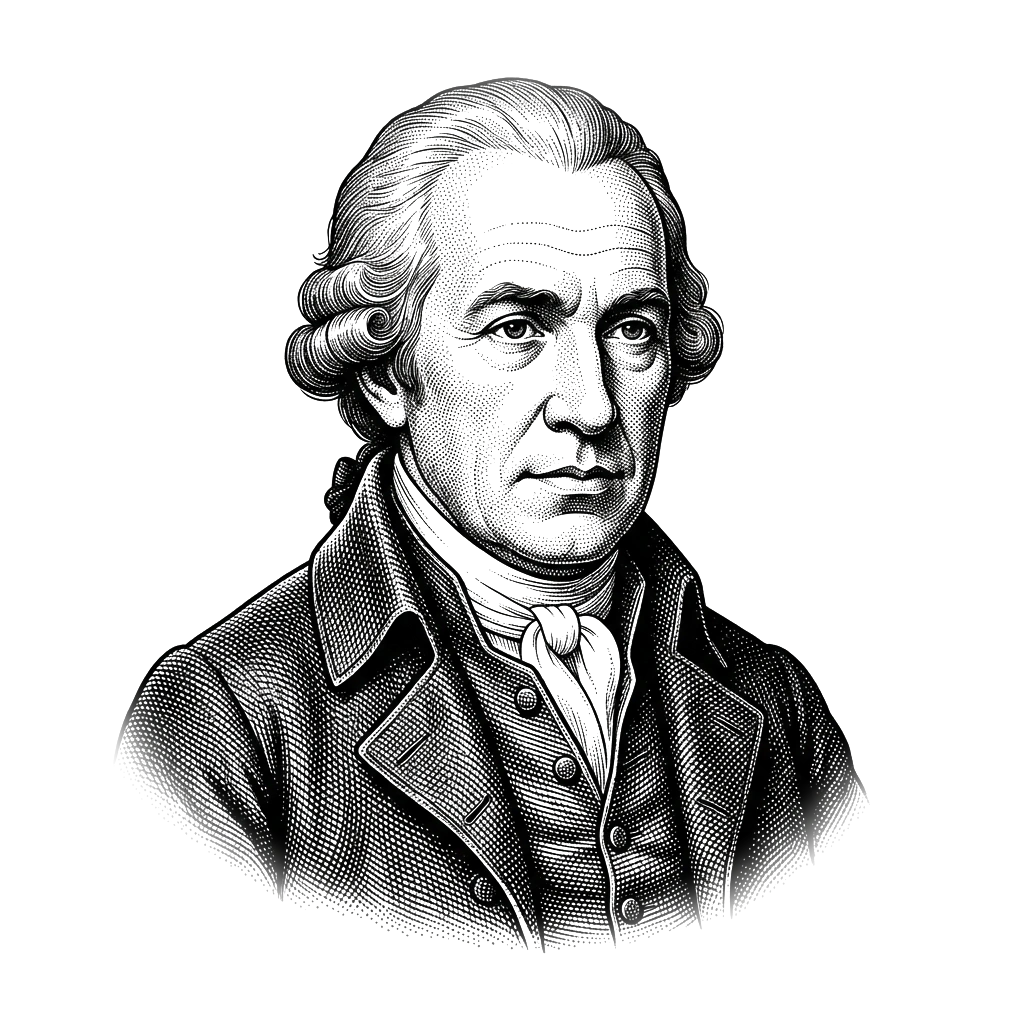
On a sunny Sunday afternoon in the spring of 1765, walking across the green expanse of Glasgow Green on the banks of the River Clyde, a frail, melancholic instrument maker to the University of Glasgow had a vision that would ignite the Industrial Revolution. James Watt had spent months wrestling with a scale model of the Newcomen atmospheric steam engine belonging to the university’s natural philosophy laboratory. The engine was an intolerable thermal glutton: with every stroke, the cold injection water used to condense the steam cooled the entire massive iron cylinder down to room temperature, meaning that more than three-quarters of the incoming fresh steam from the boiler was wasted merely reheating the cylinder walls for the next cycle.
As Watt strolled past the public washhouse, the physical mechanism resolved in his mind with crystalline simplicity: "I had not walked further than the Golf-house when the whole thing was arranged in my mind... to make a perfect steam-engine, it was necessary that the cylinder should be always as hot as the steam which entered it, and that the condensation should take place in a separate vessel." In that solitary flash of thermodynamic insight—the separation of the boiling vessel from the condensing vessel—Watt solved the crisis of mechanical power, liberating human civilization from its ancient dependence on draft animals, seasonal river currents, and wood fuel.
Born in Greenock on the Firth of Forth in 1736, the son of a carpenter and shipwright, Watt was a sickly child who suffered from chronic migraines, depression, and asthma. Unable to attend school regularly, he spent hours in his father's workshop carving wooden models, inspecting ship quadrants, and teaching himself geometry and metallurgy. After serving a grueling one-year apprenticeship in London making brass mathematical instruments, he returned to Glasgow, where the university guild granted him a workshop. There, he fell into conversation with Joseph Black, the brilliant chemist who had recently discovered latent heat—the hidden energy absorbed or released during a phase change from water to steam without changing temperature.
Watt applied Black’s latent heat theory directly to iron and steam. In his separate condenser, the steam exited the hot working cylinder through a valve into an isolated, cold chamber kept in a continuous water bath and evacuated by an air pump. To keep the working cylinder permanently hot, Watt went further: he sealed the top of the cylinder, surrounded it with a steam jacket, and used steam pressure rather than cold atmospheric air to drive the piston down. The result was a thermodynamic leap: the Watt engine reduced coal consumption by seventy-five percent compared to the Newcomen design, transforming steam power from a crude, localized pump into an efficient, universal prime mover.
Yet a breakthrough on paper is not a working machine of iron and brass. For a decade, Watt hovered on the verge of bankruptcy, struggling with primitive eighteenth-century metallurgy where iron cylinders cast by Scottish foundries were oval, uneven, and leaky. In 1774, Watt formed a historic partnership with the energetic Birmingham industrialist Matthew Boulton at the Soho Manufactory. Boulton had capital, commercial vision, and connections to the master ironmaster John Wilkinson, whose newly invented precision cannon-boring machine could bore an iron cylinder so true that "a thin sixpence could not be passed between the piston and the cylinder."
Boulton immediately recognized that British industry did not merely want pumps to drain flooded Cornish copper mines; the burgeoning cotton mills of Manchester and the flour mills of London required rotary power. Watt answered with a cascade of brilliant mechanical inventions. Because a rival held a patent on the simple crank and connecting rod, Watt bypassed the patent by inventing the Sun and Planet gear (1781) to convert reciprocating linear piston motion into continuous circular rotation. In 1784, he patented Parallel Motion—an ingenious linkage of articulated levers that guided the piston rod in a perfectly straight vertical line without friction. Watt considered Parallel Motion his supreme aesthetic triumph: "I am more proud of the parallel motion than of any other mechanical invention I have ever made."
To regulate the velocity of his engines under changing factory loads, Watt introduced the Centrifugal Governor (1788)—a pair of brass flyballs that swung outward under increasing rotational speed, automatically throttling the steam intake valve. The centrifugal governor was one of the earliest practical automated cybernetic feedback systems in human engineering, establishing the engineering foundations of control theory.
To market his engines to skeptical mill owners accustomed to horse mills, Watt quantified mechanical work into a universal commercial unit: "horsepower." Testing heavy brewery draft horses lifting weights from a deep pit, Watt calculated that a standard horse could lift thirty-three thousand foot-pounds of work per minute. By rating his engines in horsepower and charging customers a royalty equal to one-third of the coal savings over Newcomen engines, Boulton & Watt generated immense commercial wealth, fueling the transformation of Great Britain into the workshop of the world.
Retiring from active business in 1800 at the age of sixty-four, wealthy and internationally celebrated, Watt spent his final two decades in the garret workshop of his estate, Heathfield Hall, near Birmingham. There, surrounded by lathes, chemical retorts, and stone busts, he invented a mechanical sculpture-copying machine and entertained the leading minds of the Lunar Society. He died peacefully on August 25, 1819, at the age of eighty-three.
In 1889, the International Electrical Congress formally named the standard unit of electrical and mechanical power in his honor: the watt. James Watt transformed humanity’s relationship with time, labor, and energy. Before him, human civilization was constrained by biological muscles and natural weather; after him, mechanical energy could be summoned anywhere on earth at will. He put fire to work, powering the steamships that crossed oceans, the locomotives that spanned continents, and the electrical grids that light modern civilization.
“I had not walked further than the Golf-house when the whole thing was arranged in my mind.”
“I am more proud of the parallel motion than of any other mechanical invention I have ever made.”
“Nature can always be brought to do work if we only find the right lever.”
“It is not easy to invent, but it is far harder to execute.”
“My mind ran upon making the engine keep itself hot.”
- The Separate Condenser Patent (Patent No. 913) 1769
- Sun and Planet Rotary Motion Patent (Patent No. 1306) 1781
- Parallel Motion Linkage Patent (Patent No. 1432) 1784
- The Centrifugal Flyball Governor 1788
- Standardization of the Horsepower 1782