Galileo Galilei
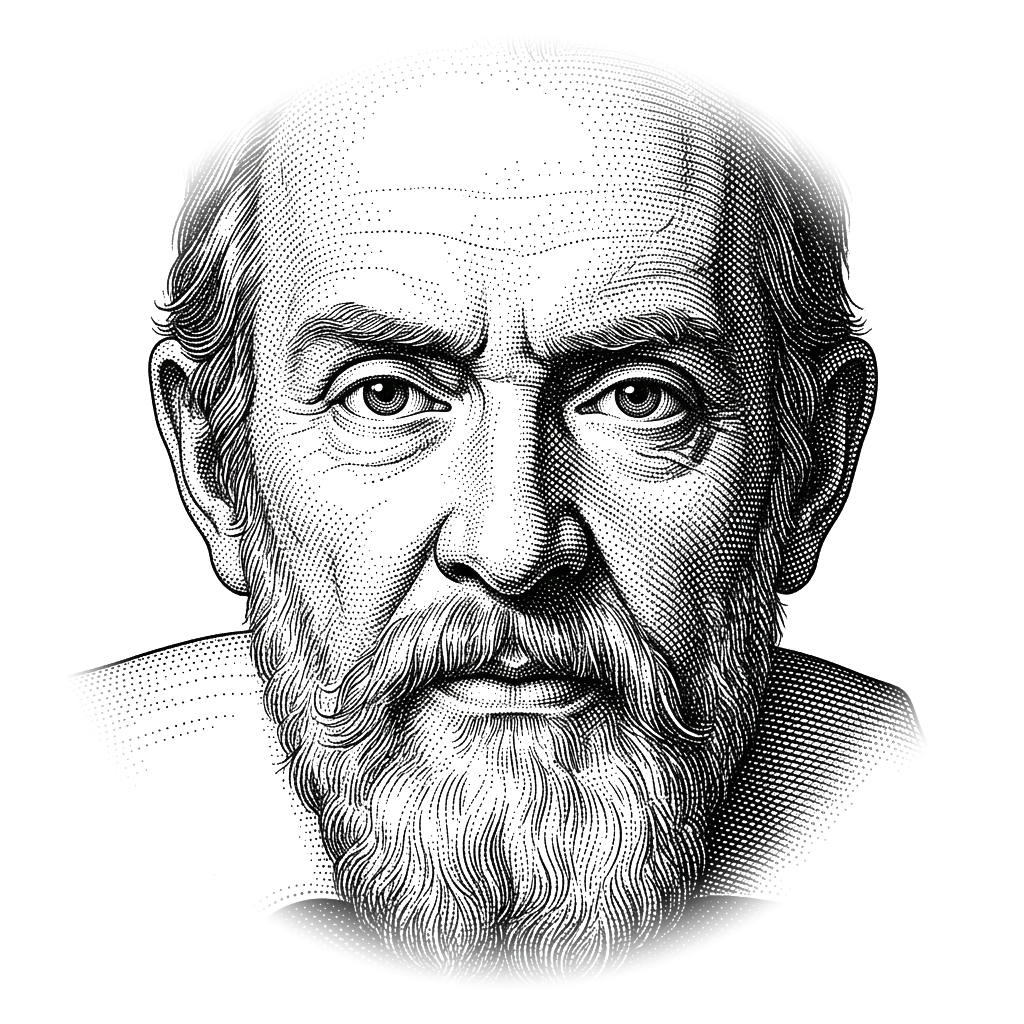
In the cathedral of Pisa in the winter of 1581, a seventeen-year-old medical student stood in the dim incense smoke and fixed his eyes upon a swinging bronze chandelier. A verger had pulled the lamp aside to light it and released it into the air, where it swung in wide, sweeping arcs before gradually subsiding into barely perceptible tremors. The boy did not admire the liturgical craftsmanship of the metal; he placed his fingers upon his own wrist and began timing the oscillations against the steady rhythm of his pulse. He discovered something that defied every tenet of Aristotelian physics: whether the arc was vast or tiny, the time required for the chandelier to complete one full oscillation remained identical. The period of the pendulum depended not upon the amplitude of its swing or the weight of its bronze, but solely upon the length of the suspension cord. In that single act of clinical telemetry, Galileo Galilei established the foundational signature of his life: he refused to accept what ancient authority decreed ought to happen, trusting only what the measured instrument proved did happen.
Abandoning medicine to the despair of his father, Galileo took up mathematics and mechanics, obtaining the professorship at Pisa and later at Padua. In the Piazza dei Miracoli, he mounted the spiraling steps of the Leaning Tower to drop two spheres of identical material but vastly unequal weight—one heavy, one light—before an assembly of university professors. Aristotle had decreed that a ten-pound weight must fall ten times faster than a one-pound weight. Galileo let them fall together: they struck the earth with a single, resonant thud. For two millennia, natural philosophy had been an exercise in verbal rhetoric and scholastic commentary; Galileo dragged it into the physical laboratory and commanded it to measure acceleration.
In the summer of 1609, residing in the Republic of Venice, Galileo heard rumors that a Dutch spectacle-maker had assembled two lenses inside a tube that made distant ships appear near. Where others regarded the instrument as a military spyglass or a carnival novelty, Galileo saw a metaphysical probe. Grinding his own convex and concave lenses with obsessive precision, he constructed a telescope capable of thirty-power magnification. In the freezing winter nights of 1609 and 1610, he pointed the wooden tube toward the celestial vault.
What he witnessed shattered the cosmological order of Western civilization. For twenty centuries, the heavens had been revered as the realm of divine perfection—an immutable crystalline domain of unblemished spherical bodies circling the stationary Earth. Through Galileo’s lens, the Moon was revealed to be rough, pitted with craters, scarred by jagged valleys, and crowned with towering mountain peaks whose shadows shifted across lunar dawns exactly like the peaks of the Apennines. The Milky Way dissolved from a luminous cloud into a dizzying ocean of millions of unmapped stars.
Most devastating of all, on the night of January 7, 1610, he observed three tiny, bright stars flanking the planet Jupiter. Over successive nights, he watched them shift positions, disappear behind the giant disc, and reappear on the other side. They were not fixed stars; they were four moons orbiting Jupiter in a miniature Copernican system. In his electrifying pamphlet Sidereus Nuncius—The Starry Messenger—Galileo announced that the Earth was not the unique center of celestial revolution. If Jupiter carried four moons as it moved through space, the Earth could move around the Sun without losing its own solitary satellite.
When Galileo subsequently observed the phases of Venus—demonstrating that the evening star grew from a thin crescent to a full disc in exact correspondence with its illumination by the Sun—the Ptolemaic geocentric model collapsed into mathematical impossibility. Venus was unmistakably circling the Sun. Yet the Roman Church, entrenched in the Counter-Reformation and committed to the literal interpretation of biblical passages commanding the Sun to stand still, grew alarmed. In 1616, the Holy Office formally declared the Copernican doctrine foolish, absurd, and formally heretical, and Cardinal Robert Bellarmine officially admonished Galileo to abandon the opinion.
For sixteen years, Galileo bided his time. The election of Maffeo Barberini—a cultivated Florentine patron of the arts and sciences who took the papal throne as Pope Urban VIII—appeared to offer protection. Urban granted Galileo permission to write a balanced, theoretical work comparing the Copernican and Ptolemaic systems, provided that both models were presented hypothetically.
In 1632, Galileo published his masterpiece of Italian scientific prose: Dialogue Concerning the Two Chief World Systems. It was an intellectual massacre disguised as a polite conversation. Set over four days in a Venetian palazzo, the dialogue pitted Salviati (a brilliant Copernican representing Galileo’s own voice) and Sagredo (an intelligent, open-minded Venetian gentleman) against Simplicio—a dogmatic Aristotelian pedant whose very name was a double-edged pun on "simpleton," and into whose mouth Galileo tactlessly placed the exact arguments and phrases that Pope Urban VIII had privately spoken to him.
Embedded within the Dialogue was Galileo’s deepest contribution to physical mechanics: the principle of classical relativity. In a passage of sublime descriptive power, he asked the reader to descend into the windowless main cabin below the decks of a large ship, accompanied by flies, butterflies, and a small bucket of water dripping into a vase below: "Have the ship proceed with any speed you like, so long as the motion is uniform and not fluctuating this way and that. You will not be able to discern the least change in any of the aforesaid effects, nor from any of them will you be able to tell whether the ship is moving or standing still."
The drops fall straight down into the neck of the vase without being left behind by the ship’s speed; the fish swim with equal ease in all directions; the butterflies do not need to fly harder toward the bow. In an unaccelerated reference frame, the mechanical laws of physics operate identically regardless of whether the frame is stationary or moving at continuous speed. Through this single thought experiment, Galileo demolished the primary physical objection to the Copernican system: the claim that if the Earth were hurtling through space, a dropped stone would land miles behind the tower from which it fell.
The reaction in Rome was swift and unforgiving. Pope Urban, enraged by the mockery of Simplicio and facing intense political pressure from Spanish cardinals during the Thirty Years' War, summoned the sixty-nine-year-old, ailing scientist to face the Roman Inquisition. Broken by inflammatory rheumatism and threatened with physical torture, Galileo knelt on the marble floor of the Dominican convent of Santa Maria sopra Minerva on June 22, 1633. In a penitential white shirt, he read an agonizing formal recantation: "I curse and detest my past errors and heresies... and I swear that in the future I will never again say or assert, verbally or in writing, anything that might furnish occasion for a similar suspicion against me." Legend whispers that as he rose from his knees, he stamped his foot upon the stone and muttered: Eppur si muove—"And yet it moves."
He was sentenced to life imprisonment, commuted by papal clemency to perpetual house arrest at his small country estate, Il Gioiello, in Arcetri near Florence. Forbidden to publish on cosmology or receive unauthorized visitors, and struck completely blind in 1638, the old lion spent his final years returning to the mechanics of his youth. Smuggled across the Alps to the Protestant presses of the Elzevirs in Leiden, his final work appeared: Discourses and Mathematical Demonstrations Relating to Two New Sciences.
In this founding charter of modern physics, Galileo derived the law of falling bodies: that distance scales with the square of time ($d \propto t^2$), and proved that the path of a projectile is a perfect parabola synthesized from uniform horizontal motion and accelerated vertical fall. When Galileo died at Arcetri in January 1642, the Inquisition barred his family from erecting a tomb in the basilica of Santa Croce. Yet his victory was total. In the very year Galileo died, Isaac Newton was born in England, inheriting the polished instruments of inertial motion that Galileo had carved from falling stones, swinging lamps, and distant stars.
“The book of nature is written in the language of mathematics.”
“And yet it moves (Eppur si muove).”
“In questions of science, the authority of a thousand is not worth the humble reasoning of a single individual.”
“I have never met a man so ignorant that I couldn't learn something from him.”
“Measure what is measurable, and make measurable what is not so.”
- Sidereus Nuncius (The Starry Messenger) 1610
- Discorso intorno alle cose che stanno in su l'acqua (Bodies in Water) 1612
- Istoria e dimostrazioni intorno alle macchie solari (Letters on Sunspots) 1613
- Il Saggiatore (The Assayer) 1623
- Dialogo sopra i due massimi sistemi del mondo 1632
- Discorsi e dimostrazioni matematiche intorno a due nuove scienze 1638