Friedrich Hayek
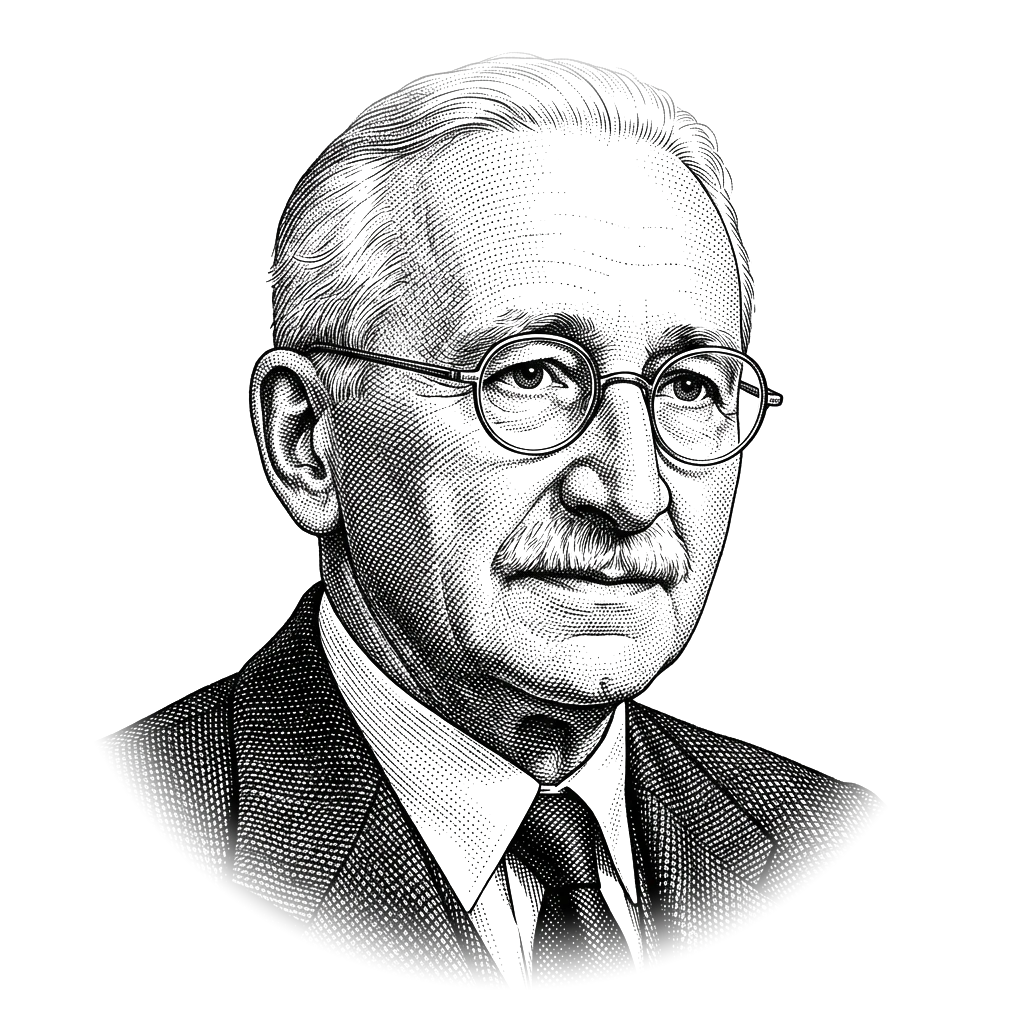
In the turbulent autumn of 1940, in a drafty temporary office at Peterhouse, Cambridge—evacuated from the London School of Economics to escape the German Blitz—a forty-one-year-old Austrian aristocrat sat writing a passionate warning to the democratic world. Friedrich August von Hayek watched with mounting alarm as British and American intellectuals, impressed by wartime state mobilization and Soviet industrial claims, embraced central economic planning as the inevitable destiny of modern civilization. To Hayek, this was a catastrophic intellectual delusion. Having witnessed the collapse of the Habsburg Empire, the hyperinflation of the Weimar Republic, and the totalitarian slide of Central Europe into fascism, he recognized that socialism and fascism were not ideological polar opposites, but twin branches of the same fatal hubris: the belief that a committee of central planners can rationally orchestrate the boundless complexity of human society.
Published in 1944 on war-rationed paper, The Road to Serfdom struck the Western world like a thunderbolt. Hayek argued that economic planning is not a neutral, technical instrument that leaves personal and political liberties intact; because economic control is the control of the means for all human ends, anyone who possesses sole control of the means must determine which ends are to be served. Step by step, central planning concentrates power into the hands of a coercive state bureaucracy, until political dissent is crushed, the rule of law is dismantled, and "the worst get on top." Translated into dozens of languages and condensed into a million-copy Reader's Digest edition, the book made Hayek internationally famous—and an intellectual pariah among Western socialist academies.
Yet Hayek's foundational contribution to economics lay not in political polemics, but in epistemology. In his landmark 1945 paper, "The Use of Knowledge in Society," Hayek exploded the central mathematical assumption of neoclassical economics: the concept of "perfect information." The economic problem of society, Hayek demonstrated, is not merely a mathematical optimization problem of allocating "given" resources among known ends. The insurmountable challenge is that the knowledge of the circumstances of which we must make use never exists in concentrated or integrated form, but solely as dispersed bits of incomplete, often contradictory knowledge possessed by millions of separate individuals.
A tramp steamer captain seeking a return cargo in Singapore, an estate agent aware of an unrented warehouse in Manchester, or a farmer deciding whether to plant rye or barley based on local soil moisture possess vital knowledge of time and place that cannot be reduced to statistical aggregates or transmitted to a central planning bureau in Washington or Moscow. How, then, can millions of individuals coordinate their actions without a central commander? Hayek’s answer was the market price system: a decentralized telecommunications network.
In Hayek's vision, prices are not merely money tags; they are compressed signals communicating relative scarcity across the globe. If a tin mine collapses in Malaysia, or a new industrial use for tin is discovered, countless thousands of users of tin throughout the world—without knowing why the scarcity occurred, without ever meeting one another, and without an order from a government commissar—are induced to economize on tin, search for substitutes, and reallocate capital. The price mechanism operates as a marvel of spontaneous order: achieving an intricate global coordination that no human brain could ever design, yet emerging spontaneously from the voluntary interactions of individuals pursuing their own plans.
This led Hayek to formulate his core philosophical distinction between Taxis (constructed, artificial organizations like armies, corporations, and government bureaus) and Kosmos (grown, self-organizing spontaneous orders like language, common law, and market economies). A constructed order is limited by the finite intelligence of the organizer; a spontaneous order can achieve a degree of complexity vastly surpassing what any single human mind can comprehend. To attempt to design a society from the top down is what Hayek called "the fatal conceit"—a failure to understand the radical humility required before evolved cultural institutions.
For three decades following the Second World War, as Keynesian demand management and state-directed welfare capitalism dominated Western governments, Hayek was largely sidelined, dismissed by mainstream economists as a reactionary relic of nineteenth-century laissez-faire. In Chicago, Freiburg, and Salzburg, he turned from technical economics to jurisprudence and political philosophy, composing The Constitution of Liberty (1960) and Law, Legislation and Liberty (1973–1979). He argued that true freedom is not the absence of restraint, but the presence of the Rule of Law: general, abstract rules applied equally to all, known in advance, allowing individuals to use their own knowledge for their own purposes.
Then, in 1974, came the great historical vindication. With the Western world mired in "stagflation"—the simultaneous nightmare of high inflation and high unemployment that Keynesian theory insisted was impossible—the Royal Swedish Academy of Sciences awarded Hayek the Nobel Memorial Prize in Economic Sciences. In his Nobel lecture, "The Pretence of Knowledge," Hayek delivered a blistering critique of mathematical economists who, craving the superficial prestige of the physical sciences, treated human societies as deterministic machines: "To act on the belief that we possess the knowledge and the power which enable us to shape the processes of society entirely to our liking... is likely to make us do much harm."
In the late 1970s and 1980s, Hayek's thought became the intellectual engine of a global economic revolution. When Margaret Thatcher became Prime Minister of Britain in 1979, she famously pulled a copy of The Constitution of Liberty from her handbag during a Conservative Party policy meeting, slammed it onto the table, and declared: "This is what we believe!" In the United States under Ronald Reagan, in post-Mao China, and throughout the collapsing Soviet bloc, Hayek’s critique of central planning provided the conceptual blueprint for market liberalization and the dismantling of totalitarian state monopolies.
Hayek died in Freiburg, Germany, on March 23, 1992, at the age of ninety-two, having lived to witness the fall of the Berlin Wall and the total collapse of the Soviet planned economy he had predicted sixty years earlier. Friedrich Hayek bequeathed to civilization the profound realization that human freedom and human ignorance are inextricably bound together. Because no single mind can ever know more than a tiny fraction of the social reality upon which it depends, our only hope for liberty and prosperity lies in preserving the open, evolutionary institutions that allow free individuals to learn from trial, error, and one another.
“The curious task of economics is to demonstrate to men how little they really know about what they imagine they can design.”
“We must look at the price system as a mechanism for communicating information if we want to understand its real function.”
“To act on the belief that we possess the knowledge and the power which enable us to shape the processes of society entirely to our liking... is likely to make us do much harm.”
“Emergence of spontaneous order is the marvel of civilization.”
“Liberty is not a means to a higher political end. It is itself the highest political end.”
- The Use of Knowledge in Society 1945
- The Road to Serfdom 1944
- The Constitution of Liberty 1960
- Law, Legislation and Liberty (3 Volumes) 1973–1979
- The Fatal Conceit: The Errors of Socialism 1988