Gautama Buddha
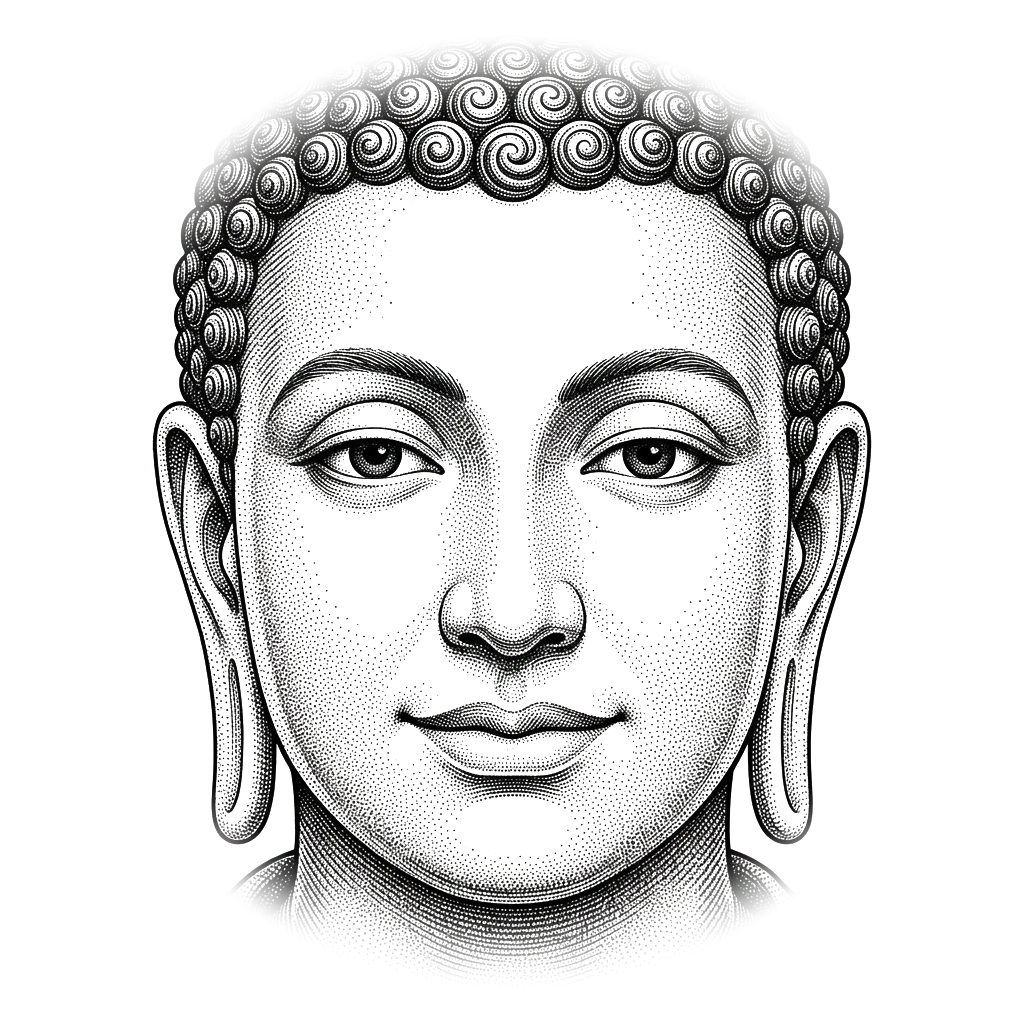
In the heavy pre-dawn heat of the sixth century BC, near the banks of the Neranjana River in the ancient kingdom of Magadha, an itinerant ascetic in threadbare ochre robes sat cross-legged beneath the spreading boughs of a sacred fig tree. Siddhartha Gautama had spent six years pushing his physical body to the brink of biological extinction: fasting until his ribs protruded like the rafters of a collapsed roof, holding his breath until intracranial pressure roared in his ears, sleeping on beds of thorns alongside wandering saddhus. The prevailing religious wisdom of iron-age India insisted that spiritual liberation required the violent mortification of the physical flesh to release the eternal, unblemished soul—the Atman—from the contaminating wheel of matter and rebirth.
Gautama realized that mortification was merely the mirror image of sensual indulgence: both were obsessive fixations upon the ego, fueled by craving (tanha). He accepted a bowl of rice milk from a village maiden named Sujata, bathed in the river, walked to the Bodhi tree, and sat down with an iron resolution: 'Let my skin and sinews and bones dry up, let my flesh and blood dissolve; I shall not rise from this seat until I attain unexcelled, complete enlightenment.' As the morning star rose on the horizon, he did not look upward to an absolute creator deity; he looked inward into the mechanics of conscious experience. What he discovered was the most radical deconstructive phenomenology in human history: the universe contained no eternal soul, no unchanging substance, and no uncaused first cause.
In his first sermon at the Deer Park in Sarnath, delivered to the five ascetics who had previously abandoned him, Gautama set in motion what tradition calls the Wheel of the Dhamma. He did not present a theological dogma to be accepted on blind faith; he presented a clinical diagnostic protocol modeled directly on ancient Indian medical science. Suffering (dukkha)—the pervasive dissatisfaction, impermanence, and friction of existence—is the universal symptom. Craving (tanha)—the thirst for sensual permanence, the thirst for becoming, and the thirst for annihilation—is the causal etiology. The cessation of suffering (nirodha) through the extinguishing of craving is the positive prognosis: Nirvana. And the Noble Eightfold Path—spanning ethical discipline, mental concentration, and discerning wisdom—is the therapeutic cure.
More revolutionary than his ethical therapy was his metaphysical deconstruction of personal identity: Anatta (not-self). Vedic orthodoxy taught that behind the transient body resides a permanent, divine spark of being. Gautama dismantled this illusion with anatomical precision. When an individual examines consciousness through rigorous meditative introspection, where is the permanent self located? Is it in the physical body (rupa)? The body ages, sickens, and rots. Is it in raw sensations (vedana)? Feelings arise and pass away in milliseconds. Is it in mental perceptions (sanna), volitional formations (sankhara), or bare sensory consciousness (vinnana)? All five aggregates (khandhas) are in a perpetual state of flux, flashing into existence and dissolving like foam on the ocean. There is no chariot behind the wheels, axle, pole, and chassis; there is only the functional assembly of parts.
To explain how continuity, moral responsibility, and rebirth could operate without a permanent soul, Gautama formulated the foundational architecture of Buddhist philosophy: Paticcasamuppada—Dependent Origination. Reality is not a collection of static substances; it is a dynamic web of interconnected, conditional processes. Nothing arises uncaused, and nothing exists through its own intrinsic nature. Gautama expressed this in a four-line formula of universal causal kinematics: 'When this exists, that comes to be; with the arising of this, that arises. When this does not exist, that does not come to be; with the cessation of this, that ceases.'
He articulated this cosmic nexus as a twelve-linked causal chain: from primordial ignorance (avijja) spring volitional formations; from volitions arises consciousness; from consciousness emerge mind and physical form; from mind-and-form arise the six sense faculties; from faculties arises contact; from contact arises sensation; from sensation arises craving; from craving arises clinging; from clinging arises becoming; from becoming arises birth; and from birth arises old age, death, sorrow, and despair. Notice the radical therapeutic implication: if suffering is produced by an unbroken chain of natural conditions, then dismantling the originating condition—ignorance—mechanically dissolves the entire structure of suffering. Enlightenment was not an otherworldly magic; it was the engineering of causal cessation.
For forty-five years, Gautama walked the dusty roads of the Ganges plain, refusing caste hierarchies, admitting outcasts and women into the monastic sangha, and engaging kings, courtesans, and philosophers in relentless dialogue. In the celebrated Kalama Sutta, he articulated a charter of free empirical inquiry unmatched in ancient religion: 'Do not go upon what has been acquired by repeated hearing; nor upon tradition; nor upon rumor; nor upon scripture; nor upon surmise; nor upon an axiom; nor upon specious reasoning. But when you yourselves know: These things are wholesome, these things blameless... then undertake and abide in them.'
When his mortal body failed at the age of eighty, lying between two blossoming sal trees in the quiet village of Kusinara, his grief-stricken disciple Ananda wept, asking who would guide them when the Master was gone. Gautama turned to his followers and uttered his final words—not a prayer for divine mercy, but a stern, compassionate reminder of the universal law of physics and mind: 'Behold, O monks, this is my final advice to you: all conditioned things are subject to decay. Strive on with diligence (appamada).'
Today, Gautama Buddha's psychological phenomenology stands at the very cutting edge of modern cognitive neuroscience, evolutionary psychology, and complex systems theory. Modern neuroscientists like Francisco Varela and Antonio Damasio recognize that the brain contains no 'Cartesian theater,' no central homunculus commanding the organism, but rather a decentralized, emergent network of dynamic neural processes precisely mirroring the five aggregates.
Gautama Buddha stripped the human quest for transcendence of theological mythology and ritual sacrifice. He transformed religion from an appeal to the gods into an empirical science of mental purification, proving that true freedom is found not in conquering the external cosmos, but in untying the knot of craving within the human heart.
“Peace comes from within. Do not seek it without.”
“Mind is the forerunner of all states. Mind is their chief; mind-made are they.”
“When this exists, that comes to be; with the arising of this, that arises. When this does not exist, that does not come to be; with the cessation of this, that ceases.”
“Do not dwell in the past, do not dream of the future, concentrate the mind on the present moment.”
“Radiate boundless love towards the entire world—above, below, and across—unhindered, without ill will, without enmity.”
- Dhammacakkappavattana Sutta (Setting the Wheel of Dhamma in Motion) c. 528 BC
- Anattalakkhana Sutta (The Discourse on the Not-Self Characteristic) c. 528 BC
- Maha-nidana Sutta (The Great Discourse on Origination) c. 500 BC
- Satipatthana Sutta (The Foundations of Mindfulness) c. 500 BC
- Kalama Sutta (The Instruction to the Kalamas) c. 500 BC
- Mahaparinibbana Sutta (The Great Passing) c. 483 BC