Frank Lloyd Wright
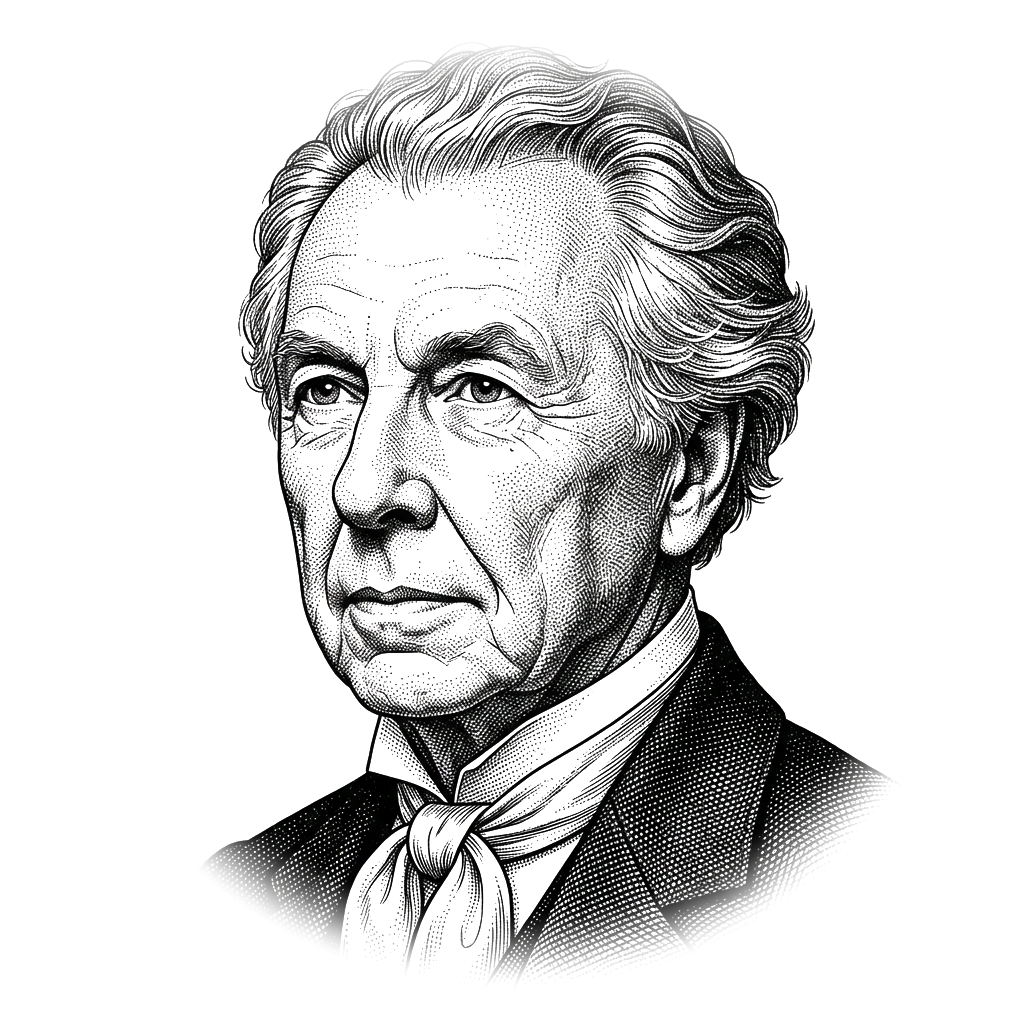
In the rural limestone hills of southwestern Wisconsin, near the town of Spring Green, overlooking the meandering waters of the Wisconsin River, a sixty-four-year-old architectural visionary stood on the scorched foundations of his ancestral home. Frank Lloyd Wright had seen Taliesin—the home he built on the brow of the hill, christened with the Welsh name for "Shining Brow"—burn to the ground twice: first in the horrifying 1914 massacre when a servant murdered seven people and set the cedar shingles ablaze, and again in 1925 when an electrical fire leveled the living quarters. By 1932, in the depths of the Great Depression, critics dismissed Wright as an arrogant nineteenth-century relic, bankrupt, scandalous, and finished.
Yet standing among the blackened limestone chimneys, Wright refused to concede defeat. In his manifesto An Autobiography, published that same year, he issued his uncompromising aesthetic manifesto: "Architecture is life, or at least it is life itself taking form, and therefore it is the truest record of life as it was lived in the world yesterday, as it is lived today, or ever will be lived." Out of those ashes, Wright would orchestrate the most astonishing creative resurrection in American cultural history, proving that architecture is not the decoration of a box, but the liberation of human space.
Born in Richland Center, Wisconsin, in 1867 to a nomadic preacher father and an intensely ambitious Welsh mother, Wright had been trained in early childhood with the geometric wooden blocks invented by Friedrich Fröbel for kindergarten education. For hours, the boy assembled cubes, spheres, and prisms, absorbing an instinctive feel for geometric harmony that never left his fingers. In 1887, arriving in Chicago just as the city was rising from the Great Fire of 1871, Wright entered the studio of Louis Sullivan—the master he revered as the Lieber Meister—absorbing Sullivan’s famous axiom that "form follows function."
Yet Wright pushed Sullivan's organicism far further. In the leafy Chicago suburb of Oak Park, Wright invented the Prairie School. He looked upon the prevailing Victorian domestic houses—tall, dark, cluttered, vertical wooden boxes partitioned into airless rooms like prison cells—with aesthetic fury: "The average American home was a bad box with a lid on it... a bedeviled box with holes punched in it to let in light and air." Wright performed what he called "the destruction of the box": knocking down interior partition walls to create a flowing, continuous open floor plan, lowering the ceiling heights to human proportions, pushing the rooflines into long, sweeping horizontal cantilevers that echoed the flat Midwestern prairie, and anchoring the entire home around a massive central stone hearth.
Then, in 1935, came the masterpiece that redefined modern world architecture: Fallingwater. Commissioned by Pittsburgh department store magnate Edgar J. Kaufmann to build a weekend retreat in the Laurel Highlands of Pennsylvania, Kaufmann had expected Wright to place the home facing Bear Run so the family could gaze at the picturesque waterfall. Wright insisted on an audacious reversal: "I want you to live with the waterfall, not just look at it... it should become an integral part of your lives."
Suspending the house directly over the rushing torrent on dramatic reinforced concrete cantilevered trays anchored into the natural Pottsville sandstone ledges, Wright unified structure and geology. Stream water roared beneath the living room floor; natural boulders pushed up through the flagstones of the hearth; glass walls met stone piers without wooden frames, dissolving the barrier between the human shelter and the living forest. Fallingwater was the absolute triumph of Organic Architecture: a building that did not sit upon the earth as an alien foreign imposition, but appeared to grow spontaneously out of the site as a natural geological outcrop.
Wright’s spatial revolution extended from domestic homes to civic monuments. In 1936, for the S.C. Johnson & Son administration building in Racine, Wisconsin, Wright designed the Great Workroom: an expansive, windowless cathedral of labor supported by sixty slender, hollow dendritic (mushroom-shaped) concrete columns that flared outward at the ceiling like giant lily pads, filtering sunlight through miles of Pyrex glass tubing. When state building inspectors declared the columns structurally unsafe, claiming they would collapse under two tons of weight, Wright staged a dramatic public demonstration, piling twelve tons of pig iron onto a test column until the inspectors surrendered in awe.
In his final masterpiece, the Solomon R. Guggenheim Museum in New York City (1943–1959), Wright executed his ultimate destruction of traditional museum geometry. Rejecting the standard museum layout of rectilinear rooms and corridors, Wright constructed a soaring, inverted ziggurat of white reinforced concrete: a continuous, spiral helical ramp winding around an enormous central skylit atrium. Visitors take an elevator to the top and descend along the gentle slope, viewing paintings in a flowing, continuous spatial ribbon. New York critics protested that the architecture overwhelmed the art; Wright replied that the building was itself a work of art that would liberate painting from the prison of the rectangular wall.
Frank Lloyd Wright worked to the very end of his life, pacing the drafting tables of Taliesin West in the Arizona desert, brandishing his red pencil and wearing his pork-pie hat, designing hundreds of houses, churches, skyscrapers, and civic centers. He died in Phoenix on April 9, 1959, at the age of ninety-one, six months before the Guggenheim Museum opened its doors to the public.
He left behind over five hundred finished structures and an entirely new spatial consciousness. Frank Lloyd Wright taught America and the world that space is not an empty void to be packaged in drywall and steel, but the living breath of human shelter. By destroying the box, championing natural materials, respecting the spirit of the site (genius loci), and insisting that democratic humanity deserves architecture that elevates the soul, Wright proved that great buildings do not conquer nature; they harmonize human life with the beauty of the earth.
“Architecture is life, or at least it is life itself taking form.”
“Form and function should be one, joined in a spiritual union.”
“The mother art is architecture. Without an architecture of our own, we have no soul of our own civilization.”
“A building should appear to grow easily from its site and be shaped to harmonize with its surroundings.”
“I want you to live with the waterfall, not just look at it... it should become an integral part of your lives.”
- Fallingwater (Edgar J. Kaufmann House) 1935–1939
- Solomon R. Guggenheim Museum 1943–1959
- Robie House 1909–1910
- S.C. Johnson Administration Building & Research Tower 1936–1950
- Taliesin and Taliesin West 1911–1959