Adi Shankara
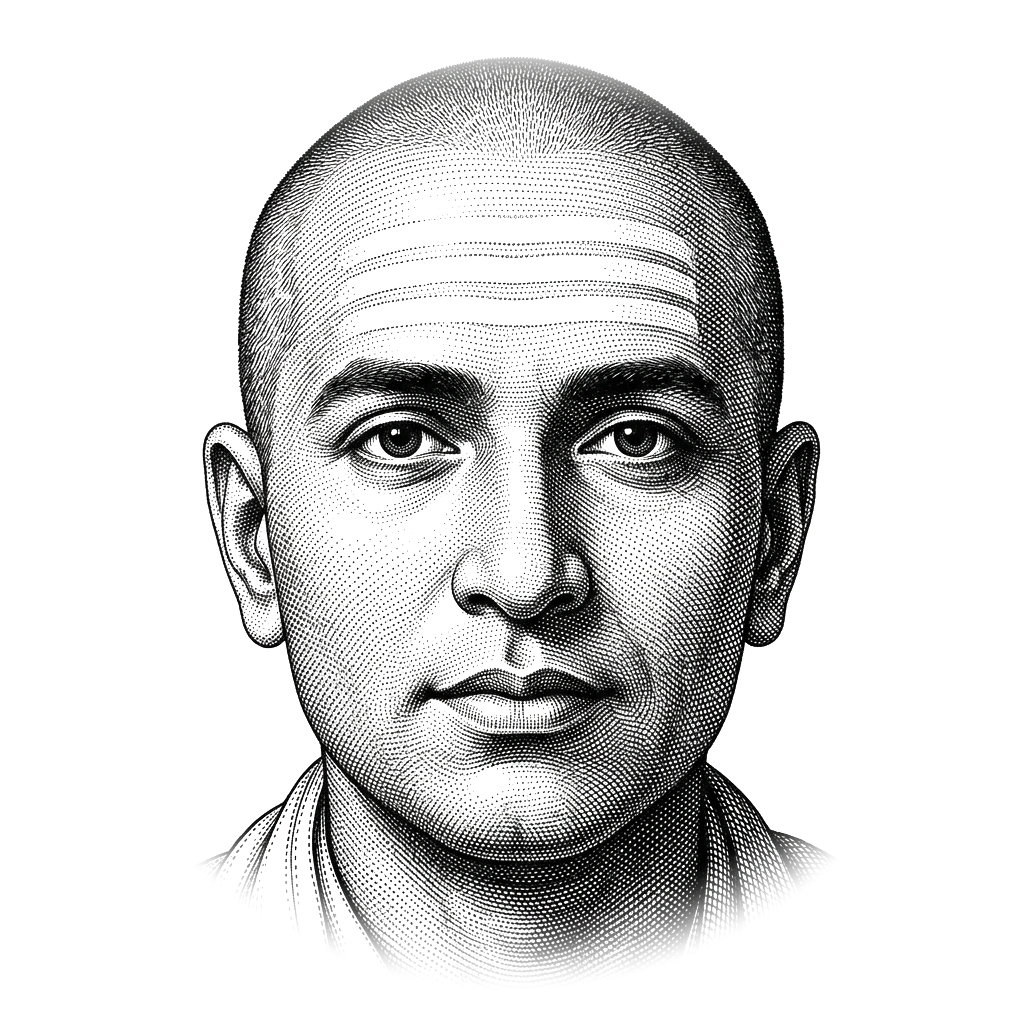
On the banks of the sacred river Narmada in central India, around the dawn of the ninth century, a young renunciant from Kerala stood before the hermitage cave of Govinda Bhagavatpada, seeking initiation into the ancient lineage of the Vedic rishis. When the sage called out from the subterranean darkness, asking who stood outside, the boy did not offer his lineage, caste, family name, or hometown. Instead, he recited a spontaneous ten-verse hymn of absolute negation: "I am neither mind, nor intellect, nor ego, nor memory; neither ear, nor tongue, nor nose, nor eyes; neither earth, nor water, nor fire, nor wind. I am purely of the nature of pure awareness and unalloyed bliss; I am Shiva, I am Shiva (Chidananda rupah shivo'ham shivo'ham)." Recognizing in the youth the incandescent realization of non-duality, the master opened the cave, initiating the eight-year-old child as Shankara—the thinker who would single-handedly reconstruct the philosophical grammar of Indian civilization.
Born in Kaladi into a humble Nambudiri Brahmin home, Shankara had lost his father in infancy. Tradition recounts that his intellectual velocity was almost preternatural: mastering the four Vedas, the ancient grammatical treatises, and the epics before his peers had completed preliminary schooling. When his mother pleaded with him to fulfill traditional domestic duties, take a wife, and carry on the ancestral household hearth, Shankara persuaded her to grant permission for formal sannyasa—the total renunciation of property, caste insignia, and social status. Walking barefoot across the length and breadth of the subcontinent with a wooden water pot and a bamboo staff, Shankara encountered an India fractured into hundreds of warring devotional sects, rigid ritualist schools, and decaying philosophical academies, each fiercely asserting its own dogmatic hegemony.
The intellectual weapon Shankara forged to unify this fragmented civilizational landscape was Advaita Vedanta—radical, non-dual metaphysical monism. In his monumental commentaries (Bhasyas) on the Brahmasutras, the primary Upanishads, and the Bhagavad Gita, Shankara articulated a dialectical architecture of stunning clarity, compressed into his famous aphorism: Brahma satyam jagan mithya jivo brahmaiva naparah—"Brahman alone is ultimate reality; the world is an apparent, dependent appearance; and the individual soul is non-different from Brahman." Reality is not composed of an infinite multitude of alienated, independent substances; existence is an indivisible, unbroken continuum of non-dual consciousness (advitiya chaitanya).
To explain the overwhelming common-sense perception of multiplicity, fragmentation, birth, decay, and death, Shankara formulated his rigorous theory of Adhyasa—superimposition—and Maya. Just as a traveler walking down a twilight path mistakes a harmless coiled piece of rope for a venomous snake, experiencing real trembling, rapid heart rate, and acute panic from a purely projected illusion, so too the unenlightened human mind projects names, forms, and mortal vulnerability (nama-rupa) onto the singular, unmoving substrate of pure Being. The snake is neither real (it vanishes the moment a torch is lit) nor absolute non-existence (it caused tangible terror while perceived). The sensory world possesses an intermediate ontological status (mithya): pragmatically real for daily commerce, but subrated and dissolved upon the awakening of direct knowledge (jnana).
Shankara's epistemology was ruthlessly critical. In direct debate with the Purva Mimamsa school—the powerful orthodox ritualists led by Kumarila Bhatta and Mandana Mishra, who argued that salvation is achieved exclusively through the meticulous mechanical performance of Vedic animal sacrifices and fire rituals—Shankara mounted an uncompromising philosophical counterattack. Action (karma), he argued, is inherently finite, bound to causality, driven by personal desire, and produces only temporary, perishable fruits. An action cannot create liberation (moksha), because liberation is not a newly manufactured product or an exotic geographic destination in heaven; it is the recognition of what already eternally is.
Knowledge alone (jnana), unconditioned and direct, destroys the primordial ignorance (avidya) that veils the soul's native wholeness. When Shankara debated Mandana Mishra in the ancient academic city of Mahishmati—with Mandana's brilliant wife Ubhaya Bharati serving as impartial arbiter, placing fresh flower garlands on both debaters' necks with the rule that the first whose garland withered in mental agitation would be declared defeated—the dialectical duel lasted over two weeks. Day after day, Shankara systematically dismantled the ritualist presuppositions, demonstrating that ritual actions prepare the mind through purification, but only radical non-dual insight into the identity of the Self (Atman) and the Supreme (Brahman) can sever the bonds of samsara.
Yet Shankara was not merely an austere academic logician inhabiting ivory towers of speculation. He was simultaneously a prolific poet of ecstatic, heart-melting devotion and a master institution builder. While his philosophical treatises like the Upadeshasahasri display diamond-sharp dialectical rigor, his devotional hymns—such as the Bhaja Govindam, the Saundaryalahari, and the Dakshinamurti Stotram—resonate with tender lyricism and emotional vulnerability. In the Bhaja Govindam, he mocked dry pedants who memorize grammar rules while their mortal bodies crumble toward the grave: "Worship Govinda, worship Govinda, foolish mind! When death arrives to claim you, memorizing the grammatical root Dukrnkarane will not save you." He understood that the non-dual absolute is not an abstract, bloodless void, but the luminous heart of love, beauty, and reverence.
To anchor his philosophical revolution in durable physical reality, Shankara traversed India three times on foot, conducting what became known as his Digvijaya—the conquest of the four directions through reasoned discourse. He established four monastic headquarters (Amnaya Mathas) at the geographic cardinal points of the subcontinent: Sringeri in the forested mountains of the South, Puri on the eastern shore of the Bay of Bengal, Dwarka on the western coast of the Arabian Sea, and Badrinath high in the freezing peaks of the northern Himalayas. By assigning specific Vedas and lineages of wandering renunciants (Dashanami sannyasis) to each center, Shankara provided India with an enduring spiritual and cultural infrastructure that preserved its civilizational unity across centuries of political conquest and upheaval.
Having fulfilled his monumental life's mission, Shankara passed away around the age of thirty-two, near Kedarnath in the snowy heights of the Himalayas, leaving behind an intellectual legacy that fundamentally reshaped the course of Asian philosophy. His system of Advaita Vedanta became the premier reference point against which all subsequent schools of Indian thought—Ramanuja's qualified non-dualism, Madhva's dualism, and modern Indian renaissance thinkers like Swami Vivekananda and Ramana Maharshi—would define their systems.
Shankara's ultimate gift to the human journey is the courageous assertion of innate human majesty. He refused to view humanity as miserable sinners begging for salvation from a distant, capricious deity. Instead, he pulled back the veil of ignorance to reveal that within the deepest core of every living creature beats the infinite, immortal, and luminous ground of existence itself. In realizing this non-dual truth, fear dissolves, separation ends, and the soul discovers that it has never been severed from the eternal bliss of Being.
“Brahman is the only truth, the world is an illusion, and the individual soul is none other than Brahman.”
“Knowing that I am different from the body, I need not neglect the body of my chariot.”
“Action cannot destroy ignorance, for it is not in conflict with or contrary to ignorance. Knowledge alone destroys ignorance.”
“Like the appearance of silver in mother of pearl, the world seems real until the Self, the underlying reality of all, is realized.”
“Silence is the true language of the Self.”
- Brahmasutrabhasya (Commentary on the Brahma Sutras) c. 800 AD
- Brihadaranyaka Upanishad Bhasya c. 800 AD
- Chandogya Upanishad Bhasya c. 805 AD
- Bhagavad Gita Bhasya c. 805 AD
- Upadeshasahasri (A Thousand Teachings) c. 810 AD
- Vivekachudamani (Crest-Jewel of Discrimination) Traditional attribution