Adam Smith
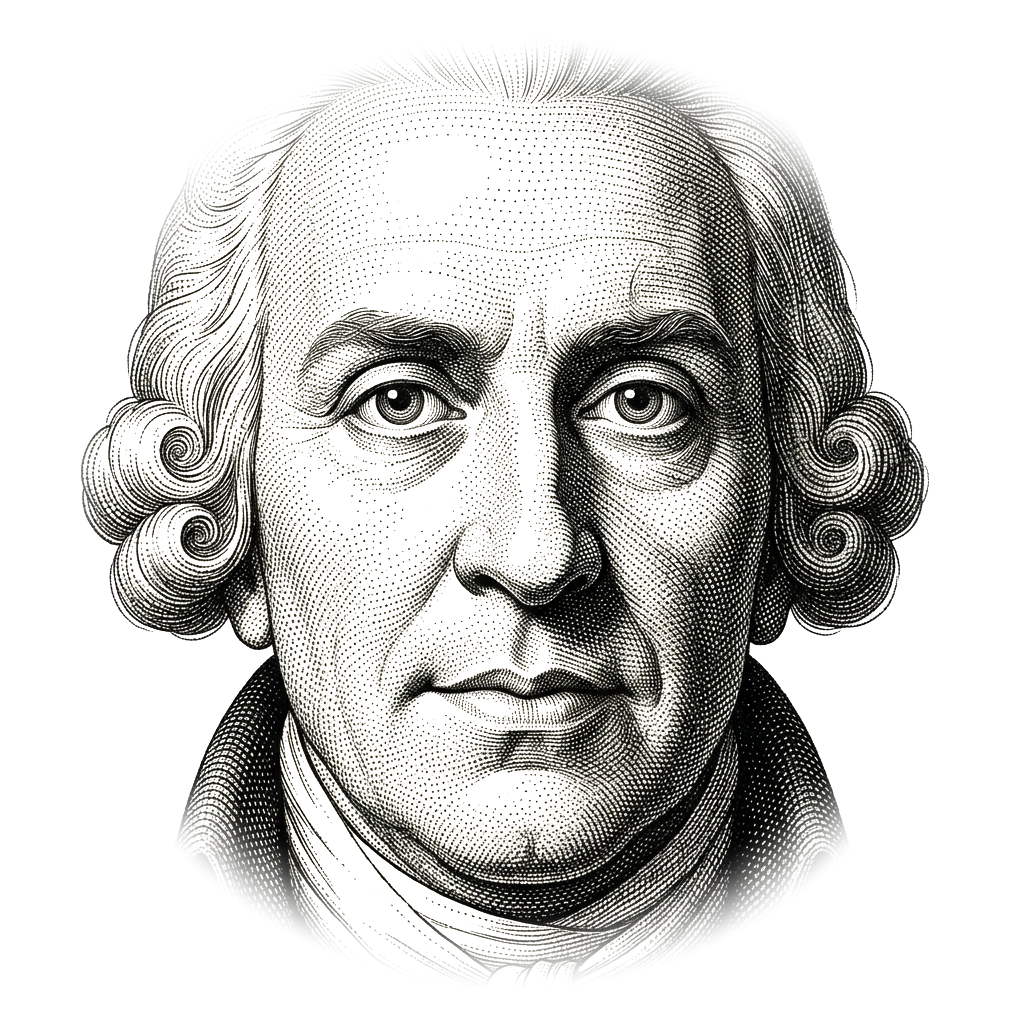
In the quiet coastal town of Kirkcaldy on the Firth of Forth, a solitary Scotsman spent the late 1760s pacing the garden of his mother’s cottage in deep, hypnotic abstraction. He was notoriously absent-minded: he would stir bread and butter into a teapot and declare it the worst tea he had ever tasted, or stroll fifteen miles along the turnpike in his dressing gown before the bells of Dunfermline woke him from his reverie. His speech was hesitant, his gait an awkward rocking roll. Yet behind this disheveled academic exterior operated the most clarifying social mind of the modern world. Adam Smith did not view human society as a chaotic mob requiring the iron grip of a monarch, nor as a corrupt theater of vanity requiring ascetic withdrawal. He saw it as an emergent, self-organizing system whose intricate order was generated from the decentralized interactions of ordinary individuals pursuing their own lives.
Educated at Glasgow under Francis Hutcheson and later enduring the stagnant, intellectually comatose Oxford of the 1740s, Smith returned to Scotland to take the chair of Moral Philosophy at the University of Glasgow. There, amidst the vibrant ferment of the Scottish Enlightenment alongside his closest friend David Hume, he published his first great work in 1759: The Theory of Moral Sentiments. Before he ever analyzed the exchange of goods in the marketplace, Smith investigated the exchange of passions in the human soul. He showed that morality does not descend from divine decrees or cold rational calculus, but arises from "sympathy"—our innate capacity to project ourselves into the experience of another, regulated by an internalized "impartial spectator" that evaluates our conduct as if from an objective distance. Humans, Smith observed, desire not merely to be loved, but to be lovely; not merely to be praised, but to be praiseworthy.
In 1776, as Britain’s American colonies declared their independence, Smith published the culmination of twelve years of labor: An Inquiry into the Nature and Causes of the Wealth of Nations. Where mercantilist dogma insisted that national wealth consisted of piles of gold and silver hoarded in royal vaults, secured through protective tariffs and imperial monopolies, Smith shattered the bullion illusion with a single opening sentence. Wealth was not specie; wealth was the annual product of land and labor—the tangible flow of consumable goods and services that sustained the life of the entire populace, especially the laboring poor.
To reveal the engine of that wealth, Smith did not begin with grandiose economic abstractions, but with a humble pin factory. A single craftsman, uneducated in the trade, might strain all day to shape, cut, and head a single brass pin, and could certainly not produce twenty. But in a small workshop where labor was divided, one man drew out the wire, another straightened it, a third cut it, a fourth pointed it, a fifth ground it at the top for receiving the head, and three distinct operations were required to affix the head itself. Ten workmen, dividing the trade into eighteen discrete operations, produced upwards of forty-eight thousand pins in a single day—four thousand eight hundred pins per man. The division of labor, by reducing each person's task to simple, repeatable motions, saved time, sharpened dexterity, and encouraged the invention of specialized machinery. Yet this division, Smith observed, was not the deliberate creation of human wisdom; it was the spontaneous consequence of an innate human propensity to "truck, barter, and exchange one thing for another."
From this foundational insight emerged Smith’s most famous and widely misunderstood principle: the self-regulating coordination of the market. Society does not depend on universal altruism to feed its cities. "It is not from the benevolence of the butcher, the brewer, or the baker, that we expect our dinner," Smith wrote, "but from their regard to their own interest. We address ourselves, not to their humanity but to their self-love, and never talk to them of our own necessities but of their advantages."
When individuals are free to trade and employ their capital where they believe it will yield the greatest return, they are guided by relative prices—the subtle, distributed signals of scarcity and abundance. Without any central committee or royal decree directing production, scarce resources flow toward their highest-valued uses. An individual pursuing solely his own security and gain is "led by an invisible hand to promote an end which was no part of his intention." By seeking his own advantage, he frequently promotes the interest of society far more effectively than when he consciously intends to promote it. Smith swept away the paternalistic premise of state planning: no statesman or prince possesses the computational capacity or local knowledge required to direct private citizens in how to employ their own capital.
Yet Smith was never the dogmatic, laissez-faire apologist that subsequent caricatures painted. The Wealth of Nations is, in equal measure, a devastating indictment of monopolists, merchants, and corporate conspiracies against the public. "People of the same trade seldom meet together, even for merriment and diversion," he observed with dry Scottish cynicism, "but the conversation ends in a conspiracy against the public, or in some contrivance to raise prices." He relentlessly attacked the British East India Company as a rapacious, blood-soaked monstrosity whose mercantile monopoly ruined both Indian producers and British citizens.
Moreover, Smith recognized the dark psychological cost of the very division of labor that generated material wealth. A man whose whole life is spent performing a few simple operations, of which the effects are perhaps always the same, "has no occasion to exert his understanding, or to exercise his invention... and generally becomes as stupid and ignorant as it is possible for a human creature to become." To counteract this mental mutilation, Smith became a passionate champion of state-funded universal public education. He argued that the state must step in where the market cannot profitably tread: providing national defense, administering impartial justice, building public infrastructure such as roads, canals, and harbors, and ensuring that the laboring masses were not crushed by the machinery of industrial efficiency.
In his final days in Edinburgh in the summer of 1790, realizing his strength was failing, Smith summoned his two closest friends—the chemist Joseph Black and the geologist James Hutton—and ordered them to carry sixteen volumes of his unfinished manuscripts into the garden and burn them to ashes. He had built his life on rigorous, polished completeness; he would not leave fragments for posthumous speculation. When friends gathered at his home on his last Sunday evening, he retired early, turning at the doorway to remark: "I believe we must adjourn this meeting to some other place."
He died as he had lived: modest, uncorrupted, and quietly radical. Adam Smith had discovered that human prosperity does not require benevolent tyrants or heroic self-abnegation. It requires an institutional framework of justice, freedom of contract, and competitive markets—a system of natural liberty that harnesses the inescapable realities of human nature to build a commonwealth of abundance. He proved that the wealth of a nation is measured not by the splendor of its palaces, but by the dignity, comfort, and independence of its ordinary citizens.
“It is not from the benevolence of the butcher, the brewer, or the baker that we expect our dinner, but from their regard to their own interest.”
“He intends only his own gain, and he is in this, as in many other cases, led by an invisible hand to promote an end which was no part of his intention.”
“Man naturally desires, not only to be loved, but to be lovely; or to be that thing which is the natural and proper object of love.”
“People of the same trade seldom meet together, even for merriment and diversion, but the conversation ends in a conspiracy against the public, or in some contrivance to raise prices.”
“No society can surely be flourishing and happy, of which the far greater part of the members are poor and miserable.”
- The Theory of Moral Sentiments 1759
- Considerations Concerning the First Formation of Languages 1761
- An Inquiry into the Nature and Causes of the Wealth of Nations 1776
- Essays on Philosophical Subjects 1795
- Lectures on Jurisprudence 1978