William James
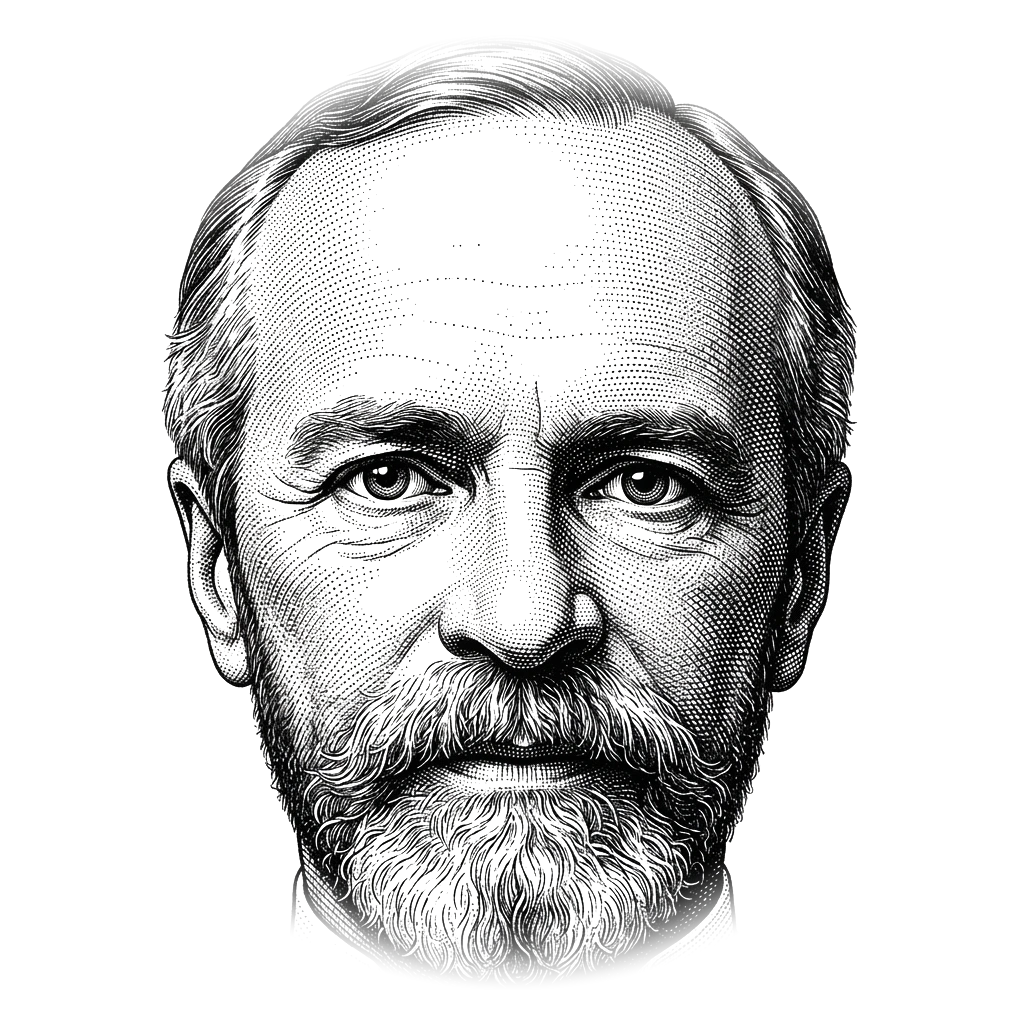
In the closing decades of the nineteenth century, the science of mind was trapped in an intellectual mortuary. For two centuries, Anglo-Scottish empiricism—from Locke and Hume to James Mill and Bain—conceived the human intellect as a mechanical mosaic. In their taxonomy, consciousness was an aggregate of discrete psychic atoms: ideas strung like beads upon a cord, sensations tiled like mosaic stones, or mental cars coupled by mechanical association. In Germany, Wilhelm Wundt’s Leipzig laboratory dissected these psychic particles with calipers and chronometers, slicing conscious experience into static sensory slices. Mind was treated as an inert cabinet of cataloged specimens.
William James looked directly into human experience and saw that the psychologists had described a cemetery instead of a living organism.
Consciousness, James perceived, never appears to itself chopped into bits. It is not an assemblage of dead bricks cemented by association, nor train cars rattling across a track. It is an unbroken, undulating, ceaselessly self-transforming river. In 1890, within the twelve-hundred pages of his masterwork, The Principles of Psychology, James gave this living continuity its enduring name: the stream of thought, or the stream of consciousness.
James’s core act of seeing began by overturning the associationist fallacy: confusing the object of thought with the thought of the object. A sentence consists of separate printed words; a musical chord is scored as distinct notes; a landscape contains distinct trees and stones. But the mental state apprehending them is an indivisible, seamless whole.
Furthermore, this flowing river never repeats a single drop. A state of mind once gone can never recur identically. You may gaze upon the same green lawn, hear the same symphonic phrase, or revisit a childhood garden; yet the brain state receiving the impression has been altered by every intervening pulse of blood, breath, and idea. You can no more experience the identical sensation twice than plunge your hand into the same Heraclitean current.
Moreover, James observed that the stream does not consist solely of crisp sensory arrests—what he termed the "substantive parts," the nouns and verbs of mental life where the mind perches like a bird on a bough. It is equally composed of "transitive parts"—the swift, relational flights between perches, the felt currents of "and," "but," "if," and "by." We do not merely experience objects; we directly experience the relations between them, the forward leans of expectation, the relational fringes hovering around every thought like a halo. Mind is not an album of framed portraits; it is an unbroken flight across a shifting atmosphere.
Having dismantled the myth of the atomized intellect, James turned his gaze downward into the flesh. In 1884, in his landmark essay "What is an Emotion?", he executed the most daring intellectual inversion in the history of psychology.
Common sense had always maintained a flattering, disembodied sequence: we encounter an enraged bear on a forest trail, our intellect perceives the peril, we feel terror, and, propelled by that fright, our heart races and our limbs flee. We lose a fortune, feel grief, and therefore weep. We are insulted, feel rage, and strike.
James severed this ancient Cartesian assumption:
"Our natural way of thinking about these coarser emotions is that the mental perception of some fact excites the mental affection called the emotion, and that this latter state of mind gives rise to the bodily expression. My theory, on the contrary, is that the bodily changes follow directly the perception of the exciting fact, and that our feeling of the same changes as they occur IS the emotion."
We do not weep because we are sorrowful; we are sorrowful because we weep. We do not strike because we are enraged; we are enraged because our muscles surge and our blood boils. We do not tremble because we are afraid; we are terrified because our viscera contract, our pulse races, and our skin chills.
The sensory impression of the bear strikes the brain and discharges instantly through primitive reflex arcs into the viscera, vascular tree, and skeletal muscles. Only when sensory nerves carry the immediate report of this somatic convulsion back to the cerebral cortex does felt emotion ignite. Emotion is not an ethereal cloud hovering above the body; it is the mind’s direct readout of the somatic storm raging in the gut, chest, and throat. Strip away the pounding heart, shallow breath, knotted stomach, and trembling limbs, James insisted, and no emotional fury remains—only a cold, neutral, intellectual appraisal.
This visceral architecture was anchored in a profound materialist realization: the physical plasticity of the nervous system. Decades before neuroscience mapped synaptic remodeling, James recognized that organic matter possesses a unique physical property: "a structure weak enough to yield to an influence, but strong enough not to yield all at once."
Habit, James demonstrated, is no vague spiritual custom. It is a physical channel worn into living neural tissue. Just as running water carves a deepening gully down a hillside until every subsequent rainfall drains down the same groove, so every sensory-motor discharge through the brain lowers the physical resistance along that neural path. Plasticity transforms conscious effort into effortless, unthinking clockwork. Habit is the great conservative flywheel of society, preserving energy by consigning repetitive tasks to the basal machinery of reflex.
Here James’s functionalism achieved its majestic biological synthesis. Mind did not evolve to sit in detached contemplation of the cosmos. Drawing upon Darwin, James recognized that consciousness is an evolutionary organ whose sole reason for existence is the governance of action.
In a world bombarding the senses with millions of competing stimuli, an organism attending to everything would perish in paralysis. The stream of thought is therefore never neutral: it is an engine of passionate, relentless selection. Attention is the sculptor of reality. Out of the chaotic, buzzing confusion of raw experience, the mind carves a coherent world. And the ultimate engine of that selection—the will—is not an occult lever, but the sustained effort of attention: holding an idea firmly before the mind until its motor channels open and it discharges into life.
By wedding the ethereal flow of consciousness to the visceral turbulence of the body and the physical grooves of the brain, William James rescued human psychology from lifeless abstraction. He revealed that we are embodied creatures whose thoughts are currents, whose emotions are somatic echoes, and whose habits carve the destiny of our plastic nervous systems.
“Consciousness, then, does not appear to itself chopped up in bits... It is nothing jointed; it flows. A 'river' or a 'stream' are the metaphors by which it is most naturally described.”
“We feel sorry because we cry, angry because we strike, afraid because we tremble, and not that we cry, strike, or tremble, because we are sorry, angry, or fearful, as the case may be.”
“The greatest weapon against stress is our ability to choose one thought over another.”
“Habit is thus the enormous fly-wheel of society, its most precious conservative agent.”
- What is an Emotion? (Mind) 1884
- The Principles of Psychology (2 vols.) 1890
- The Will to Believe and Other Essays in Popular Philosophy 1897
- The Varieties of Religious Experience: A Study in Human Nature 1902
- Pragmatism: A New Name for Some Old Ways of Thinking 1907