Thomas Aquinas
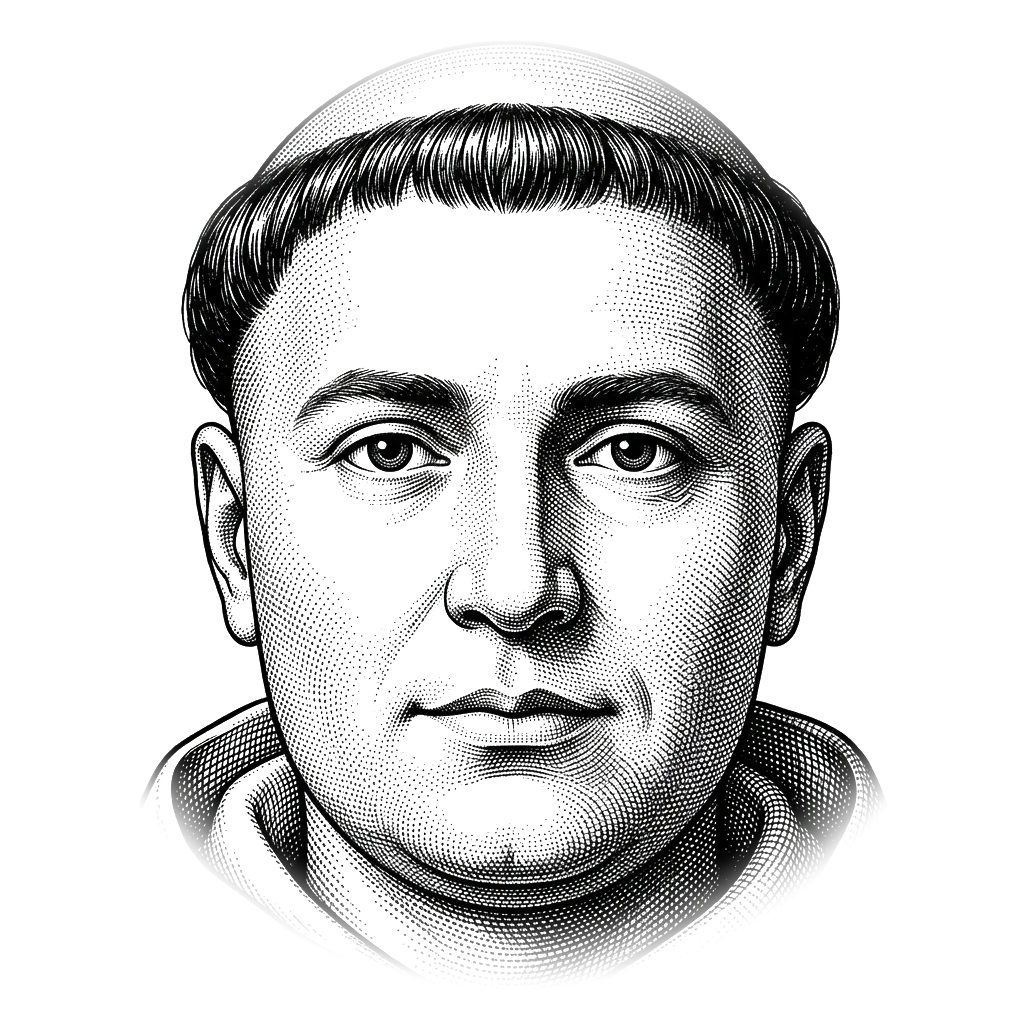
The Dominican convent of San Domenico Maggiore in Naples, on the sixth of December 1273, witnessed the sudden stillness of the most industrious intellect in Christendom. Thomas of Aquino, having said morning mass in the chapel of Saint Nicholas, laid down his quill, pushed aside the unbound gatherings of the Summa Theologiae, and suspended work at the ninetieth question of the third part, midway through his treatise on the sacrament of Penance. When Reginald of Piperno, his secretary and confessor, pleaded with him to resume the monumental synthesis that had occupied his daylight hours and sleepless nights for nine years, Thomas offered only a quiet, definitive refusal: "Reginald, I cannot. All that I have written seems like straw compared with what I have seen and what has been revealed to me." The silence was not a renunciation of intellect, but its consummation—a recognition that the apparatus of human reasoning, pushed to the utmost limits of dialectical precision, inevitably confronts the uncreated light in which all distinctions are dissolved.
Yet that apparatus had redefined the intellectual architecture of the West. Born around 1225 in the fortress castle of Roccasecca to the Counts of Aquino, Thomas had defied his aristocratic family's worldly ambitions—enduring two years of imprisonment in the family keep for refusing to become the abbacy-bound Benedictine they demanded—to enter the mendicant Order of Preachers. In Paris and Cologne, under the mentorship of Albertus Magnus, the massive, silent youth derided by his peers as the "dumb ox" absorbed the newly recovered corpus of Aristotle, translated from Arabic and Greek. Where conservative Augustinian masters saw in Aristotelian natural philosophy a pagan infection that threatened biblical faith, Thomas recognized a providential opportunity. He perceived that if grace does not destroy nature but perfects it (gratia non tollit naturam, sed perficit), then reason and revelation, properly understood, cannot contradict one another, because both emanate from the same transcendent source of all truth.
The foundational wager of the Thomistic project was the real distinction between essence (essentia) and existence (esse). In every finite creature, what a thing is—its definable nature, intelligible structure, and categorical boundaries—is distinct from the sheer fact that it is. A phoenix or a triangle can be comprehensively defined and grasped by the intellect without ever existing in the extra-mental world; existence is not an intrinsic predicate baked into finite quiddity, but an extrinsic gift received from beyond. Only in God, whose essence is subsistent existence itself (Ipsum Esse Subsistens), do what-is and that-it-is entirely coincide. From this metaphysical hinge, Thomas constructed his celebrated Five Ways (Quinque Viae): not formal syllogistic proofs designed to coerce belief from a skeptic, but cosmological ascending vectors demonstrating that the contingent, changing, caused, graded, and teleological fabric of the cosmos requires an uncaused, necessary, and supreme sustaining Ground.
To navigate between anthropomorphic literalism and apophatic agnosticism, Thomas formulated the doctrine of the analogy of being (analogia entis). When we predicate goodness, wisdom, or power of God, we speak neither univocally—as though divine goodness were simply human goodness scaled to infinity—nor equivocally—as though the word meant something utterly unrelated. Instead, our language functions analogously, rooted in the ontological dependence of effect upon cause. A portrait reflects the artist without being an identical twin; so too creation participates in the divine perfections while remaining infinitely distinct from divine transcendence. This analogical bridge allowed Thomas to construct an epistemology grounded entirely in sensory reality (nihil est in intellectu quod non sit prius in sensu), affirming the dignity of empirical observation while keeping the gateway to metaphysical contemplation wide open.
In the social and moral order, Thomas synthesized the virtues into a majestic architecture that united classical pagan excellence with theological transcendence. Aristotle's four cardinal virtues—prudence, justice, fortitude, and temperance—govern the natural flourishing of man within the political commonwealth, while the three theological virtues—faith, hope, and charity—infuse the soul with the divine capacity for beatitude. Crucially, Thomas placed charity (caritas) as the form of all the virtues (forma omnium virtutum); without love, courage hardens into brutality, and justice stiffens into cruelty. In his jurisprudence, Thomas grounded human law in natural law, which is itself the rational creature's participation in the eternal law of the divine intellect. Any positive enactment of an earthly sovereign that violates natural justice is not law, but an act of violence (non lex sed legis corruptio).
The method through which this synthesis was hammered out was the scholastic disputation. In the Summa, Thomas never simply asserted dogma. Instead, he structured every question around a rigorous dialectical rhythm: stating the problem, marshaling the most formidable objections that could be raised by pagan philosophers, Muslim commentators like Averroes and Avicenna, Christian heretics, and Church Fathers, answering with a crisp authority (Sed contra), advancing his reasoned resolution (Respondeo dicendum), and then answering every single objection point by point. He took his opponents' arguments more seriously than they often took them themselves, demonstrating an intellectual hospitality that refused to defeat a caricature when a steel-clad objection could be met on its own terms.
Behind the formidable intellectual machinery beat the heart of a contemplative mystic and poet. When Pope Urban IV instituted the Feast of Corpus Christi in 1264, he commissioned Thomas to compose the liturgical office. The resulting hymns—Pange Lingua, Tantum Ergo, O Salutaris Hostia, and Adoro Te Devote—stand among the highest achievements of medieval Latin verse, combining dogmatic precision with exquisite lyricism. In the Pange Lingua, scholastic distinctions between substance and accidents are transformed into liturgical hymnody: sensory perception fails, but faith alone suffices to confirm the sincere heart (Praestet fides supplementum / Sensuum defectui). For Thomas, theology was not a sterile academic exercise; it was an act of worship, an intellectual pilgrimage of the mind toward the vision of God.
Thomas worked at an astonishing velocity, dictating to three or four secretaries simultaneously on different treatises, pacing his cell and rubbing his brow as his mind traversed the vast taxonomy of being. He was completely detached from personal ambition, twice refusing the archbishopric of Naples to remain a simple friar who walked barefoot between European university towns. When fellow friars found him weeping before the crucifix in the convent of Naples, they overheard the icon speak to him: "You have written well of me, Thomas. What reward will you have for your labor?" To which Thomas replied without hesitation: "Nothing but yourself, Lord" (Nil nisi te, Domine).
The legacy of Aquinas was not an instant triumph, but a long, contentious consolidation. In 1277, three years after his death on the road to the Council of Lyon at the Cistercian Abbey of Fossanova, the Bishop of Paris included several Thomistic propositions in a sweeping ecclesiastical condemnation of radical Aristotelianism. Yet the coherence, equilibrium, and sheer explanatory power of the Thomistic synthesis proved irresistible. Formally canonized in 1323, designated a Doctor of the Church in 1567, and elevated as the perennial philosophy of Catholic higher education by Pope Leo XIII in 1879, Thomas provided a lasting model for how faith and critical rationality can converse without mutual destruction.
His lasting gift to civilization is the serene conviction that truth is an indivisible unity. Thomas taught that whatever is true, by whomever it is spoken, proceeds from the Holy Spirit (omne verum a quocumque dicatur a Spiritu Sancto est). By daring to baptize Aristotle and cross-examine revelation through the crucible of pagan philosophy, he established an intellectual courage that refuses to cower before empirical discovery, confident that every genuine revelation of natural reality will ultimately harmonize with the mystery of Being itself.
“Grace does not destroy nature, but perfects it.”
“To one who has faith, no explanation is necessary. To one without faith, no explanation is possible.”
“The things that we love tell us what we are.”
“There is nothing on this earth more to be prized than true friendship.”
“Whatever is received into something is received according to the condition of the receiver.”
- Summa Theologiae 1265–1274
- Summa contra Gentiles 1259–1265
- De Ente et Essentia 1252–1256
- Quaestiones Disputatae de Veritate 1256–1259
- Pange Lingua and Eucharistic Hymns 1264