Sun Tzu
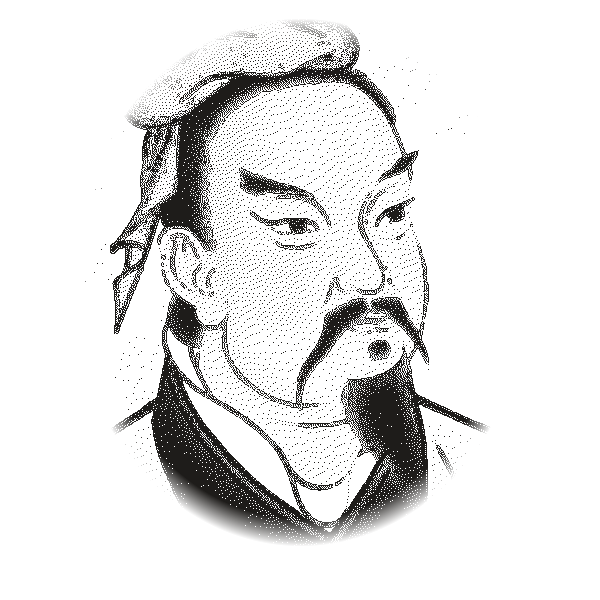
In the sixth century before Christ, in the southern kingdom of Wu along the lower Yangtze River, a mysterious strategist from the northern state of Qi arrived at the royal court of King Helü. The king had studied the thirteen bamboo scrolls of military philosophy the foreigner had submitted, admired their cold, mathematical lucidity, and wished to test whether their author was an idle theoretician or a master of human discipline. "Can you apply your principles," Helü asked with sly amusement, "to a company composed entirely of women?" Sun Tzu replied that he could. The king summoned one hundred and eighty palace concubines, dressed them in light armor, handed them halberds, and appointed his two favorite consorts as company commanders.
When Sun Tzu instructed the women on how to turn at the sound of the drums—eyes forward at the first beat, right face at the second, left face at the third—the concubines collapsed into helpless, fluttering giggles. Sun Tzu did not raise his voice. He stood with serene stillness and declared: "If words of command are not clear and distinct, if orders are not thoroughly understood, the general is to blame." He repeated the drill commands a second time, slow and clear. Once more, the drum sounded; once more, the women laughed aloud. Sun Tzu spoke again, his voice dropping into cold iron: "When orders are clear and the soldiers nevertheless disobey, it is the fault of their officers."
Before the horrified eyes of the king, who leaped from his throne begging for mercy, Sun Tzu ordered the executioner to step forward. The two favorite concubines were beheaded on the pavilion steps. Sun Tzu appointed the next two women in rank, beat the drum once more, and watched the remaining concubines execute every march, halt, turn, and spear-thrust in total, petrified silence without missing a step or uttering a sound. The lesson was complete: in strategy, clarity without absolute execution is meaningless, and authority without unyielding enforcement is an illusion.
In an era when warfare across China was still celebrated as an aristocratic ritual of chariot duels, divination bones, and chivalric displays of personal valor, the Art of War (Sunzi Bingfa) represented a terrifying intellectual revolution. Sun Tzu stripped armed conflict of its romantic, feudal plumage and exposed its brutal, existential reality: "War is a matter of vital importance to the State; the province of life or death; the road to survival or ruin. It is mandatory that it be thoroughly studied."
War, for Sun Tzu, was never an athletic tournament or an arena for noble heroes to display courage. It was an expensive, devastating disease of statecraft, to be concluded as swiftly as possible, or avoided altogether through superior foresight. His opening axiom swept away centuries of martial chivalry with a single stroke: "All warfare is based on deception. Hence, when able to attack, we must seem unable; when using our forces, we must seem inactive; when we are near, we must make the enemy believe we are far away; when far away, we must make him believe we are near."
Where ordinary commanders relied on brute force and frontal collisions, Sun Tzu treated war as an informational calculus. He recognized that conflict is an asymmetric game played between two perceptual models. If you can manipulate what the adversary perceives, you can dictate where he concentrates his troops, when he marches, and how he exhausts his reserves. The enemy’s mind, not his body, is the true theater of operations.
From this insight flowed his supreme aesthetic and practical ideal: the bloodless victory. "To fight and conquer in all your battles is not supreme excellence," Sun Tzu wrote; "supreme excellence consists in breaking the enemy's resistance without fighting."
To achieve this, he formulated a rigorous strategic hierarchy: "The highest realization of warfare is to attack the enemy’s strategy; the next best is to disrupt his alliances; the next best is to attack his army in the field; and the worst policy of all is to besiege walled cities."
To besiege a fortress is the confession of strategic bankruptcy. It ties down armies for months, consumes astronomical treasure, exposes troops to pestilence, and leaves the homeland vulnerable to opportunistic neighbors. The master strategist defeats the enemy before the swords are drawn: he frustrates the enemy’s plans while they are still in gestation, isolates him diplomatically, deprives him of food and morale, and maneuvers him into a geometric position where surrender is the only rational choice. When victory requires a mountain of corpses, the state has already lost.
Underpinning his entire tactical architecture was the doctrine of formlessness (wuxing). Sun Tzu recognized that rigidity is the signature of death, while fluidity is the signature of life.
"Military tactics are like unto water," he wrote in one of the most sublime passages of classical Chinese prose; "for water in its natural course runs away from high places and hastens downwards. So in war, the way is to avoid what is strong and to strike at what is weak. Water shapes its course according to the nature of the ground over which it flows; the soldier works out his victory in relation to the foe whom he is facing. Therefore, just as water retains no constant shape, so in warfare there are no constant conditions. He who can modify his tactics in relation to his opponent and thereby succeed in winning may be called a heaven-born captain."
If an army maintains a rigid, visible formation, an intelligent adversary can design an exact counter-formation to shatter it. But an army that is formless—adapting continuously to terrain, timing, and enemy psychology—cannot be mapped by hostile spies or trapped by opposing tactics. You appear where the enemy does not expect you; you strike where he is undefended; you vanish before he can strike back. You divide the enemy into isolated fragments while keeping your own forces concentrated into a single, cohesive fist.
To navigate this formless fluid, the commander requires one sovereign asset above all: foreknowledge. Sun Tzu was the first military thinker in history to dedicate an entire chapter of his treatise to the systematic operation of espionage. He dismissed omens, spirits, dreams, and astrological divinations as useless superstitions: "Knowledge of the enemy's dispositions can only be obtained from other men."
He categorized intelligence into five interconnected networks: local spies, internal spies, converted enemy spies, doomed spies sacrificed with false disinformation, and surviving spies who return with verified data. Through this web of human telemetry, the general eliminates the fog of uncertainty before setting foot upon the march.
This culminated in his most celebrated aphorism: "If you know the enemy and know yourself, you need not fear the result of a hundred battles. If you know yourself but not the enemy, for every victory gained you will also suffer a defeat. If you know neither the enemy nor yourself, you will succumb in every battle."
Having led the armies of Wu to historic victories over the rival state of Chu, capturing the enemy capital of Ying, Sun Tzu quietly slipped away from court, disappearing into the mist of history to escape the fatal jealousy of kings. He left behind thirteen brief chapters carved into strips of dried bamboo—a work so compressed, so mathematically austere, that twenty-five centuries later it remains the foundational manual of military strategy, corporate competition, and asymmetric warfare. He proved that the greatest victor is not the lion who roars before the slaughter, but the water that finds the crack in the stone, flowing silently through the dark until the mountain falls.
“The supreme art of war is to subdue the enemy without fighting.”
“All warfare is based on deception.”
“In the midst of chaos, there is also opportunity.”
“If you know the enemy and know yourself, you need not fear the result of a hundred battles.”
“Let your rapidity be that of the wind, your compactness that of the forest; in raiding and plundering be like fire, is immovable like a mountain.”
- Sunzi Bingfa: Chapter 1 (Laying Plans / Initial Estimations) c. 500 BC
- Sunzi Bingfa: Chapter 3 (Attack by Stratagem / Planning Offensives) c. 500 BC
- Sunzi Bingfa: Chapter 5 (Energy / Strategic Military Power) c. 500 BC
- Sunzi Bingfa: Chapter 6 (Weak Points and Strong / Vacuity and Substance) c. 500 BC
- Sunzi Bingfa: Chapter 13 (The Use of Spies / Employing Secret Agents) c. 500 BC