Richard Feynman
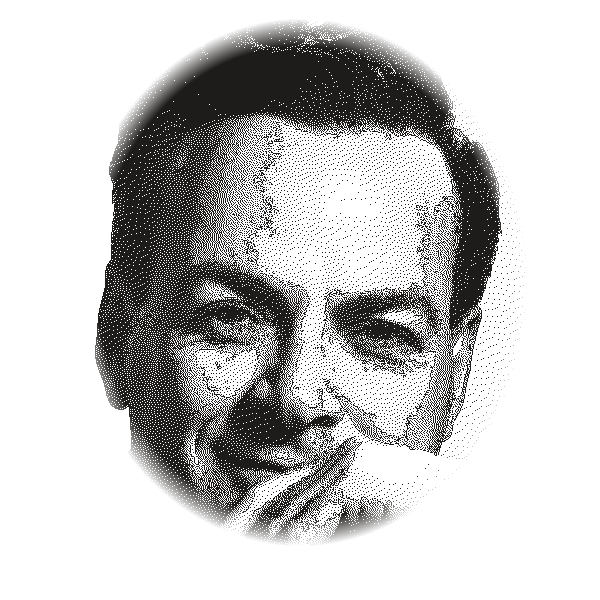
In the spring of 1948, at a secluded inn in Pocono Manor, Pennsylvania, twenty-eight of the world's most eminent theoretical physicists gathered to confront an existential crisis in modern science. Quantum electrodynamics—the theory describing how electrons interact with light—was drowning in infinities. Every attempt to calculate the simplest physical process, such as an electron emitting and reabsorbing a virtual photon, yielded an answer of positive infinity. Julian Schwinger presented an immense, dazzling exhibition of classical mathematical analysis, filling blackboards with hundreds of intricate green differential equations that left the audience exhausted. Then a young, irreverent physicist from Far Rockaway, Queens, stepped up to the board and began drawing squiggly lines and arrows that looked like tree branches. It was Richard Feynman.
Feynman did not calculate like Schwinger or Dirac. He visualized. Where classical quantum mechanics used Schrödinger wave equations or Heisenberg operator matrices, Feynman saw particles traveling along trajectories in spacetime. But unlike a classical particle that follows a single deterministic path of least action, a quantum particle explores every conceivable path simultaneously. An electron traveling from point A to point B does not simply move in a straight line; it takes the path that loops behind the moon, the path that spins backward in time, the path that dances around Jupiter, and the path that stays at home. Each path carries a rotating complex phase whose frequency is dictated by the classical action divided by Planck's constant. By summing the amplitudes of every possible history—the path integral formulation—the wildly divergent phases cancel each other out through destructive interference, leaving only the classical trajectory as the path where the action is stationary.
This was the sum-over-histories formulation of quantum mechanics: a radical conceptual democratization of spacetime. Yet Feynman's most enduring gift to twentieth-century physics was not the abstract integral, but the visual diagrams he invented to track it. In Feynman diagrams, the nightmare of relativistic perturbation theory was reduced to a transparent pictorial bookkeeping system. A solid line represented an electron propagating through spacetime; a wavy line represented a photon; a vertex where lines met represented the fundamental interaction coupling constant. A positron moving forward in time was mathematically equivalent to an electron moving backward in time.
What had previously required months of tortuous algebraic derivation by teams of mathematical physicists could now be sketched on the back of a paper napkin in twenty seconds. Each visual vertex and line mapped directly onto an exact algebraic propagator. If you wanted to calculate electron-electron scattering (Møller scattering), you simply drew all the topologically distinct ways two electrons could exchange photons, read off the mathematical factors from the picture, and computed the integral. Julian Schwinger once joked that Feynman had brought quantum mechanics to the masses; but Hans Bethe and Freeman Dyson recognized the deeper truth: Feynman had invented a new physical language that allowed physicists to compute quantum electrodynamic interactions to ten decimal places of precision, matching experimental measurements of the Lamb shift and the anomalous magnetic moment of the electron with unprecedented exactitude.
Behind this dazzling visual mechanics lay an epistemological philosophy of fierce, uncompromising honesty. Feynman possessed a visceral hatred of pomposity, intellectual jargon, and self-deception. On the blackboard of his office at Caltech, where he taught for over three decades, he kept a single sentence inscribed: What I cannot create, I do not understand. For Feynman, understanding did not mean manipulating symbolic equations until they balanced; it meant being able to rebuild the physical phenomenon from first principles, step by step, without leaning on authority or established convention. If a physicist could not explain a concept in simple, concrete language without relying on technical jargon, Feynman argued, that physicist did not truly understand it.
This relentless drive to grasp physical reality at its roots led him to legendary diversions that became the folklore of modern science. At Los Alamos during the Manhattan Project, bored by administrative routine, he spent his evenings picking the combination locks of safes containing classified nuclear secrets, leaving mischievous notes inside to prove that physical security was an illusion. Later, he learned to play the frigideira in Brazilian samba bands, cracked Mayan hieroglyphs, and painted portraits under a pseudonym. But these were not merely eccentric hobbies; they were the manifestations of an insatiable, playful curiosity that refused to respect artificial intellectual boundaries.
In his later years, Feynman's intuition repeatedly anticipated the technological horizons of the future. In December 1959, in a historic lecture to the American Physical Society titled There's Plenty of Room at the Bottom, he laid the theoretical foundation for nanotechnology, proposing that individual atoms could be manipulated mechanically to synthesize molecular machines and dense information storage. In 1981, meditating on the impossibility of simulating quantum mechanical systems on classical digital computers due to the exponential growth of Hilbert space, he delivered another foundational lecture: Simulating Physics with Computers. Nature isn't classical, he declared, so if you want to make a simulation of nature, you'd better make it quantum mechanical. In that single lecture, he ignited the field of quantum computing.
In 1986, facing terminal abdominal cancer, Feynman performed his final public service on the presidential commission investigating the Space Shuttle Challenger disaster. Frustrated by bureaucratic evasions and NASA's PR management, he took a piece of the shuttle's synthetic O-ring material, clamped it in a small C-clamp, and dropped it into a cup of ice water during a nationally televised congressional hearing. When he released the clamp, the rubber failed to spring back, remaining stiff and compressed. In five seconds of quiet, elegant physical demonstration, Feynman bypassed hundreds of pages of engineering obfuscation to reveal the unvarnished truth: cold temperatures had destroyed the resiliency of the seals. Nature cannot be fooled.
Richard Feynman died in Los Angeles in February 1988 at the age of sixty-nine. His final recorded words were characteristically dry and unsentimental: 'I'd hate to die twice. It's so boring.'
Today, the diagrams that bear his name are etched onto blackboards, printed in research papers, and processed by supercomputers in every high-energy physics laboratory on Earth, from CERN to SLAC. His path integral formulation has transcended quantum electrodynamics to become the native mathematical language of quantum chromodynamics, string theory, and condensed matter physics. Richard Feynman taught a generation of scientists how to strip away the calcified layers of mathematical pretension, look directly at the physical world with joyous, irreverent wonder, and calculate the miraculous dance of light and matter with absolute empirical integrity.
“What I cannot create, I do not understand.”
“The first principle is that you must not fool yourself—and you are the easiest person to fool.”
“Nature doesn't care what you consider mathematically attractive. She is what she is.”
“I would rather have questions that can't be answered than answers that can't be questioned.”
“There's plenty of room at the bottom.”
- Space-Time Approach to Non-Relativistic Quantum Mechanics 1948
- Space-Time Approach to Quantum Electrodynamics 1949
- The Feynman Lectures on Physics (3 volumes) 1964
- Quantum Mechanics and Path Integrals (with Albert Hibbs) 1965
- QED: The Strange Theory of Light and Matter 1985
- Simulating Physics with Computers 1982