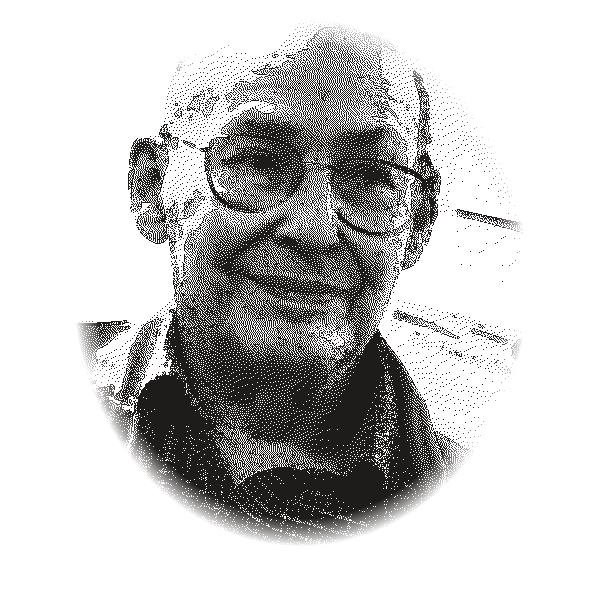
Marvin Minsky
For centuries, Western philosophy and psychology were haunted by the myth of the homunculus. Thinkers imagined consciousness as an indivisible theater of mind, presided over by a single, unified "I"—an internal executive seated at the controls of perception and will. When the computer emerged in the mid-twentieth century, early cyberneticists and logicians succumbed to the same monolithic temptation. They searched for a single grand master principle: a universal logical deduction engine, a massive linear equation solver, or an undifferentiated network of simulated neurons that would, through sheer statistical feedback, magically blossom into self-awareness.
Marvin Lee Minsky regarded this search for a single, unified secret of intelligence as a profound intellectual failure. A polymath who wandered effortlessly between mathematics, neurophysiology, optics, and philosophy, Minsky saw that nature never solves difficult problems with elegant, monolithic simplicity. Biology is an opportunistic tinkerer. A living brain is not a clean, unified temple designed from an axiomatic blueprint; it is an unruly, evolved kludge—a sprawling collective of hundreds of specialized mechanisms, jury-rigged subsystems, and competing reflexes accumulated across hundreds of millions of years of evolutionary triage.
To understand mind, Minsky argued, one had to abandon the comforting illusion of the unified self. The central paradox of cognition was both simpler and far more shocking: intelligence emerges from non-intelligence. The mind is a vast, messy society of mindless parts.
Minsky did not arrive at this insight through armchair speculation. In 1951, as a graduate student at Princeton, he built the SNARC (Stochastic Neural Analog Reinforcement Calculator), the world's first hardware neural network simulator, wiring together three hundred vacuum tubes, forty stepping motors, and gyroscopes to simulate a network of forty Hebbian synapses navigating a maze.
Yet having built the physical progenitor of connectionism, Minsky refused to become its evangelist. In 1969, collaborating with his close friend Seymour Papert at the MIT Artificial Intelligence Laboratory, he delivered the most devastating critique in the history of machine learning: the monograph Perceptrons.
Frank Rosenblatt and the popular press had heralded the perceptron as a miraculous synthetic brain capable of self-learning any pattern. Minsky and Papert subjected the device to rigorous geometric and algebraic analysis. They proved mathematically that a single-layer perceptron was fundamentally incapable of computing the simplest non-linear functions. It could not compute the exclusive-OR (XOR) logical relation, nor could it determine whether a geometric figure in a visual field was connected or disjoint without global, combinatorially explosive weights.
The book froze funding for neural networks for a decade, an era later dubbed the "AI Winter." Minsky’s critics accused him of sabotaging a rival school. But to Minsky, it was a necessary act of intellectual hygiene. He had demonstrated that raw statistical association without structural representations of hierarchy, geometry, and semantics was a blind alley. Mind could not be achieved simply by throwing uniform threshold units into a pot and stirring.
In 1974, Minsky formulated the cognitive architecture that bridged the chasm between raw perception and symbolic logic: The Frame Theory.
Traditional artificial intelligence assumed that when an agent perceives the world, it either builds a model from scratch out of raw sensory pixels or applies first-order predicate logic to an exhaustive list of axioms. Minsky saw that human beings do neither. We do not construct the world anew at every glance; we recognize it through stereotyped expectations.
A Frame, Minsky proposed, is a structured data template representing a familiar, remembered situation—a living room, a birthday party, or an encounter with a predatory animal. A frame possesses fixed structural boundaries, but its internal details consist of slots filled with default assumptions. When you walk into a room, you do not examine the floor to verify that gravity holds, nor do you measure the walls to confirm three-dimensional geometry. Your "room frame" supplies those facts by default. Your cognitive bandwidth is reserved exclusively for the exceptions: the broken vase on the rug, the unfamiliar person by the window.
If an incoming observation contradicts a default slot, the mind does not suffer a logical contradiction; it simply modifies the slot or shifts to an adjacent frame along an associative network. In one stroke, Minsky explained how the human mind operates in real time under radical uncertainty: we do not calculate reality; we project our expectations onto it and adjust only the differences.
This framework culminated in 1986 with his magnum opus, The Society of Mind.
Minsky dismantled the human psyche into an ensemble of interacting micro-agents, each so small and narrow that it could not be accused of having a mind of its own. Consider a child building a tower of blocks. Traditional psychology spoke of "the child's desire to build." Minsky looked through an engineering microscope and revealed a miniature bureaucracy of competing agents: BUILDER, SEE, GRASP, MOVE, BALANCE, and DESTROY.
SEE knows nothing of balance; GRASP knows nothing of color; BUILDER knows nothing of vision. Intelligence is the coordination that occurs when these primitive specialists are organized into dynamic hierarchies.
Most critically, Minsky introduced the concept of Censors and Suppressors. Mind does not advance merely by generating ideas; it advances by learning what not to think. A massive portion of human mental architecture is dedicated to negative expertise: inhibiting fruitless associations, suppressing taboo desires, and aborting unproductive lines of thought before they reach conscious awareness. Freudian repression and psychological conflict were not pathological anomalies, but the essential engineering mechanisms that keep a complex multi-agent system from destroying itself in internal loops of competition.
Minsky’s restless intellect was incapable of staying confined within the boundaries of computer science. In 1955, frustrated by the chromatic glare and scattering of light when attempting to image neural connections in living brain tissue, he conceived, built, and patented the Confocal Scanning Microscope. By passing light through a microscopic pinhole, focusing it on a single diffraction-limited volume, and placing a matching pinhole in front of the photodetector, Minsky eradicated out-of-focus background flare. Decades later, with the arrival of laser beams and digital sensors, Minsky's confocal patent became the universal optical engine of modern biology and cancer medicine.
He designed early robotic hands, composed music, advised Stanley Kubrick on the cold, rational cadence of HAL 9000 for 2001: A Space Odyssey, and founded the legendary intellectual sandbox of the MIT Media Lab.
He was often controversial, dismissing traditional philosophy as obsolete theology and provocatively describing the human brain as a "meat machine." Yet beneath his deliberate provocations lay an unyielding, joyful humanism.
Marvin Minsky believed that humanity's greatest indignity was its ignorance of itself—that we had lived for millennia trapped inside the machinery of our own brains, attributing our thoughts, emotions, and sorrows to magic, fate, or cosmic design. By daring to treat the soul as a society of mechanisms, he gave humanity something infinitely more precious than a myth: an engineering blueprint to understand, repair, and transcend the architecture of its own mind.
“You don't understand anything unless you understand it in more than one way.”
“The mind is a society of mindless parts.”
“The principal activity of brains is making changes in themselves.”
“It is not whether machines think, but whether men do.”
“Negative knowledge is the most powerful kind of knowledge: knowing what not to do.”
- Theory of Neural-Analog Reinforcement Systems (Ph.D. Thesis) 1954
- U.S. Patent 3,013,467: Confocal Scanning Microscope 1957
- Steps Toward Artificial Intelligence (IRE) 1961
- Perceptrons (with Seymour Papert) 1969
- A Framework for Representing Knowledge (Frame Theory) 1974
- The Society of Mind 1986
- The Emotion Machine 2006