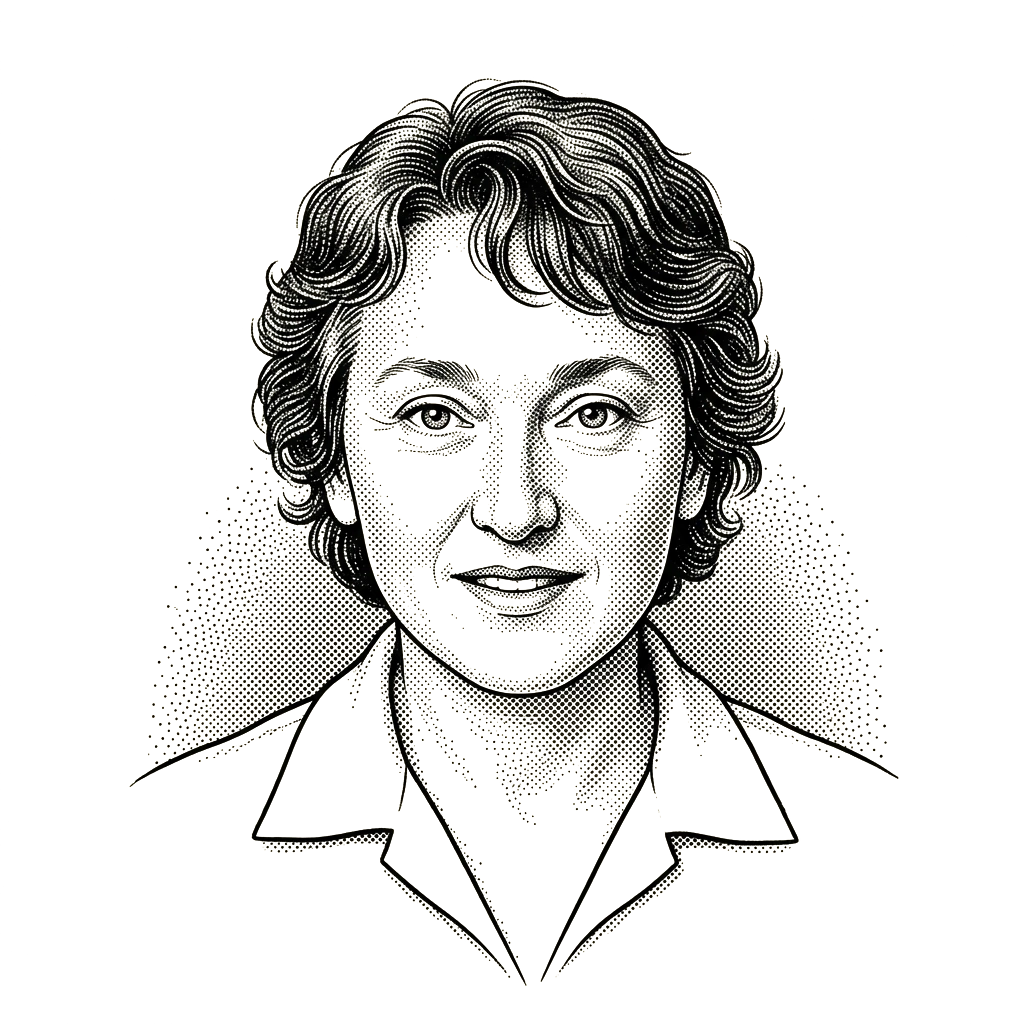
Lynn Margulis
In the mid-1960s, evolutionary biology was governed by a rigid orthodoxy. The Modern Synthesis had reduced life's history to a single mechanism: the gradual accumulation of random point mutations, pruned by natural selection. The organism was a sovereign individual. Its genome was an inviolable ledger, its survival a solitary combat against competitors in an indifferent wild. Speciation occurred when geographic barriers bifurcated populations, letting copying errors slowly drift them apart. Life evolved vertically: parent to offspring, branch by solitary branch.
Lynn Margulis looked at a cell through a microscope and saw that the sovereign individual was an illusion.
Where the zoological consensus saw a singular microscopic machine, Margulis saw a metropolis. Inside every animal, plant, and fungal cell—the complex cells known as eukaryotes—resided discrete structures carrying out metabolic life support: mitochondria burning oxygen to generate adenosine triphosphate (ATP), and in plants, chloroplasts capturing photons to split water and fix carbon. Orthodoxy taught that these organelles were internal inventions of the host cell, evolved de novo through the gradual folding of internal membranes directed by mutations in nuclear DNA.
Margulis recognized that this explanation defied cytological reality. Mitochondria and chloroplasts did not behave like cellular parts. They reproduced inside the cell by binary fission, exactly like free-living bacteria, completely outside the timetable of the host nucleus's mitosis. If a protist lost its chloroplasts, it could never regenerate them; they arose only from the division of existing chloroplasts. Most tellingly, they possessed their own distinct, extranuclear DNA—not coiled in chromosomes around histone spools like eukaryotic genes, but arranged in naked, circular loops: the universal architecture of bacteria.
In 1967, after her manuscript had been rejected by fifteen scientific journals, Margulis (writing under her married name, Lynn Sagan) published "On the Origin of Mitosing Cells" in the Journal of Theoretical Biology. The paper resurrected and synthesized a long-discarded heresy: Serial Endosymbiotic Theory (SET).
Margulis argued that the eukaryotic cell was not the product of gradual, solitary mutation. It was the product of violent, ancient corporate mergers.
Two billion years ago, during the Great Oxidation Event, photosynthetic cyanobacteria flooded the primordial atmosphere with oxygen—a corrosive, reactive gas that precipitated the greatest extinction crisis in planetary history. For reigning anaerobic microbes, oxygen was lethal poison.
In Margulis's reconstruction, the crisis forced an extraordinary metabolic alliance. An anaerobic host cell engulfed an oxygen-respiring bacterium. Instead of being digested as prey or destroying the host as a pathogen, the invader survived. The host provided shelter and organic substrates; the captive bacterium detoxified encroaching oxygen and paid rent in a flood of metabolic energy.
Over hundreds of millions of years, what began as an armed truce stabilized into obligate co-dependence. The engulfed bacterium surrendered most of its autonomy, transferring the bulk of its genes to the host's central nucleus while retaining the core machinery of oxidative phosphorylation. The captive bacterium became the mitochondrion. In a subsequent, serial event, an already-mitochondriate eukaryote swallowed a photosynthetic cyanobacterium. That captive solar engine became the chloroplast, giving birth to the algae and green plants that transformed the continents.
The implications were staggering. If Margulis was correct, the defining evolutionary leap that birthed complex life—every animal, plant, and fungus—was not a slow accumulation of solitary errors, but a sudden, massive horizontal synthesis. Evolution did not proceed solely by branching divergence; it proceeded by convergence. Genomes did not simply mutate; they fused.
For over a decade, the evolutionary establishment dismissed her work as cytological storytelling lacking biochemical proof. Vindication arrived with molecular phylogenetics in the late 1970s and 1980s. When Carl Woese, Michael Gray, and W. Ford Doolittle sequenced the ribosomal RNA preserved within organellar genomes, the verdict was unequivocal: mitochondrial rRNA did not map to the eukaryotic nucleus. It branched squarely within Alphaproteobacteria. Chloroplast rRNA branched directly within Cyanobacteria. Organelles were tamed bacteria. What had been condemned as crackpot speculation became empirical canon.
Yet the brilliance of Margulis's seeing lay in her refusal to treat symbiosis as an ancient historical quirk. For Margulis, endosymbiosis was not merely how the eukaryotic cell originated; symbiogenesis—the generation of new tissues, organs, species, and ecosystems through permanent symbiotic mergers—was the primary creative motor of evolutionary innovation.
Natural selection, she insisted, was a magnificent pruning hook, ruthlessly weeding out the unfit. But it was not an inventor. Point mutations were overwhelmingly neutral or destructive; swapping a single nucleotide in a three-billion-base sequence rarely built a brand-new physiological organ. The real source of novelty was the acquisition of pre-packaged, fully tested microbial genomes. An animal did not need to invent cellulase digestion from scratch through millions of trial-and-error mutations; it swallowed a consortium of gut microbes that had perfected cellulose metabolism two billion years earlier.
This led Margulis to redefine biological individuality itself. An organism is not an isolated unit of selection; it is a holobiont—a host and its integrated microbial ecosystem. A termite cannot digest wood without the dense microbial tangle inside its hindgut; a human body contains as many microbial cells as human cells, maintaining an immune and metabolic balance without which the host collapses. We are not solitary entities. We are walking, metabolizing collectives.
Her fierce commitment to this vision produced both her greatest triumphs and her most stubborn missteps. Margulis maintained that eukaryotic cilia, flagella, and the mitotic spindle originated from ancient symbiotic spirochetes—a claim she defended passionately until her death in 2011. Here, molecular genetics ultimately ruled against her: tubulin and dynein proved to be endogenous eukaryotic innovations rather than bacterial imports.
Yet even her excesses stemmed from the same foundational insight that modern science is only now fully catching up to: that life on Earth is fundamentally bacterial, an interconnected planetary web that has operated without interruption for nearly four billion years. In her collaboration with James Lovelock on the Gaia hypothesis, she extended this logic from the microscopic to the planetary, showing that Earth's atmosphere, oceans, and climate are not an inert physical stage upon which life acts, but active physiological outputs continuously tuned by the microbial commons.
Margulis shattered the Victorian myth of the solitary warrior organism battling alone against the wild. She showed that the true architects of life are consortia, that survival is an art of perpetual negotiation, and that the deepest complexity in nature is built by taking the stranger inside.
“Life did not take over the globe by combat, but by networking.”
“Natural selection eliminates and maybe maintains, but it doesn't create.”
“We are all walking communities of bacteria. The idea of the individual is a myth.”
“Science is an anarchic, irreverent enterprise: either you believe in authority or you believe in observation.”
- On the Origin of Mitosing Cells (Journal of Theoretical Biology) 1967
- Origin of Eukaryotic Cells (Yale University Press) 1970
- Symbiosis in Cell Evolution 1981, 1993
- Microcosmos: Four Billion Years of Microbial Evolution (with Dorion Sagan) 1986
- Acquiring Genomes: A Theory of the Origins of Species (with Dorion Sagan) 2002