James Clerk Maxwell
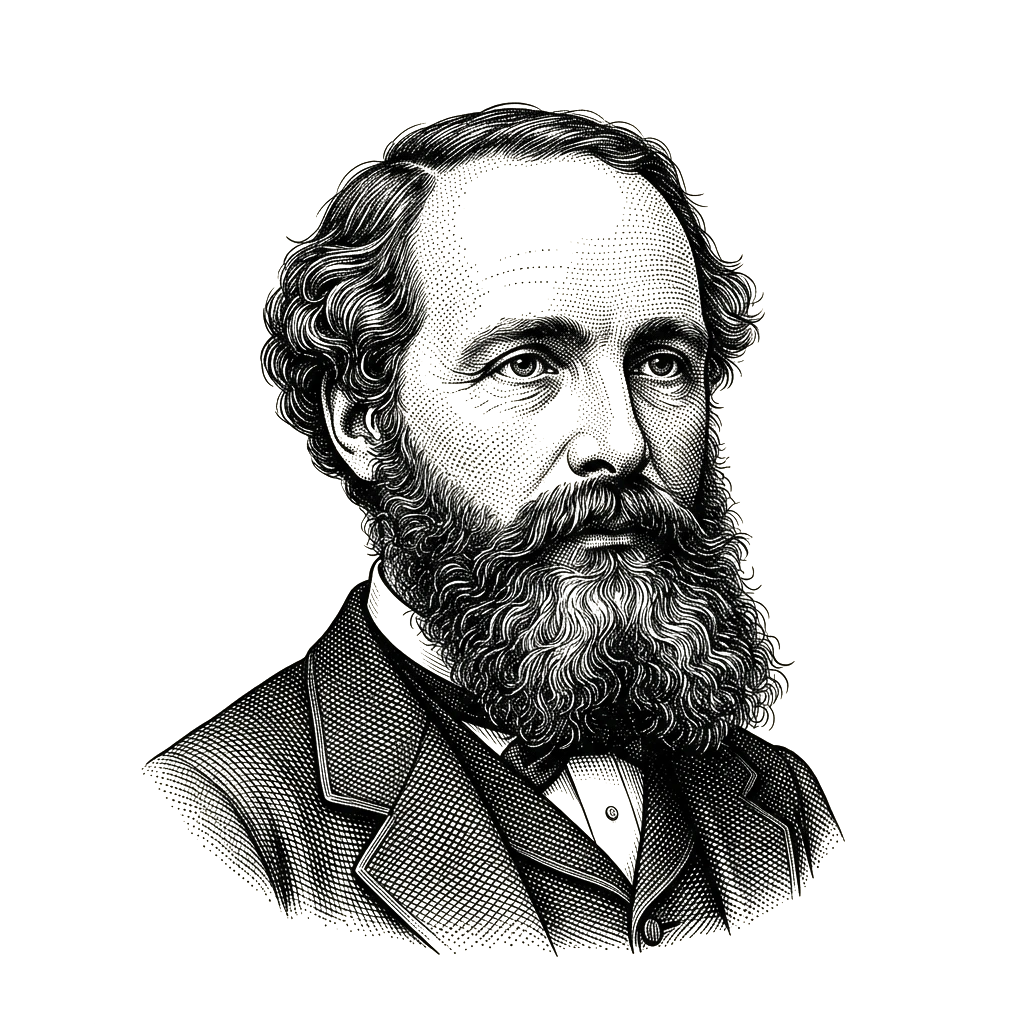
In the autumn of 1855, mathematical physics was trapped inside a Newtonian orthodoxy that had conquered the heavens but was quietly suffocating terrestrial physics.
For two centuries, since the publication of the Principia, the ultimate ideal of natural philosophy was the instantaneous force acting at a distance across empty Euclidean space. Electric charges and current elements were treated as isolated point-masses pulling and pushing one another across a void according to inverse-square laws. The mathematics—championed by Charles-Augustin de Coulomb, André-Marie Ampère, and Wilhelm Weber—was continentally revered. It was also fundamentally blind.
Across the English Channel, at the Royal Institution in London, an unschooled blacksmith’s son named Michael Faraday was seeing something completely different. Lacking the formal mathematics to solve a differential equation, Faraday possessed unrivaled spatial intuition. Sprinkling iron filings over a sheet of paper resting upon a bar magnet, he did not see isolated poles exerting mysterious forces across a vacuum. He saw space itself organized into curved, tensioned threads—arches of stress and strain that he termed "physical lines of force." Force did not leap across nothingness; matter was merely the termination point of an interconnected dynamical state filling all space.
Continental theorists dismissed Faraday’s lines as naive, unmathematical metaphors—pictorial crutches for an experimenter who could not calculate.
James Clerk Maxwell, a twenty-four-year-old fellow of Trinity College, Cambridge, looked at Faraday’s diagrams and saw the exact opposite: Faraday was not unmathematical; his intuition was ahead of the mathematics of his century.
Maxwell understood that the choice between action-at-a-distance and continuous lines of force was an epistemological divide. Newtonian physics located reality in discrete particles, treating empty space as an inert backdrop. Faraday’s vision required a complete inversion: reality resided in the medium, and the particle was an edge effect.
To translate Faraday's lines into rigorous geometry, Maxwell began in 1855 with "On Faraday’s Lines of Force," modeling them as streamlines of an incompressible fluid. But by 1861, in "On Physical Lines of Force," he realized electromagnetism possessed inertia and mechanical stress. He constructed an intricate mechanical scaffolding: spinning hexagonal vortex cells of ether separated by microscopic spherical "idle wheels." The rotation of the vortices produced centrifugal tension along their axes and lateral pressure outward—the exact signature of magnetic attraction and repulsion.
Then came the conceptual rupture. In a dielectric or vacuum, charges could not flow freely. Yet when an electric field was applied, the elastic substance of the vortex cells distorted, shifting charges against their restorative elasticity until the force ceased. Maxwell termed this transient strain the displacement current ($\mathbf{J}_D = \frac{\partial \mathbf{D}}{\partial t}$).
This was the hinge of modern physics. In classical electrodynamics, Ampère’s law held that magnetic curl arose solely from conduction currents ($\nabla \times \mathbf{H} = \mathbf{J}$). But for open circuits—such as a charging capacitor—Ampère's formulation violated charge conservation. Charge accumulated on the plates, yet no conduction current crossed the gap. By introducing displacement current, Maxwell restored mathematical continuity: the time-varying electric field inside the gap acts as a virtual current, generating an identical magnetic field. Nature required no physical wires to sustain an electromagnetic circuit; a changing electric field was its own conduit.
With displacement current installed, the equations snapped into dynamic symmetry. A changing magnetic field generated an electric field; a changing electric field generated a magnetic field. Each birthed the other in an endless, reciprocal chain.
In 1864, in "A Dynamical Theory of the Electromagnetic Field," Maxwell discarded his mechanical scaffolding, retaining only the dynamical field equations. Operating on the curl in vacuum, the variables decoupled into a three-dimensional wave equation:
$$\nabla^2 \mathbf{E} = \mu_0 \epsilon_0 \frac{\partial^2 \mathbf{E}}{\partial t^2}$$
The propagation speed of this undulating disturbance was dictated solely by two static laboratory quantities: electrostatic permittivity ($\epsilon_0$) and magnetic permeability ($\mu_0$):
$$c = \frac{1}{\sqrt{\mu_0 \epsilon_0}}$$
Using the 1856 Weber-Kohlrausch ratio of electrostatic to electromagnetic units, Maxwell calculated $c \approx 310,740\text{ km/s}$. Armand Fizeau had recently measured the terrestrial speed of light at $314,858\text{ km/s}$. The values matched within experimental error.
In a single, quiet sentence, Maxwell wrote:
"We can scarcely avoid the inference that light consists in the transverse undulations of the same medium which is the cause of electric and magnetic phenomena."
Light was an electromagnetic wave. Optics was swallowed whole by electrodynamics.
Yet during these exact years, Maxwell led an equally radical revolution in heat and matter.
In 1859, dissatisfied with Rudolf Clausius's kinetic models, Maxwell realized that tracking deterministic collisions among trillions of gas molecules was impossible. Rather than retreating, he introduced probability into the foundational laws of physics, deriving the velocity distribution:
$$f(v) = 4\pi \left(\frac{m}{2\pi k_B T}\right)^{3/2} v^2 \exp\left(-\frac{m v^2}{2 k_B T}\right)$$
It was the first statistical law in physics. Temperature, pressure, and viscosity were not properties of isolated atoms, but emergent invariants of macroscopic ensembles. Deducing that gas viscosity should be independent of density over broad pressure ranges—a prediction widely ridiculed—Maxwell and his wife Katherine built a sealed torsion-pendulum in their home and proved it empirically.
In 1867, probing the Second Law of Thermodynamics, Maxwell conceived his "Demon"—a microscopic being operating a frictionless shutter to sort fast and slow molecules without performing work. By demonstrating that microscopic knowledge could lower entropy, Maxwell exposed the Second Law not as a mechanical absolute, but as a statistical truth rooted in human ignorance—anticipating information physics a century before Shannon and Landauer.
James Clerk Maxwell died in 1879 at forty-eight, before Hertz confirmed radio waves and before Heaviside condensed his twenty original equations into four vector forms.
Yet he fundamentally redrew the ontology of science. Before him, the universe was an assembly of hard matter traversing empty space. After him, matter was an incidental condensation in an ocean of continuous, vibrating, probabilistic fields. As Albert Einstein noted on the centenary of Maxwell's birth: "One scientific epoch ended and another began with James Clerk Maxwell."
“The vast interplanetary and interstellar regions will no longer be regarded as waste places in the universe... We find them already full of this wonderful medium; so full that no human power can remove it from the smallest portion of space.”
“The special superiority of the electromagnetic theory of light consists in its being a dynamical theory, a theory of the motions of matter, not an hypothesis of elastic media.”
“Thoroughly conscious ignorance is the prelude to every real advance in science.”
“Happy is the man who can recognize in the work of To-day a connected portion of the work of life, and an embodiment of the work of Eternity.”
- On Faraday's Lines of Force 1856
- On Physical Lines of Force 1861–1862
- A Dynamical Theory of the Electromagnetic Field 1865
- Theory of Heat 1871
- A Treatise on Electricity and Magnetism 1873