Leonardo da Vinci
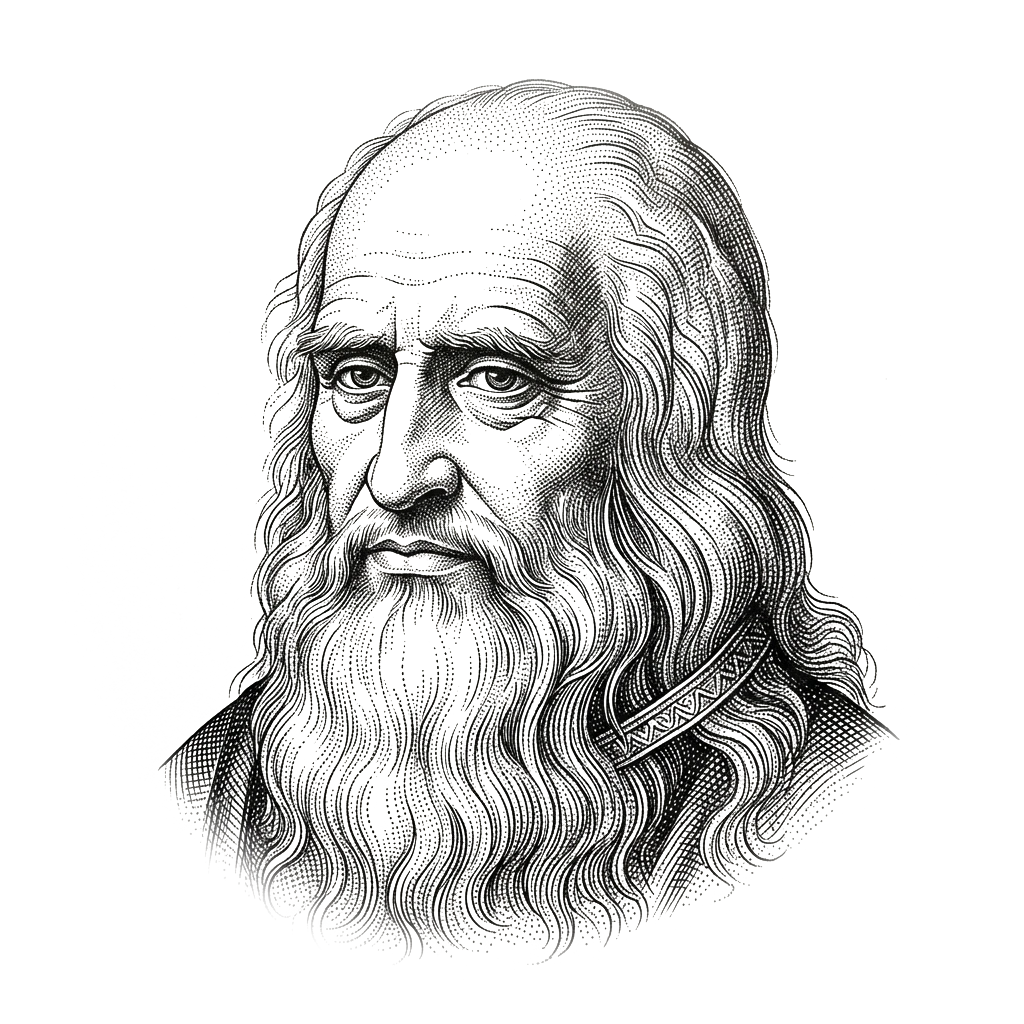
In the spring of 1452, in the Tuscan hill town of Vinci, an illegitimate child was born to a notary and a peasant girl. Denied a formal Latin schooling and barred from entering the respectable guilds of law and medicine, the boy was left to wander the olive groves and rushing mountain streams with an untamed, feral curiosity. He was left-handed and wrote from right to left in reverse mirror-script, hiding his private thoughts from casual glance. Where his contemporaries saw nature as a finished collection of static symbols created for human convenience, Leonardo da Vinci saw a restless, turbulent continuum of energy. Watching the current of the river Arno divide around a mossy rock, he noted with astonishing visual precision: "Observe the motion of the surface of the water, which resembles that of hair, which has two motions, of which one depends on the weight of the hair, the other on the direction of the curls; thus the water forms eddying whirlpools, one part of which is due to the principal current, the other to the random and reverse motion." To Leonardo, the curl of a woman's hair, the branching of an oak tree, the eddy of a river, and the circulation of arterial blood were not poetic analogies; they were identical mathematical expressions of a single universal geometry: the vortex.
Arriving in Florence as a teenager, he entered the bottega of Andrea del Verrocchio, where goldsmithing, bronze casting, mechanics, and painting collided in a furnace of manual craftsmanship. Legend recounts that when Verrocchio saw the luminous, translucent angel Leonardo painted in the corner of the Baptism of Christ, the master laid down his brushes and never painted again. Yet Leonardo had no desire to be confined to the canvas. Painting, for him, was merely the most delicate instrument of natural philosophy—a visual science capable of demonstrating how light, shadow, and anatomy obeyed unbending mechanical laws.
In 1482, seeking greater intellectual and financial scope, the thirty-year-old Leonardo relocated to the court of Ludovico Sforza, the Duke of Milan. In his astonishing letter of application, he presented himself not as a painter, but as a military architect. Across ten numbered paragraphs, he outlined his capacity to construct indestructible armored wagons, portable bridges, novel mortars, covered trenches, and hydraulic conduits; only in an offhand postscript at the bottom did he mention: "Also I can execute sculpture in marble, bronze, or clay, and in painting I can do as much as any other, be he who he may."
During his Milanese years, between designing court pageants and casting a colossal twenty-four-foot bronze equestrian monument, Leonardo descended into the crypts of the Santa Maria Nuova hospital to dissect human cadavers by flickering candlelight. In an age when physicians relied on the ancient humoral theories of Galen, Leonardo flayed skin, exposed tendons, and saw the human body as an exquisite hydraulic machine of levers, pulleys, and valves.
His crowning physiological triumph was his study of the human heart. Peering into the base of the aorta, he discovered the three-lobed aortic valve and the hollow bulges behind it—structures known today as the Sinuses of Valsalva. Centuries before fluid dynamics existed, Leonardo realized that blood ejecting from the left ventricle does not slam backward against the fragile valve membranes to close them; rather, the blood swirls into tiny vortices within the sinus cavities, and these curling fluid eddies gently and effortlessly press the leaflets shut without backflow. It was an insight of such breathtaking fluidic sophistication that modern cardiology did not fully confirm it until MRI imaging in the late twentieth century.
No physical phenomenon obsessed Leonardo more than the dream of human flight. On the slopes of Monte Ceceri near Florence, he spent months with his sketchbook watching kites, falcons, and bats, recording how birds adjusted their wing-tips to ride thermal drafts and glide upon invisible cushions of air. "A bird is an instrument working according to mathematical law," he recorded in the Codex on the Flight of Birds, "which instrument it is in the capacity of man to put into movement with all its motions."
He realized that air was not an empty void, but a compressible physical fluid possessing weight and density. If a bird could compress air beneath its feathers, a properly designed machine could do the same. Across hundreds of folios, he sketched flapping ornithopters powered by stirrups and pulleys, an aerial screw that anticipated the modern helicopter, a pyramidal linen parachute, and lightweight gliders with flexible wingtips. When his manual flapping machines proved physically impossible due to the limited power-to-weight ratio of human muscle, he immediately pivoted toward passive soaring, studying how eagles banked against the wind without beating their wings. He understood the fundamental mechanics of lift and drag three centuries before Sir George Cayley and the Wright brothers took to the air.
In his paintings, this relentless empirical investigation manifested as sfumato—smoke. Leonardo recognized that in the physical world, nature produces no hard black contours; objects fade into atmosphere through subtle, continuous gradations of light and shadow. In The Last Supper, painted on the refectory wall of Santa Maria delle Grazie, he depicted Christ’s announcement of betrayal not as a static liturgical icon, but as an explosive psychological shockwave rippling through the apostles, each reacting according to his physiological temperament with the dynamic force of a localized tempest.
In the Mona Lisa, painted over decades and carried with him until his death, the human face and the terrestrial globe dissolve into an inseparable unity. The winding aqueducts and jagged limestone gorges of the backdrop do not serve as decorative scenery; they are the geological bones and veins of the Earth, echoing the blood and bone beneath Lisa Gherardini's skin. The smile that flickers at the corners of her mouth is an optical masterpiece of peripheral vision: look directly at her lips, and the smile disappears into shadow; look slightly away at her eyes, and the shadows around her mouth register upon the eye's rod cells as a luminous, knowing smile. He had engineered a painting that moved because human perception moves.
In his final years, exiled from an Italian peninsula engulfed in war, Leonardo accepted the invitation of King Francis I of France to live at the manor of Clos Lucé in Amboise. His right hand was partially paralyzed by a stroke, yet his left hand continued to drive the quill across paper in a fever of cosmic speculation. In his dark final drawings, known as The Deluge, all human vanity and architectural grandeur are swept away by terrifying, apocalyptic vortices of water and wind. Giant curling waves crash over shattered cities, splintering trees and drowning mountains in vast, spiral plumes of foam.
Leonardo had realized that the universe is governed by an inescapable cycle of creation and dissolution, an eternal thermodynamic vortex where matter is assembled, agitated, and ground back into primordial dust. When he died in Amboise in May 1519, he left behind tens of thousands of notebook pages and only a handful of finished paintings. Yet his legacy remains unmatched in the annals of human curiosity. He proved that art and science are not rival kingdoms, but two eyes of the same mind—that to paint the world faithfully, one must understand how it is assembled, and to understand how it is assembled, one must learn how to see.
“Simplicity is the ultimate sophistication.”
“Learning never exhausts the mind.”
“The human foot is a masterpiece of engineering and a work of art.”
“Water is the driving force of all nature.”
“Obstinate rigor (Ostinato rigore).”
- Codex Atlanticus c. 1478–1519
- Codex Madrid I & II c. 1493–1497
- The Last Supper (Santa Maria delle Grazie) 1498
- Codex on the Flight of Birds 1505
- Mona Lisa (La Gioconda) c. 1503–1519
- Codex Leicester c. 1508–1510
- Trattato della pittura (Treatise on Painting) 1651