Gregor Mendel
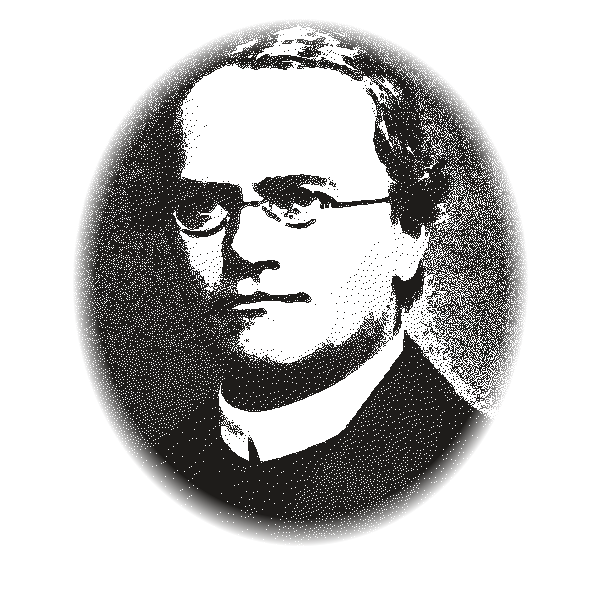
In the two-acre walled garden of the Augustinian St. Thomas Abbey in Brünn, Moravia, a stocky friar in black vestments spent eight quiet summers bending over rows of edible pea plants with a camel-hair brush and a pair of dissecting scissors. It was 1856. Outside the monastery walls, the intellectual world was preparing for Charles Darwin's On the Origin of Species. Darwin would explain how natural selection shapes the tree of life; but Darwin's theory was crippled by a fatal blindspot: he had no workable mechanism of heredity. The universal consensus among nineteenth-century naturalists was 'blending inheritance'—the intuitive belief that the hereditary traits of parents mix together in their offspring like red and white paint, merging into an unalterable pink.
Gregor Johann Mendel realized that blending inheritance was a mathematical impossibility. If traits blended like liquids, every new, advantageous variation would be diluted by half in each successive generation, dissolving back into the mediocre average of the population within a few generations. Natural selection would have nothing permanent to act upon. Mendel did not accept the paint-pot metaphor. Trained in combinatorial mathematics and physics at the University of Vienna under Christian Doppler and Andreas von Ettingshausen, he brought something completely foreign to biology: statistical quantification and combinatorial discrete modeling.
Mendel chose his experimental organism with surgical foresight: Pisum sativum, the common garden pea. It was cheap, easy to cultivate, possessed distinct, binary morphological traits, and—crucially—its floral architecture allowed strict control over pollination, preventing rogue cross-fertilization by bees. Mendel isolated seven pairs of mutually exclusive, binary characteristics: round versus wrinkled seeds, yellow versus green cotyledons, purple versus white flowers, inflated versus constricted pods, green versus yellow immature pods, axial versus terminal flowers, and tall versus dwarf stems.
He did not track dozens of messy, continuous variables simultaneously, as previous hybridizers had done. He tracked one trait at a time. When he crossed pure-breeding tall plants with pure-breeding dwarf plants, the first filial generation ($F_1$) did not produce intermediate, medium-height plants, as blending inheritance dogmatically predicted. Every single $F_1$ plant was tall. The dwarf trait had not blended, weakened, or diluted; it had completely vanished. Yet when Mendel allowed these tall $F_1$ plants to self-fertilize to produce the second generation ($F_2$), the missing trait reappeared with astonishing mathematical precision. Out of 1,064 plants, 787 were tall and 277 were dwarf: a ratio of 2.84 to 1, or almost exactly 3 to 1.
Over eight years, Mendel cultivated, crossed, and hand-counted over 28,000 individual pea plants, recording the physical traits of every pod, flower, and seed in meticulous ledger books. Across all seven traits, the results were stubbornly identical: the $F_2$ generation always divided into a $3:1$ ratio. But Mendel did not stop at phenotypic counting. He allowed the $F_2$ plants to self-fertilize to produce the third generation ($F_3$). The mathematical architecture revealed itself: the 3 was not a uniform class. One-third of the dominant plants bred true for tallness, while two-thirds produced offspring segregating again into the $3:1$ ratio. The true underlying ratio was not $3:1$; it was $1:2:1$—one pure dominant, two hybrid dominants, and one pure recessive.
In that combinatorial matrix, modern genetics was born. Heredity was not a fluid; it was particulate. Physical traits are governed by discrete internal factors—what Wilhelm Johannsen would later name 'genes'—that exist in pairs within the organism, one inherited from each parent. These factors (alleles) do not blend, contaminate, or fuse; they remain intact, separate, and pristine throughout the life of the individual, segregating cleanly into gametes during reproduction. This was the Law of Segregation. When he crossed plants differing in two traits simultaneously (dihybrid crosses), he discovered the Law of Independent Assortment: the alleles governing seed shape and seed color segregated into gametes independently, yielding the famous $9:3:3:1$ phenotypic ratio.
In February and March 1865, Mendel read his paper, Experiments on Plant Hybridization, before the Natural History Society of Brünn. The audience of local botanists, pharmacists, and agronomists listened in polite, uncomprehending silence. To naturalists trained in qualitative taxonomy, Mendel's combinatorial binomial expansions and algebraic ratios ($(A + 2Aa + a)(B + 2Bb + b)$) sounded like bizarre mathematical sorcery rather than biology. The society published his paper in their proceedings in 1866, sending copies to over 120 libraries across Europe, including the Royal Society in London.
Mendel initiated a desperate correspondence with Carl von Nägeli in Munich, one of Europe's leading botanical authorities. Nägeli completely failed to grasp the significance of Mendel's work and condescendingly advised the friar to test his laws on hawkweeds (Hieracium). It was a tragic detour: Hieracium reproduces primarily by apomixis—asexual seed production without fertilization—meaning Mendel's combinatorial ratios could not replicate. Discouraged, burdened by his administrative election as Abbot of the monastery in 1868, and engaged in a bitter tax dispute with the Austrian government, Mendel abandoned his pea crosses. He died in January 1884 from chronic nephritis, his funeral attended by townsfolk who loved him as a charitable priest, completely unaware that they were burying the father of modern biology.
For thirty-four years, Mendel's paper lay buried in library stacks, gathering dust. Then, in the spring of 1900, three European botanists working independently—Hugo de Vries in the Netherlands, Carl Correns in Germany, and Erich von Tschermak in Austria—re-discovered his paper while trying to publish their own identical hybridization results. They were stunned to find that an obscure Augustinian monk had fully deciphered the laws of inheritance a third of a century earlier.
Today, Gregor Mendel's particulate model is the foundational bedrock of all modern genetics, evolutionary biology, and molecular medicine. When Watson and Crick discovered the physical structure of DNA, they were identifying the physical molecule that carries Mendel's discrete factors. Every mapping of human genetic diseases, every crop modification feeding billions of people, and every CRISPR gene editing therapy traces its conceptual lineage back to the walled garden in Brünn. Gregor Mendel proved that beneath the bewildering, fluid diversity of living forms lies a clean, digital code of inheritance—governed not by chance, but by the infallible laws of mathematics.
“My scientific studies have afforded me great gratification; and I am convinced that it will not be long before the whole world acknowledges the results of my work.”
“My time will come.”
“The value and utility of any experiment are determined by the fitness of the material to the purpose for which it is used.”
“It requires indeed some courage to undertake a labor of such far-reaching extent; this appears, however, to be the only right way by which we can finally reach the solution of a question the importance of which cannot be overestimated.”
“Those who could not understand my results attributed them to chance.”
- Versuche über Pflanzen-Hybriden (Experiments on Plant Hybridization) 1866
- Ueber einige aus künstlicher Befruchtung gewonnene Hieracium-Bastarde (On Hieracium Hybrids) 1870
- Meteorological Observations for Moravia and Silesia 1863-1882