Baruch Spinoza
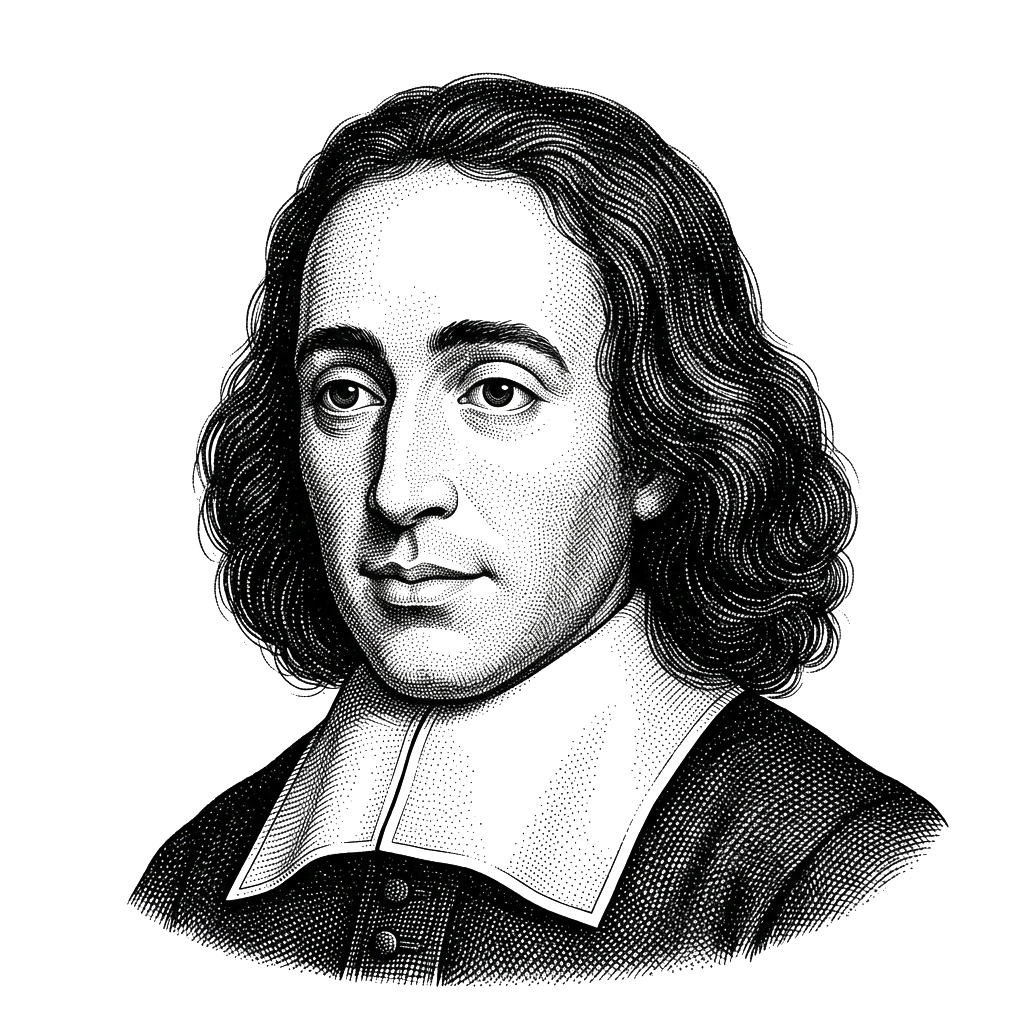
On the twenty-seventh of July, 1656, in the Portuguese synagogue of Amsterdam, the elders gathered before the open Ark of the Law to read the most savage sentence of excommunication in modern history. The candles were extinguished one by one into basins of water until the sanctuary was plunged into total darkness, symbolizing the spiritual extinction of twenty-three-year-old Baruch Spinoza. The decree of cherem thundered through the shadows: "Cursed be he by day, and cursed be he by night; cursed be he when he lies down, and cursed be he when he rises up. Cursed be he when he goes out, and cursed be he when he comes in. The Lord shall not spare him, but then the anger of the Lord and his jealousy shall smoke against that man." The congregation was commanded under penalty of severe spiritual punishment that no one should speak with him, write to him, show him any favor, or read any parchment composed by his hand.
Spinoza did not riot, weep, or plead for mercy. He quietly changed his name from the Hebrew Baruch to the Latin Benedictus—both meaning "blessed"—and walked out into the Dutch rain. He was an exile from his own community, an outcast from the Spanish-Portuguese crypto-Jews who had fled the Inquisition only to recreate its rigid orthodoxy in the canal-laced sanctuary of the Dutch Republic. His crime was neither moral turpitude nor political treason; it was an uncompromising refusal to accept the anthropomorphic monarch-God of theology—a God of wrath, miracles, arbitrary will, and human vanity.
To sustain his solitary existence, Spinoza took up the craft of optical lens grinding. In small rented rooms in Rijnsburg, Voorburg, and finally The Hague, he spent his daylight hours bent over copper dishes, grinding and polishing glass lenses for microscopes and telescopes. His lenses were sought after by the greatest natural philosophers of the age, including Christiaan Huygens and Gottfried Wilhelm Leibniz. There was a sublime, tragic symmetry between his trade and his thought: by day he shaped glass to bring the invisible details of the physical universe into optical clarity; by night he wielded the geometry of pure reason to bring the infinite structure of being into conceptual focus.
The glass dust that filled his lungs slowly killed him, inflicting a chronic pulmonary phthisis that would end his life at forty-four. Yet he lived with an astonishing, ascetic serenity. When the Elector Palatine offered him the prestigious Chair of Philosophy at the University of Heidelberg, guaranteeing him total freedom of thought on the condition that he not disturb the established religion, Spinoza politely declined. He would not surrender his independence for imperial stipends. He lived in a quiet garret on pennies a day, dining on oatmeal broth and a pipe of tobacco, answering letters from the finest intellects of Europe while keeping his finished manuscripts locked inside a modest writing desk.
That desk contained his masterpiece: the Ethica Ordine Geometrico Demonstrata—the Ethics Demonstrated in Geometrical Order. Spinoza believed that metaphysical truth should not be argued through the rhetorical persuasions of essayists, but deduced with the cold, unassailable necessity of Euclidean geometry. The work unfolded through formal Definitions, Axioms, Propositions, Demonstrations, and Corollaries, terminating repeatedly in the calm, definitive cadence of Quod erat demonstrandum—which was to be demonstrated.
At the core of the Ethics lay the demolition of Cartesian dualism. René Descartes had divided the cosmos into two utterly separate substances: thinking substance (res cogitans) and extended physical matter (res extensa), desperately attempting to link them through the pineal gland. Spinoza saw that two infinite, distinct substances could never interact, for they would limit one another. There could not be multiple substances. There could only be one: infinite, uncaused, eternal, and indivisible. This single substance he designated by the revolutionary formula: Deus sive Natura—God or Nature.
God was not a cosmic monarch sitting outside the universe pulling the strings of history; God was the universe itself. Thought and extension were not two separate entities, but two infinite attributes of the exact same reality, perceived from different vantages. A physical body and its corresponding idea were one and the same event expressed in two different languages: the language of matter and the language of mind.
From this monistic foundation, Spinoza derived a revolutionary psychology of human agency. Every existing thing, he argued, possesses an innate drive to persist and expand in its being—a fundamental force he termed conatus. When this striving is aided by external causes, we experience Joy (laetitia), which is the passage of the mind to a state of greater power and perfection; when it is hindered, we experience Sadness (tristitia), which is the passage to a lesser power.
Human beings, Spinoza insisted, are not an "empire within an empire"—we are not exempt from the universal laws of cause and effect. Free will, in the sense of an uncaused decision made in defiance of natural law, is a pure illusion born of ignorance: men consider themselves free merely because they are conscious of their volitions and appetites, while remaining entirely unconscious of the causes by which they are disposed to want and desire. Human bondage consists in being tossed like a cork on the ocean by passive affects and irrational superstitions. Human freedom consists not in arbitrary choice, but in the rational understanding of necessity. To understand why a storm blows, why a tyrant oppresses, or why a neighbor hates, is to dissolve the passive misery of resentment into the active, serene joy of reason. The highest summit of human existence is the amor dei intellectualis—the intellectual love of God—which is the peaceful, ecstatic contemplation of nature’s eternal necessity.
In 1672, when a fanatical mob in The Hague lynched the republican Grand Pensionary Johan de Witt and his brother Cornelis, tearing their bodies apart and eating their flesh in the street, Spinoza was overcome with grief and rage. He prepared a placard reading Ultimi Barbarorum—"You Ultimate Barbarians"—and was on the verge of walking to the crime scene to nail it in the public square, which would have meant certain death, had his landlord not locked the front door to save his life.
Spinoza’s political treatise, the Tractatus Theologico-Politicus, was the first modern philosophical defense of free expression, religious tolerance, and democratic constitutionalism. The true purpose of the state, he wrote, is not to dominate men or restrain them by fear, but to free every man from fear so that he may live in security and exercise his reason without constraint.
He died quietly in The Hague on February 21, 1677, in the presence of his doctor, his breathing choked by glass dust. When his writing desk was unlocked according to his instructions, the manuscript of the Ethics was sent to Amsterdam and published anonymously under only his initials, B.D.S. For a century, European scholars whispered his name with horror as an atheist and a blasphemer. Yet the lonely lens grinder had constructed an architecture of mind that would outlive all his persecutors. He proved that the universe requires no supernatural miracles to be sacred, and that true blessedness is not the reward of virtue, but virtue itself.
“I have striven not to laugh at human actions, not to weep at them, nor to hate them, but to understand them.”
“Deus sive Natura (God or Nature).”
“Peace is not an absence of war, it is a virtue, a state of mind, a disposition for benevolence, confidence, justice.”
“Men believe themselves to be free, simply because they are conscious of their actions, and unconscious of the causes whereby those actions are determined.”
“Blessedness is not the reward of virtue, but virtue itself.”
- Renati Des Cartes Principiorum Philosophiae 1663
- Tractatus Theologico-Politicus 1670
- Ethica Ordine Geometrico Demonstrata 1677
- Tractatus Politicus 1677
- Tractatus de Intellectus Emendatione 1677