Archimedes of Syracuse
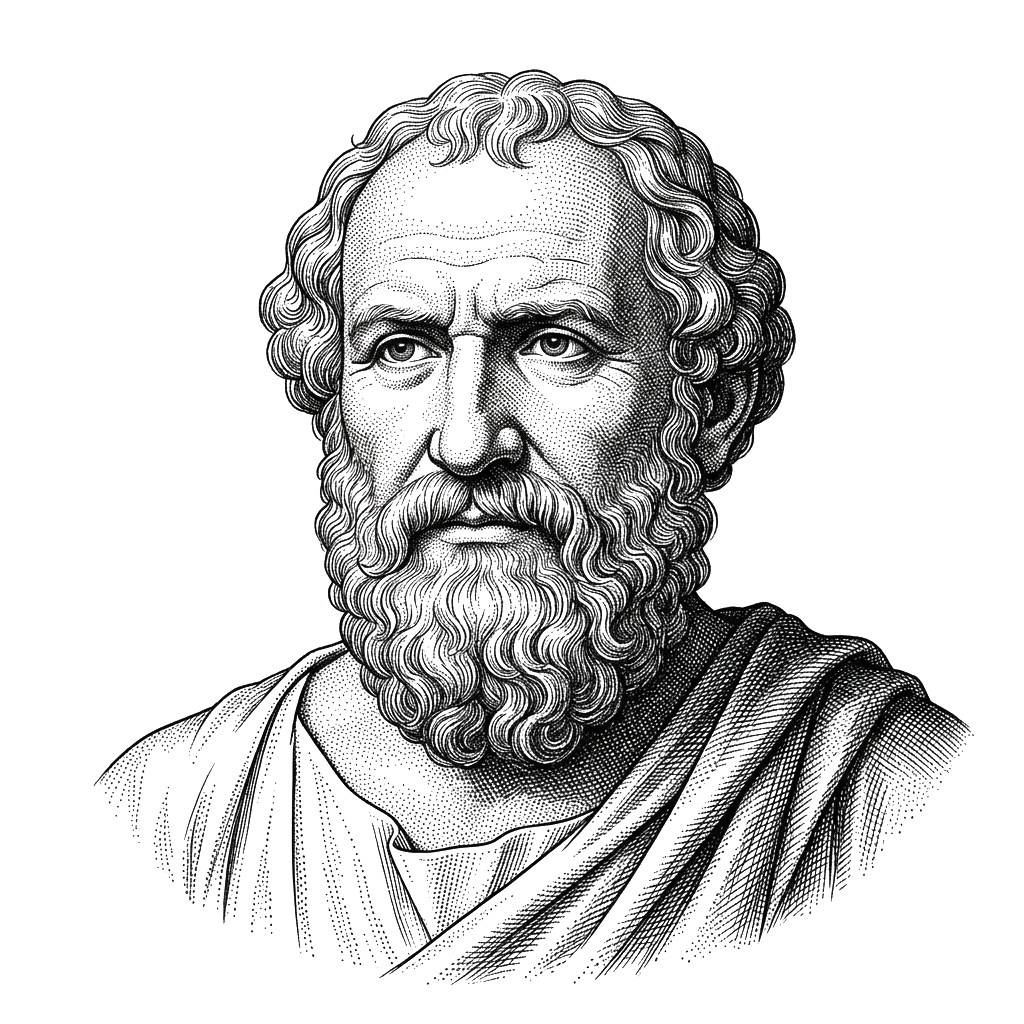
In the Sicilian sunlight of the third century before Christ, an old man in the Hellenistic city of Syracuse was known to forget his food for days at a time whenever a geometric problem seized his mind. When his servants dragged him by force to the public baths to be washed and anointed with olive oil, he would trace triangles, circles, and parabolas in the ashes of the hearth with a charred stick, or draw diagrams upon his glistening chest with his own fingernails. Archimedes did not view geometry as an abstract pastime of academic philosophers; he saw it as the sovereign, unyielding architecture of the physical universe. Where the Athenian Academy treated the material world with aristocratic disdain, preferring pure Platonic forms untainted by matter, Archimedes brought geometry down into the iron, wood, water, and stones of Syracuse. He subjected the tangible universe to the absolute authority of the scale and the compass.
Born in 287 BC, the son of the astronomer Phidias, Archimedes traveled across the Mediterranean to Alexandria to study among the disciples of Euclid before returning to his native city. There, under the patronage of King Hiero II, he became the intellectual fortress of Syracuse. Yet he held a peculiar, paradoxical contempt for his own mechanical inventions. Plutarch recorded that although his machines won him the reputation of a mind more divine than human, Archimedes refused to leave behind a single textbook on mechanical engineering, regarding the construction of engines as a sordid, mercenary craft compared to the pristine nobility of pure mathematical demonstration.
His inaugural triumph was the formulation of the law of the lever—the foundational theorem of statics. Philosophers had observed for centuries that a long beam made heavy stones easier to lift, but they explained it through vague, magical notions of circular motion. Archimedes banished all mysticism. In On the Equilibrium of Planes, he derived the principle of equilibrium not from empirical trials, but from the immutable symmetry of centers of gravity. If two unequal weights balance on a fulcrum, their distances from that fulcrum must be inversely proportional to their weights.
From this mathematical deduction flowed his celebrated, audacious boast to King Hiero: "Give me a place to stand, and I will move the Earth." When the king demanded practical proof of such mechanical omnipotence, Archimedes selected the Syracusia—a colossal, three-masted cargo ship built with twenty banks of oars, state dining rooms, and a garrison of soldiers, which had been hauled onto the shore by the collective muscle of hundreds of men. Archimedes sat calmly at a distance, seized the handle of a compound pulley system of his own design, and with a smooth, effortless motion of his hand, drew the fully loaded vessel gliding across the dry sand as smoothly as if it were riding the open sea. He had proven that human muscle, when wedded to mechanical advantage, possesses no theoretical limit.
The second pillar of his immortal legacy arose from a crisis of royal suspicion. King Hiero had delivered a measured weight of pure gold to a local goldsmith to forge a votive crown for the gods. When the crown was delivered, its weight matched the gold exactly, yet rumors whispered that the craftsman had stolen a portion of the gold and substituted an equal weight of cheaper silver. Hiero tasked Archimedes with determining the fraud without scratching, cutting, or damaging the consecrated metal.
The solution struck him not in his study, but in the public bathhouse. Stepping into a tub filled to the brim, he noticed water sloshing over the stone lip in exact proportion to the volume of his submerged body. In that flash of hydrostatic illumination, he realized that because gold is denser than silver, a crown containing silver must occupy greater volume than a crown of equal weight in pure gold, and would therefore displace a greater volume of water. Overcome with intoxicating joy, he leaped from the bath and ran naked through the streets of Syracuse toward his home, shouting the triumphant Greek cry that has echoed across centuries of human discovery: "Eureka! Eureka!"—I have found it!
In his treatise On Floating Bodies, Archimedes formalized this insight into the fundamental law of hydrostatics: any solid lighter than a fluid will, if placed in it, sink to a depth where the weight of the displaced liquid equals the total weight of the solid; and a body submerged in a fluid experiences an upward buoyant force equal to the weight of the fluid it displaces. In a world that navigated by wooden hulls and hollow oars, Archimedes had written the mathematical charter of navigation.
Yet the heights of his genius were reserved for the calculus of the infinite. In treatises that were lost for centuries until the miraculous discovery of the Archimedes Palimpsest in Constantinople in 1906, he revealed the secret engine of his mathematical discoveries: The Method of Mechanical Theorems. Long before Isaac Newton and Gottfried Wilhelm Leibniz formulated the calculus in the seventeenth century, Archimedes was slicing curved geometric solids into an infinite number of infinitely thin planar sheets, balancing those slices on an imaginary mechanical lever against simple shapes whose centers of gravity were known. Through this breathtaking mechanical integration, he discovered that the volume of a sphere is precisely two-thirds the volume of its circumscribing cylinder, and that its surface area is four times the area of its greatest circle.
To confirm these mechanical intuitions with unassailable rigor, he wielded the method of exhaustion, bounding curved shapes between inscribed and circumscribed rectilinear polygons. By calculating the perimeters of ninety-six-sided polygons inscribed within and circumscribed around a circle, he proved that the ratio of a circle’s circumference to its diameter—the constant pi—lies strictly between three and ten-seventy-firsts and three and one-seventh. He went further, inventing a numerical system in The Sand Reckoner capable of calculating the number of grains of sand required to fill the entire sphere of the universe, proving that human notation could conquer any finite infinity.
In 214 BC, during the Second Punic War, the Roman consul Marcus Claudius Marcellus arrived at Syracuse with an overwhelming armada of sixty quinqueremes and a vast siege army, expecting to crush the city in a matter of days. Instead, Rome collided with the solitary mind of Archimedes. For two years, the elderly geometer held the legions at bay with demonic mechanical ingenuity. Giant catapults flung half-ton boulders across vast distances with terrifying precision; cranes swinging from the sea walls dropped heavy lead weights through the hulls of Roman galleys; and the legendary Archimedes Claw—an articulated iron grappling hook operated by internal counterweights—surged from the battlements, seized Roman warships by the prow, lifted them vertically into the air, and shook them until their crews plunged into the sea before plunging the empty hulls to the ocean floor. Marcellus complained bitterly that he was waging war against an invisible geometric monster who used his ships like soup ladles.
Only in 212 BC, when the citizens of Syracuse were drunk during a religious festival dedicated to Artemis, did Roman soldiers scale a weakly guarded wall and breach the city. As the legions sacked the city in blood and plunder, a Roman soldier strode into the courtyard of Archimedes’ home. He found the seventy-five-year-old mathematician crouched on the pavement, his eyes fixed upon circles drawn in the sand, lost in the contemplation of a geometric proof. Archimedes shielded the sand with his hands and barked with imperial irritation: "Do not disturb my circles!"
Enraged by the old man's insolence, the legionary drew his gladius and ran him through. Marcellus, deeply grieved by the senseless murder, buried the geometer with royal honors. According to Archimedes' explicit instructions, his tomb was carved with a solitary stone cylinder circumscribing a sphere, bearing an inscription recording the two-thirds ratio of their volumes. The Roman Empire conquered the Mediterranean by the sword, but it knelt in reverence before the tomb of the geometer who had proven that the true sovereign of reality is not the legionary's iron, but the eternal proportion of the mind.
“Give me a place to stand, and I will move the Earth.”
“Eureka! Eureka! (I have found it!)”
“Do not disturb my circles.”
“Any body completely or partially submerged in a fluid is buoyed up by a force equal to the weight of the fluid displaced by the body.”
“There are things which seem incredible to most men who have not studied mathematics.”
- On the Equilibrium of Planes c. 250 BC
- Quadrature of the Parabola c. 250 BC
- On the Sphere and Cylinder c. 240 BC
- Measurement of a Circle c. 240 BC
- On Floating Bodies c. 235 BC
- The Sand Reckoner c. 230 BC
- The Method of Mechanical Theorems c. 230 BC