Winston Churchill
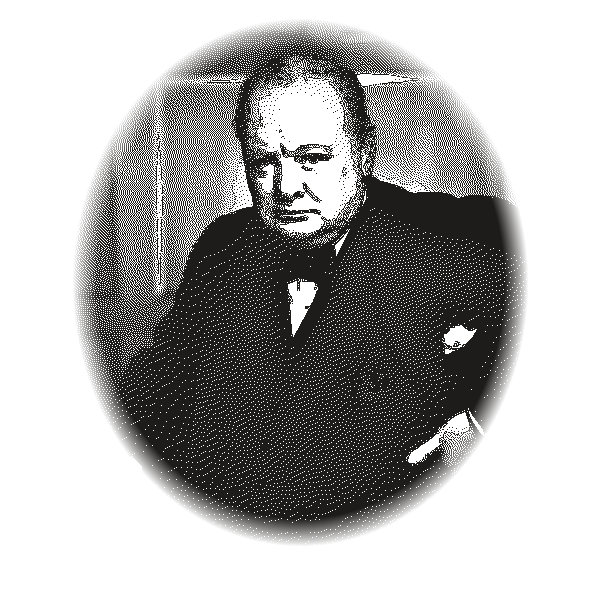
On the afternoon of Friday, May 10, 1940, as Adolf Hitler's armored panzer divisions smashed across the borders of the Low Countries and France, shattering the peace of Western Europe in an avalanche of blitzkrieg, a sixty-five-year-old political outcast walked into Buckingham Palace to kiss the hands of King George VI. Winston Leonard Spencer Churchill had spent a decade in the political wilderness, reviled by his own Conservative Party as an erratic, reactionary warmonger whose catastrophic World War I operation at Gallipoli had drowned thousands in blood, and whose lonely warnings against Nazi rearmament were dismissed as the fever dreams of an aging imperialist. Yet as Neville Chamberlain's policy of appeasement collapsed into ruins, there was only one man left in Britain whose soul was built of the iron required to face the abyss.
As Churchill later recorded in his memoirs: 'I was conscious of a profound sense of relief. At last I had the authority to give directions over the whole scene. I felt as if I were walking with destiny, and that all my past life had been but a preparation for this hour and for this trial.' Three days later, standing before a hushed House of Commons, he offered the nation neither comfort nor false promises: 'I have nothing to offer but blood, toil, tears and sweat.'
In the terrifying summer of 1940, with France fallen, the British Army evacuated naked from the beaches of Dunkirk without tanks or artillery, and the German Wehrmacht poised twenty miles across the English Channel, Britain stood completely alone. The United States was paralyzed by neutralist isolationism; the Soviet Union was bound to Nazi Germany by the Molotov-Ribbentrop Pact. Senior members of Churchill's own War Cabinet, led by Foreign Secretary Lord Halifax, urged opening negotiations with Mussolini to secure peace terms from Hitler before Britain was annihilated.
Churchill stood like a granite sea wall against capitulation. He did not merely make decisions; he mobilized the English language itself as an armored division of strategic will. Edward R. Murrow famously remarked that Churchill mobilized the English language and sent it into battle. In a sequence of parliamentary speeches that constitute the supreme masterworks of political rhetoric—'We shall fight on the beaches,' 'This was their finest hour,' 'Never was so much owed by so many to so few'—he transformed the psychological reality of an entire empire. He persuaded a battered, vulnerable island that their desperate defense was not a doomed rearguard action, but the fulcrum of human freedom. He took a frightened population and breathed into them the ancient, defiant soul of the nation.
Yet behind the magnificent, rolling prose lay an administrative and technological general of ruthless efficiency. Churchill did not govern through leisurely cabinet debates; he established the Ministry of Defence with himself at its head, flooding government departments with his legendary red-bordered action slips inscribed with the words: Action This Day. He recognized that modern warfare is an industrial contest of scientific intelligence. He created the Statistical Section under Lord Cherwell (Frederick Lindemann) to evaluate raw data, bypassed military bureaucracy to pour resources into the top-secret codebreakers at Bletchley Park under Alan Turing, and championed the operational integration of radar towers, fighter control command, and synthetic Churchill tanks.
His grand strategic vision was anchored upon two sovereign objectives: holding the British perimeter until the United States entered the war, and forging an unbreakable Grand Alliance. For eighteen agonizing months, he courted Franklin D. Roosevelt with over two thousand letters and telegrams, wooing the American president with a mixture of romantic flattery, naval urgency, and hard-headed geopolitical realism, securing the Lend-Lease Act that kept Britain's industrial lifeblood flowing.
When Hitler invaded the Soviet Union in June 1941, Churchill—who had spent twenty years denouncing Bolshevism as a foul baboonery—reversed geopolitical stance without blinking an eye: 'If Hitler invaded Hell, I would make at least a favorable reference to the Devil in the House of Commons.' Following the Japanese attack on Pearl Harbor in December 1941, Churchill traveled across the Atlantic to spend Christmas at the White House. That night, he wrote: 'I went to bed and slept the sleep of the saved and thankful.' The Grand Alliance was formed; Nazi defeat had become a mathematical certainty.
Yet as the war entered its final phase, Churchill's eyes looked past the smoking ruins of Berlin to see the emerging geopolitical tragedy. At the Yalta and Potsdam conferences in 1945, battling ill health and exhaustion, he watched helplessly as Joseph Stalin's Red Army swallowed Poland, Czechoslovakia, Hungary, and the Balkans behind a ring of bayonets. In July 1945, in the midst of the Potsdam conference, the British electorate delivered an astonishing verdict: weary of wartime austerity, they voted Churchill out of office in a landslide Labor victory. The warrior who had saved civilization was dismissed by his own people.
He accepted the defeat with dignified stoicism, retreating to his study at Chartwell to paint landscapes and write his six-volume history of The Second World War, which would win him the Nobel Prize in Literature in 1953. But he was not done with world history. In March 1946, traveling to Fulton, Missouri, with President Harry Truman, he delivered the historic 'Sinews of Peace' address, diagnosing the new geopolitical era with prophetic clarity: 'From Stettin in the Baltic to Trieste in the Adriatic, an iron curtain has descended across the Continent.' In that single phrase, he named the Cold War and laid the conceptual foundation for the North Atlantic Treaty Organization (NATO) and the defense of the Western democracies.
Winston Churchill died at his London home in January 1965 at the age of ninety. His state funeral was the largest in British history, watched by 350 million people across the globe, with representatives from 112 nations gathering beneath the dome of St. Paul's Cathedral. As his coffin was carried down the Thames on the launch Havengore, the massive dockside cranes of London dipped their jibs in silent salute to the old lion.
Today, Winston Churchill stands as the supreme architect of democratic defiance: the statesman who proved that when moral clarity, strategic vision, and rhetorical mastery are fused within a single indomitable human will, one man can alter the trajectory of human history and save civilization from the dark ages.
“We shall fight on the beaches, we shall fight on the landing grounds, we shall fight in the fields and in the streets, we shall fight in the hills; we shall never surrender.”
“Never in the field of human conflict was so much owed by so many to so few.”
“If you are going through hell, keep going.”
“History will be kind to me for I intend to write it.”
“From Stettin in the Baltic to Trieste in the Adriatic, an iron curtain has descended across the Continent.”
- The Story of the Malakand Field Force 1898
- The World Crisis (6 volumes) 1923-1931
- Marlborough: His Life and Times (4 volumes) 1933-1938
- War Speeches (Blood, Toil, Tears and Sweat; Finest Hour) 1940
- The Second World War (6 volumes) 1948-1953
- A History of the English-Speaking Peoples (4 volumes) 1956-1958