William Harvey
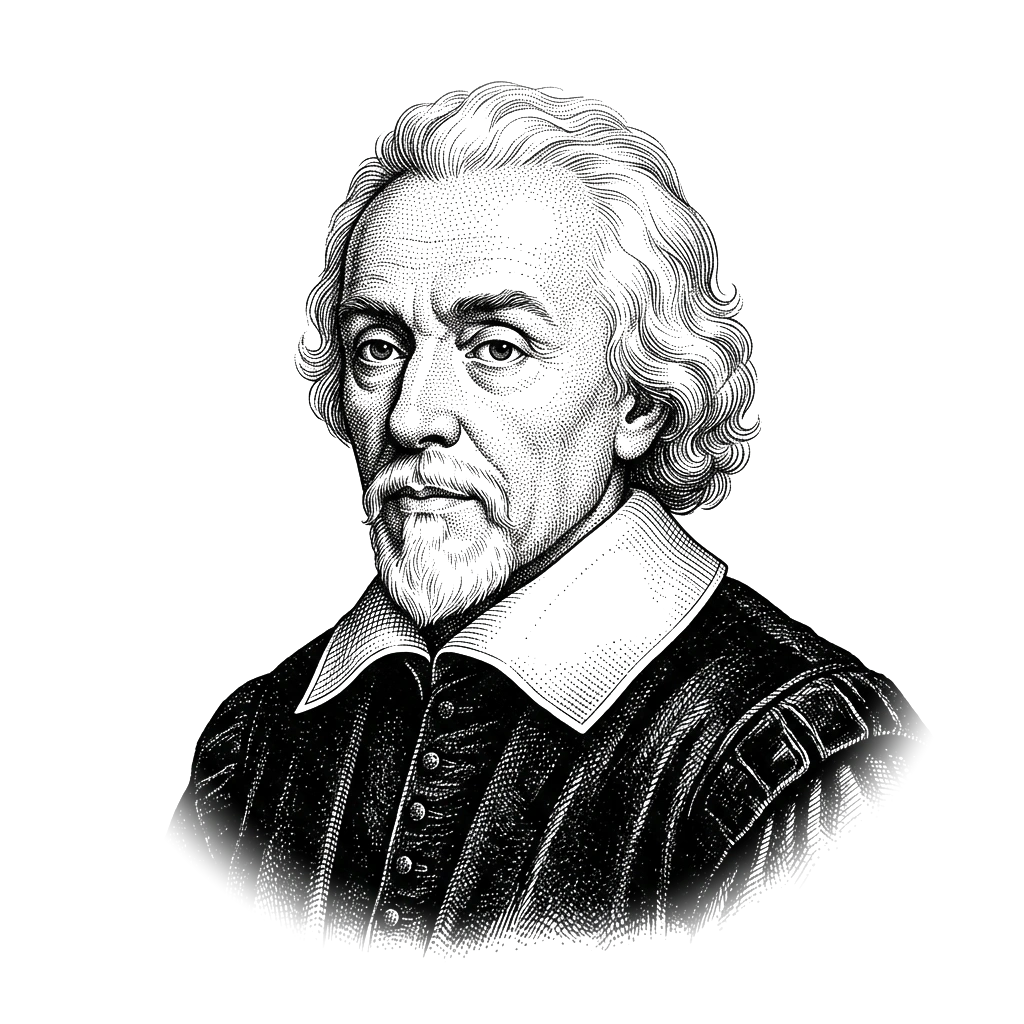
In the anatomical theater of the College of Physicians in London, in the damp spring of 1616, a short, dark-eyed physician with curly black hair and a quick, restless hand stood over the dissected body of a freshly hanged criminal. William Harvey had spent twelve years since his return from the University of Padua performing relentless vivisections on hundreds of living animals—dogs, pigs, toads, eels, serpents, and oysters—watching the rhythmic flutter of the dying heart slow to a visible crawl. For fourteen hundred years, Western medicine had been governed by the undisputed dogma of Claudius Galen: that food was converted by the liver into dark venous blood that ebbed and flowed through the veins to nourish the limbs, while the heart generated bright arterial blood charged with "vital spirits" that washed back and forth like the tides of the sea.
As Harvey dissected the beating ventricles and tested the delicate one-way membranous valves of the heart, Galen’s tidal ebb-and-flow dissolved before his eyes. He performed a simple, devastating mathematical calculation: measuring the volume of the left ventricle of a human heart, he found it holds roughly two ounces of blood. Beating seventy-two times a minute, the heart propels over five hundred pounds of blood into the aorta every hour—far more than the entire body weight of a human being, and vastly more than could ever be produced by the digestion of food in the liver. Where could this immense mountain of blood come from, and where could it go? "I began to think," Harvey wrote, "whether there might not be a motion, as it were, in a circle."
Born in Folkestone, Kent, in 1578, the eldest son of an Elizabethan merchant and mayor, Harvey had attended King's College, Canterbury, and Cambridge, before journeying to Padua—the undisputed capital of Renaissance anatomical science. There, in the steep wooden tiers of the oval anatomy theater, Harvey studied under Girolamo Fabrizi d'Acquapendente (Fabricius). Fabricius had discovered the tiny membranous "doors" or valves inside human veins, but erroneously assumed their purpose was merely to prevent blood from pooling in the lower extremities under the pull of gravity.
Harvey recognized that Fabricius had discovered the mechanical lock of a circular pump. In his famous, deceptively simple experiment on the human forearm, Harvey tied a tight tourniquet above the elbow until the veins swelled, then pressed a thumb along a vein to push the blood toward the heart. The vein emptied and remained flat; blood would not flow backward toward the fingers because the venous valves snapped shut like hydraulic floodgates. The blood could move in only one direction: through the arteries outward from the heart to the periphery, and through the veins inward from the periphery back to the heart.
In 1628, at a small printing shop in Frankfurt, Germany, Harvey published his seventy-two-page Latin masterwork: Exercitatio Anatomica de Motu Cordis et Sanguinis in Animalibus (Anatomical Treatise on the Motion of the Heart and Blood in Animals). It was the foundational charter of modern experimental physiology. Harvey approached the body not as a mystical vessel of astrological humors and vital spirits, but as a hydrodynamic mechanical engine governed by quantitative measurements, pressures, and hydraulic valves. The heart was not a furnace or a seat of the soul; it was a muscular force pump.
Yet Harvey’s theory faced one acute physical absence: with the naked eye, he could not see how blood passed from the smallest arterial branches into the beginnings of the venous return. Galenists mocked him, demanding to know how the blood crossed the barrier. Harvey stood firmly on his quantitative proof: the hydrodynamic mathematics proved that the crossing was necessary, postulating the existence of microscopic, invisible "porosities of the flesh." Thirty-three years later, in 1661, the Italian anatomist Marcello Malpighi, examining the lung of a frog through the newly invented microscope, observed the capillaries—the tiny vessels Harvey had deduced by pure physical logic.
The publication of De Motu Cordis brought fierce professional ostracism. Conservative physicians throughout Europe denounced Harvey as a dangerous heretic, mocking him as the "Circulator"—a pun meaning both one who believes in blood circulation and an itinerant charlatan or quack. Colleagues reported that Harvey lost half his medical practice in London because wealthy patients feared submitting their bodies to a physician who challenged the ancient authorities.
Harvey remained unperturbed, taking refuge in royal patronage. As personal physician to King Charles I, Harvey accompanied the King on hunting expeditions, dissecting deer in the royal forests to observe uterine development and embryonic growth. During the English Civil War, at the Battle of Edgehill in 1642, Harvey was tasked with caring for the royal princes (the future Charles II and James II); while cannonballs plowed into the ground around them, Harvey sat calmly behind a hedge reading a book until the battle swept past. When the Parliamentarian army looted his lodgings at Whitehall, destroying years of irreplaceable research papers on the generation of insects and birds, Harvey wept, calling it the greatest sorrow of his life.
In his later years, Harvey turned his experimental method to embryology, publishing Exercitationes de Generatione Animalium in 1651, asserting the revolutionary biological axiom Ex ovo omnia—all life comes from an egg. He died peacefully in London on June 3, 1657, at the age of seventy-nine, having lived to see his doctrine of blood circulation formally accepted into medical schools across Europe.
William Harvey did for the human body what Galileo and Kepler did for the solar system: he cast aside scholastic book authority and submitted the living world to quantitative experiment and physical demonstration. By transforming medicine from a literary commentary on ancient texts into an empirical, physical science of living systems, Harvey laid the foundation of modern cardiovascular medicine, proving that the human heart, like the cosmos itself, obeys the universal laws of physical nature.
“I began to think whether there might not be a motion, as it were, in a circle.”
“I profess to learn and to teach anatomy, not from books, but from dissections; not from the positions of philosophers, but from the fabric of nature.”
“All we know is still infinitely less than all that remains unknown.”
“Nature is nowhere accustomed more openly to display her secret mysteries than in cases where she shows traces of her workings apart from the beaten path.”
“It were disgraceful, with this most spacious and admirable realm of nature before us, and where the reward ever exceeds the promise, to give up the search.”
- Exercitatio Anatomica de Motu Cordis et Sanguinis (On the Motion of the Heart and Blood) 1628
- Exercitationes de Generatione Animalium (On the Generation of Animals) 1651
- De Circulatione Sanguinis (Two Anatomical Exercises Addressed to Jean Riolan) 1649
- Prelectiones Anatomiae Universalis (Lumleian Lectures Notes) 1616
- Anatomical Examination of Thomas Parr 1635