Meister Eckhart
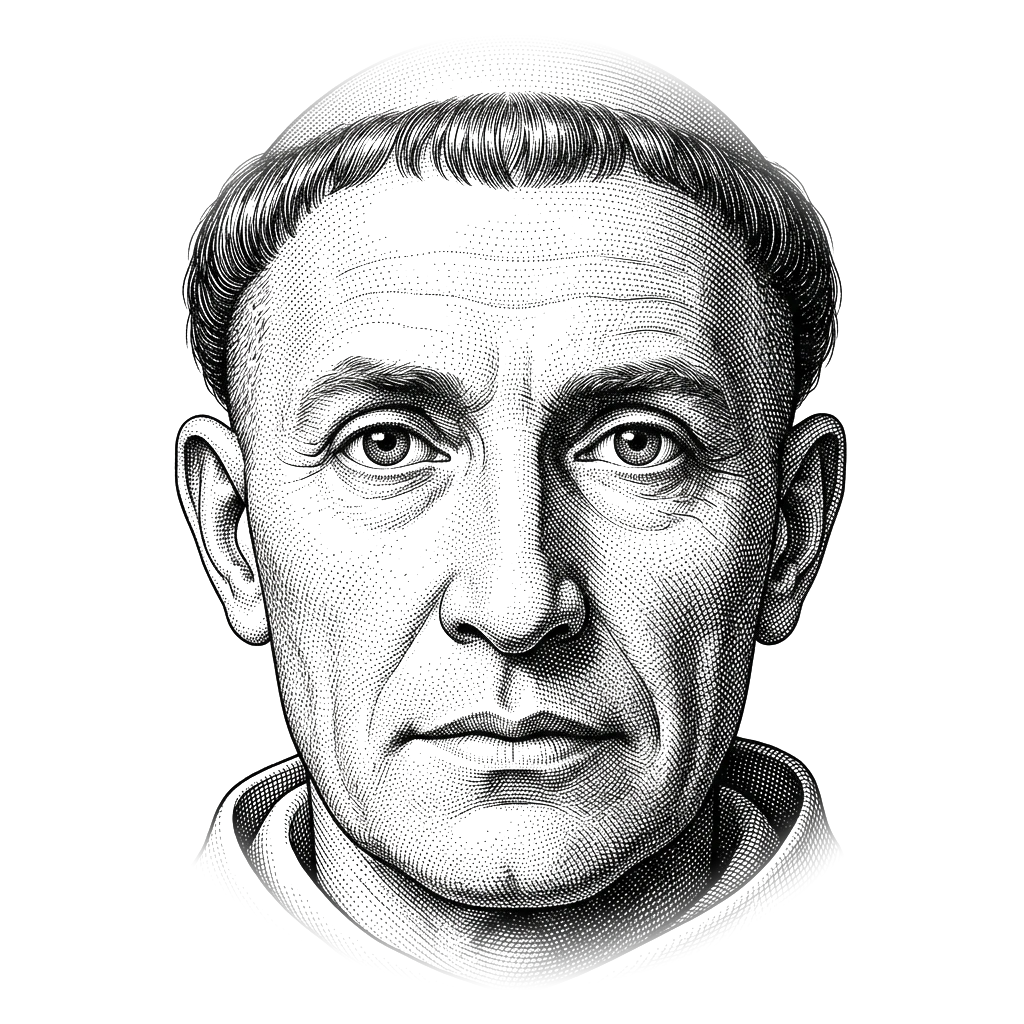
In fourteenth-century Europe, religion operated as a vast commercial exchange. The faithful calibrated their spiritual ledgers: prayers bought years out of purgatory, penances accumulated merit, and altar offerings secured protection against plague and damnation. God was treated as a celestial merchant—an external sovereign who monitored debts and bartered blessings for obedience.
Eckhart von Hochheim, the Dominican Master of Sacred Theology known simply as Meister Eckhart, looked at this economy of piety and recognized a catastrophic mistake.
The faithful, he observed, did not love God. They loved themselves through an instrument called God.
"Some people want to see God with their eyes as they see a cow, and to love God as they love a cow," Eckhart warned in the German vernacular. "You love a cow for its milk and cheese and your own profit. Thus do all who love God for outward riches or inward comfort. They do not truly love God; they love their own advantage."
Eckhart’s intervention was not a plea for moral reform or stricter asceticism. It was an intellectual demolition of the transactional ego. Where the Church saw an economy of salvation requiring mediation and ritual, Eckhart saw a psychological illusion. As long as consciousness relates to an external deity across a distance of desire, fear, or utility, it is worshipping a projection of its own self-interest.
To liberate human awareness from this spiritual commerce, Eckhart formulated a rigorous practice: Abgeschiedenheit (pure detachment) and Gelassenheit (releasement, or letting-be).
Detachment, in Eckhart's vocabulary, is not ascetic self-punishment, stoic apathy, or depressive withdrawal. It is the active dismantling of inner grasping.
The human mind habitually operates through instrumentality: it values an action, a person, or a belief not for what it is, but for what it can procure. We pray in order to be consoled; we practice virtue in order to secure heaven. For Eckhart, this in order to—this endless causal conditioning—is the very mechanism of human imprisonment. It keeps the soul locked in time, contingency, and lack.
Against this, Eckhart proposed living sunder warumbe—"without a why."
"If you ask a genuine person, one who acts from their own ground: 'Why are you doing what you are doing?' they will answer: 'I do it because I do it,'" Eckhart preached. "The rose is without a why; it blooms because it blooms. It pays no heed to itself, asks not whether anyone sees it."
To live without a why is not to act irrationally. It is to act from an unconditioned center, free from the hunger for validation or spiritual compensation. The detached person works, creates, or comforts a neighbor not as an investment in a future reward, but because the act is its own complete realization. The moment an ulterior motive enters, you step outside the ground of reality and reduce existence to a tool.
True Gelassenheit—a term Eckhart coined that would later haunt Western philosophy from Johannes Tauler to Martin Heidegger—is radical releasement. It means relinquishing not only material wealth and worldly ambition, but something far more insidious: spiritual ambition. The seeker who strives aggressively to become holy, collecting virtues like rare coins, remains just as trapped in egoic ownership as the miser hoarding gold. True releasement requires becoming ledig—utterly empty, unimpeded, and open.
Having dismantled the transactional ego, Eckhart pushed his analysis to its ultimate epistemological conclusion: the collapse of subject-object duality.
Scholastic theology posited an unbridgeable ontological gulf between the finite creature on earth and the infinite Creator in heaven. Man was an observer standing outside God, praying toward a transcendent Other.
Eckhart dismantled this division entirely. The gap between the human observer and the divine object, he argued, is an artifact of dualistic thinking. In the deep core of consciousness—what he termed the Seelengrund (the ground of the soul)—there is no separation:
"The eye through which I see God is the same eye through which God sees me; my eye and God's eye are one eye, one seeing, one knowing, one love."
This was not poetic exaggeration; it was a precise description of non-dual awareness. In pure awareness, the distinction between knower and known dissolves. The act of seeing does not belong to a private "I" gazing across a distance at a separate "God." When the mind drops its concepts, memories, and self-defensive identities, observing consciousness and the observed ground are recognized as identical. The ground of God and the ground of the soul are one indivisible reality.
From this collapsed boundary arose Eckhart's most daring distinction: the difference between "God" (Gott) and the "Godhead" (Gottheit).
"God," Eckhart explained, is the deity relative to human thought—the personal, named, relational creator who acts, judges, and enters into covenants. God, in this sense, is born when creatures are born; He is God for us. But beneath this conceptual deity lies the Gottheit: the unmanifest, unconditioned abyss (abgrunt), utterly nameless, silent, and prior to all division, form, and thought.
To reach this unconditioned reality, Eckhart insisted that the seeker must execute a radical inward Durchbruch—a breakthrough:
"Therefore, I pray to God to make me free of God."
The soul must let go even of its idea of God. Every doctrine, mental image, and religious symbol is a raft constructed by the intellect. To mistake the raft for the ocean is idolatry. One must break through the projected God of human religion to sink into the uncreated desert of the Godhead, where no personal "I" remains to claim enlightenment.
In 1326, the ecclesiastical hierarchy in Cologne moved against him. Threatened by a teaching that rendered priests, sacraments, and indulgences superfluous, Archbishop Heinrich von Virneburg charged Eckhart with heresy. Eckhart defended himself with forensic brilliance, arguing that his dialectical formulations were orthodox scholastic metaphysics, but he died around 1328 before the final verdict arrived. In March 1329, Pope John XXII issued the bull In Agro Dominico, condemning twenty-eight of his propositions as heretical or dangerous.
The papacy could censor his sentences, but it could not refute his seeing. Meister Eckhart had exposed the central mechanism of religious delusion: that the greatest obstacle between human consciousness and ultimate reality is the ego's persistent effort to possess it. Reality is not an object to be attained, an altar to be bribed, or a heaven to be earned. It is the unconditioned ground that remains when every transaction has ceased.
“The eye through which I see God is the same eye through which God sees me; my eye and God's eye are one eye, one seeing, one knowing, one love.”
“If the only prayer you ever say in your entire life is thank you, it will be enough.”
“The rose is without why; it blooms because it blooms, it cares not for itself, asks not if it is seen.”
“Man should not have an imaginary God... Therefore I pray God to rid me of God.”
“God is not found in the soul by adding anything, but by a process of subtraction.”
- German Sermons (Deutsche Predigten) c. 1298–1326
- The Book of Divine Consolation (Liber Benedictus) c. 1308
- On Detachment (Von der Abgeschiedenheit) c. 1310
- Opus Tripartitum and Parisian Questions 1302–1313