Euclid of Alexandria
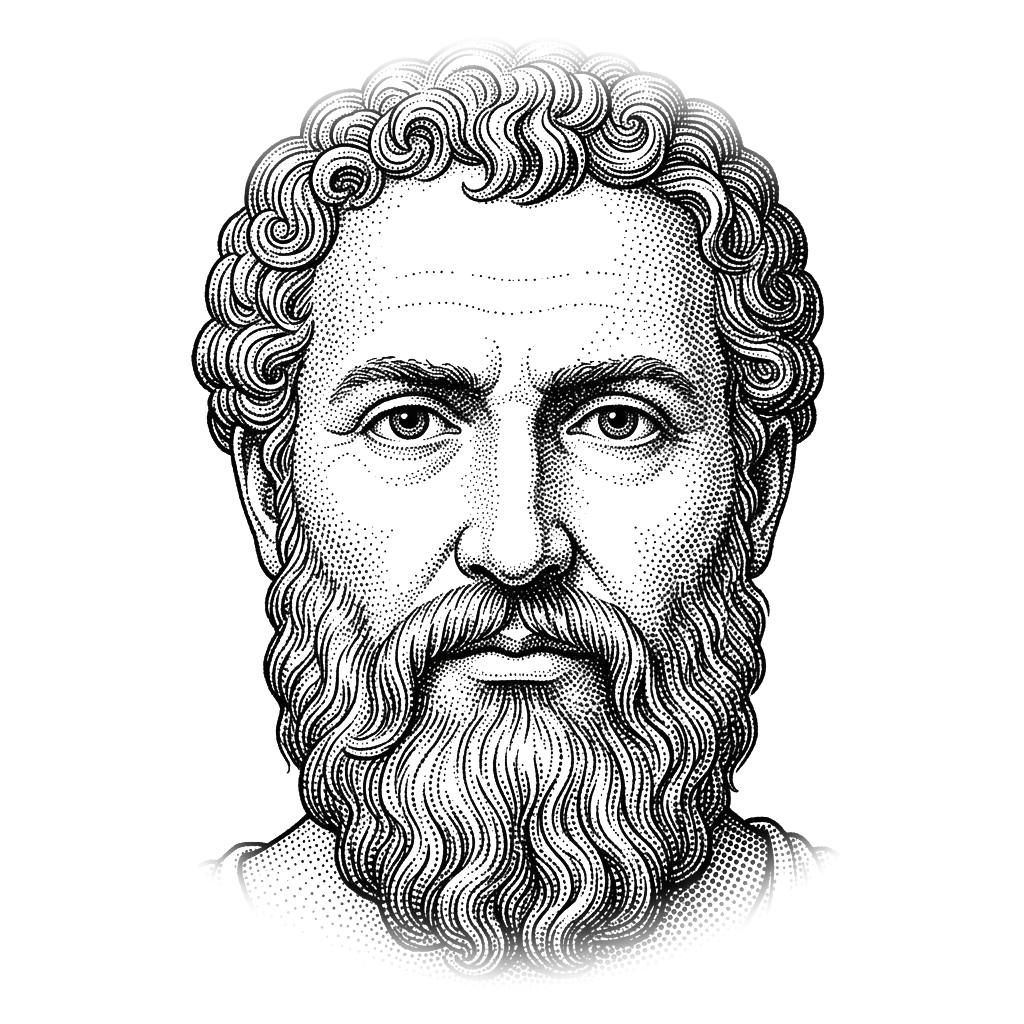
In the marble porticoes of the Mouseion of Alexandria, around the year 300 BC, under the patronage of Ptolemy I Soter, an unassuming Greek geometer laid the foundations of formal human thought. Alexandria was the brilliant, chaotic intellectual capital of the Mediterranean world—a city where Macedonian conquerors, Egyptian priests, Phoenician sea-captains, and Greek philosophers collided in the shadow of the Pharos lighthouse. Yet amid the clamor of dynastic ambitions and empirical trading inventories, Euclid pursued a quiet, absolute clarity. When King Ptolemy, frustrated by the laborious concentration required to master the geometric proofs, asked whether there might not be an easier, shorter route to the understanding of geometry, Euclid offered the legendary, uncompromising reply: "Sire, there is no royal road to geometry."
Virtually nothing is known of Euclid's personal biography; his contemporaries left no anecdotes of his lineage, his lovers, or his death. He survives entirely within the transparent monument of his thought. Born in the aftermath of Alexander the Great's conquests, Euclid absorbed the mathematical heritage of the Pythagorean brotherhood, the dialectical rigor of Plato’s Academy, and the astronomical discoveries of Eudoxus. In Alexandria, he gathered, purged, organized, and elevated two centuries of fragmented Mediterranean mathematical speculation into a thirteen-book compilation entitled The Elements (Stoicheia). In doing so, he did not merely compile geometric theorems; he invented the axiomatic method.
The revolutionary architectural leap of The Elements was its structural starting point. Euclid did not begin with ornate philosophical assertions, theological invocations, or empirical approximations measured with ropes and rulers. He began with radical, bare simplicity: twenty-three definitions, five common notions, and five postulates. A point is that which has no part; a line is breadthless length; a straight line lies evenly with the points on itself. These were not verifiable physical objects that could be dug up with a shovel or weighed on a scale; they were pristine ideal structures grasped purely by the eye of the intellect.
From this bedrock of five simple postulates—such as the ability to draw a straight line from any point to any point, and to describe a circle with any center and radius—Euclid constructed an ascending, impregnable skyscraper of deductive reasoning. In Proposition 47 of Book I, he reached the Pythagorean Theorem, demonstrating through an ingenious dance of sheared parallelograms that the square on the hypotenuse of a right-angled triangle equals the sum of the squares on the other two sides. Every subsequent proposition rested exclusively on those that had preceded it; to doubt the four-hundred-and-sixty-fifth proposition required dismantling the entire chain back to the foundational postulates.
Yet the masterpiece contained a haunting, subtle crack that would stimulate mathematical inquiry for two millennia: the Fifth Postulate, the Parallel Postulate. Unlike the elegant, self-evident simplicity of the first four postulates, the Fifth Postulate was long, cumbersome, and suspiciously phrased like a theorem: if a straight line falls across two other straight lines so as to make the interior angles on the same side less than two right angles, the two lines, if produced indefinitely, must eventually meet on that side. For twenty-two centuries, the greatest mathematicians—from Ptolemy and Ibn al-Haytham to Omar Khayyam, Saccheri, and Gauss—struggled to prove the Fifth Postulate from the other four, suspecting Euclid had erred in admitting it as an unproven axiom.
Euclid’s genius was vindicated precisely by his stubborn honesty. He delayed using the Fifth Postulate until Proposition 29 of Book I, proving everything he possibly could without it. When nineteenth-century geometers Lobachevsky, Bolyai, and Riemann finally realized that the Fifth Postulate could be denied without contradiction, they unlocked non-Euclidean geometry—curved spaces that would eventually provide Albert Einstein with the Riemannian metric tensor needed to formulate the General Theory of Relativity. Euclid had not failed; his axiomatic architecture was so diamond-pure that altering a single postulate generated entire alternate universes.
The Elements was far more than a treatise on triangles, circles, and polyhedra; Books VII through IX pioneered foundational number theory. Here, Euclid formulated the Euclidean Algorithm for finding the greatest common divisor of two integers—one of the earliest and most efficient algorithms in human history, still humming in the microprocessors of modern cryptography. In Book IX, Proposition 20, Euclid proved that prime numbers are more numerous than any assigned multitude of prime numbers: the infinity of primes, demonstrated through an indirect proof (reductio ad absurdum) of crystalline elegance.
In Book XIII, Euclid brought his thirteen-book symphony to its cosmological climax: the construction and proof of the five regular Platonic solids—the tetrahedron, the octahedron, the cube, the icosahedron, and the dodecahedron. He demonstrated that there can exist exactly five, and only five, regular convex polyhedra in three-dimensional space. The entire journey from a dimensionless point in Book I had arrived at the complete structural classification of spatial harmony.
The cultural footprint of Euclid’s Elements is rivaled in human history only by the Bible. More than a thousand editions have appeared in print since the invention of the printing press in 1482. For eighty generations of scholars, thinkers, and builders, studying Euclid was synonymous with learning how to think. When Spinoza structured his Ethics "in the geometric order" (more geometrico), when Isaac Newton formulated the Principia Mathematica, and when Abraham Lincoln paced by candlelight in Illinois memorizing Euclid to train his legal mind in the art of proof, they were walking inside Euclid’s mind.
Euclid bestowed upon our species the exhilarating realization that human reason, disciplined by logical coherence, can attain unassailable truth. Empires crumble, cities sink into the sea, and political creeds fade into forgotten myths; but the proof that the angles of a triangle equal two right angles in flat space remains as pristine and unshakeable today as when Euclid dipped his reed pen into ink in Alexandria twenty-three centuries ago. He gave humanity the grammar of spatial necessity.
“There is no royal road to geometry.”
“The laws of nature are but the mathematical thoughts of God.”
“A point is that which has no part.”
“A line is breadthless length.”
“If two lines intersect, the vertically opposite angles are equal.”
- The Elements (Stoicheia, 13 Books) c. 300 BC
- Data c. 300 BC
- Optics (Optika) c. 300 BC
- Phenomena (Phaenomena) c. 300 BC
- On Divisions of Figures c. 300 BC