Elinor Ostrom
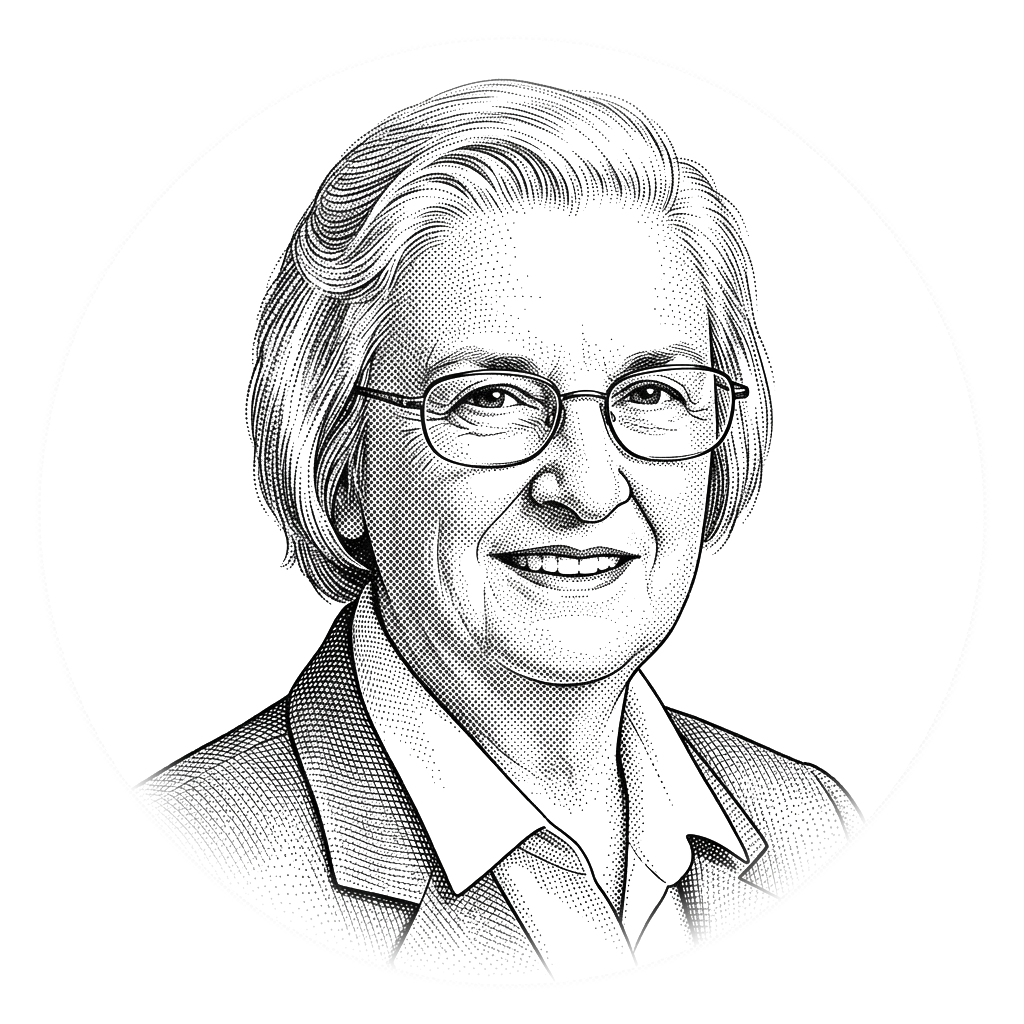
On a bright summer morning in the high mountain valleys of Törbel in the Swiss Alps, an American political economist walked among stone irrigation channels that had carried glacier runoff to terraced rye fields since the year 1483. Down in university economics departments across the world, standard economic dogma taught that common-pool resources—shared grazing pastures, communal forests, coastal fisheries, and groundwater basins—were doomed to inevitable destruction. Garrett Hardin’s famous 1968 thesis, "The Tragedy of the Commons," had codified this fatalism into a rigid mathematical axiom: rational, self-interested individuals sharing an open pasture will inevitably graze more and more cows until the grass is stripped bare and the community starves. Economists insisted there were only two possible cures: either private ownership and fence-building, or coercive top-down state regulation.
Elinor Ostrom stood in Törbel looking at communal alpine pastures that had been managed continuously by a council of local villagers for five hundred years without ever being overgrazed, without being privatized by corporate cartels, and without a single government commissar in Bern telling them how many cows to turn out on the grass. As she documented identical thriving communal systems among centuries-old irrigation huertas in Valencia, mountain forests in Japan, and coastal lobster fisheries in Maine, Ostrom arrived at the empirical realization that shattered five decades of economic orthodox theory: "A core effort in my life has been to demonstrate that the tragedy of the commons is not an inescapable fate."
Born in Los Angeles in 1933 during the depths of the Great Depression, the daughter of a set designer and a musician who divorced early, Ostrom grew up in poverty, tending a Victory garden to put food on the family table. When she entered UCLA to study political science, faculty advisors actively discouraged her from pursuing a doctorate, warning that women had no future in academic economics or political science. Denied admission to economics because she lacked advanced mathematics, Ostrom entered political science, where she conducted fieldwork on groundwater basins in Southern California. She observed that when salt water began intruding into the coastal aquifer, competitive local water pumpers did not race to drain the basin to extinction; instead, they formed voluntary water associations, negotiated court settlements, monitored each other's pumping meters, and taxed themselves to refill the basin.
In 1973, moving with her husband and intellectual partner Vincent Ostrom to Indiana University in Bloomington, they co-founded the Workshop in Political Theory and Policy Analysis. The Workshop was an intellectual greenhouse: combining game theory, experimental laboratory economics, and meticulous empirical field research across the globe. Ostrom rejected what she called "the view from 30,000 feet"—simplistic blackboard economic models that reduced complex human beings to hyper-rational, atomized calculators (Homo economicus). Instead, she insisted on getting dust on her boots, examining the nuanced, uncodified rules that real human communities develop through generations of trial, error, and shared struggle.
In her 1990 masterwork, Governing the Commons: The Evolution of Institutions for Collective Action, Ostrom introduced the world to the concept of "polycentric governance." Humans are not helpless prisoners of the Prisoner’s Dilemma, she argued; they are adaptive, social problem-solvers capable of self-organization, face-to-face communication, and building trust through reciprocal norms. Through an exhaustive cross-cultural analysis of hundreds of long-enduring common-pool resource institutions, Ostrom identified Eight Core Design Principles that characterize successful self-governing commons.
These principles were neither socialist state planning nor laissez-faire privatization: clearly defined community boundaries, rules adapted to local ecological conditions, collective-choice arrangements allowing users to participate in rule-making, effective monitoring by accountable monitors, graduated sanctions that start with gentle social pressure before escalating, low-cost dispute-resolution mechanisms, official state recognition of local authority, and nested enterprises for large-scale systems. Where these eight conditions were met, communities successfully stewarded scarce natural resources for centuries; where top-down governments intervened to nationalize the commons, local monitoring collapsed, corruption flourished, and the resources were decimated.
Ostrom took her insights from remote villages into advanced behavioral laboratory experiments. Bringing students and community members into computer labs to play common-pool resource games, she demonstrated that when players were forbidden from communicating, they overharvested the resource, confirming standard economic predictions. But the moment players were allowed just ten minutes of face-to-face conversation between rounds—with no legally binding contracts and no police enforcement—cooperation skyrocketed to near-optimal levels. Communication allowed humans to assess trustworthiness, formulate joint agreements, and shame defectors.
In 2009, the Royal Swedish Academy of Sciences awarded Ostrom the Nobel Memorial Prize in Economic Sciences, citing her "analysis of economic governance, especially the commons." She was the first woman in history to win the economics Nobel. The announcement stunned the male-dominated economics establishment, many of whom admitted they had never read her work because it was grounded in political science and field anthropology rather than abstract mathematical econometrics. Ostrom remained completely unpretentious, insisting that the prize belonged equally to her colleagues and students at the Bloomington Workshop. When she addressed the international press, she offered a classic, disarming summary of her life's work: "What works in practice can work in theory."
Diagnosed with pancreatic cancer in late 2011, Ostrom refused to slow down. From her hospital bed, she continued reviewing doctoral dissertations, mentoring researchers, and completing her final paper, "Green from the Grassroots," prepared for the United Nations Rio+20 Earth Summit. She died on June 12, 2012, at the age of seventy-eight, in Bloomington, Indiana.
Elinor Ostrom transformed the intellectual landscape of modern social science. In an era paralyzed by global ecological crises—from ocean plastic pollution to atmospheric greenhouse gas accumulation—Ostrom proved that humanity is not condemned to destroy its shared home. She demonstrated that human beings possess a vastly richer institutional repertoire than the false binary of "the Market versus the State." She gave us the scientific proof that trust, communication, and polycentric democratic institutions can govern the shared treasures of the earth, proving that ordinary people, when granted the freedom and dignity to govern themselves, can rise to become wise custodians of the world.
“A core effort in my life has been to demonstrate that the tragedy of the commons is not an inescapable fate.”
“What works in practice can work in theory.”
“There is no reason to believe that bureaucrats and politicians, no matter how well-meaning, are better at solving problems than the people on the ground.”
“Institutions are the rules of the game in a society or, more formally, are the humanly devised constraints that shape human interaction.”
“We need to recognize that human beings are capable of self-organization, of communicating, and of building trust.”
- Governing the Commons 1990
- Understanding Institutional Diversity 2005
- Rules, Games, and Common-Pool Resources 1994
- Beyond Markets and States: Polycentric Governance 2010
- Working Together: Collective Action and the Commons 2010