Douglas Engelbart
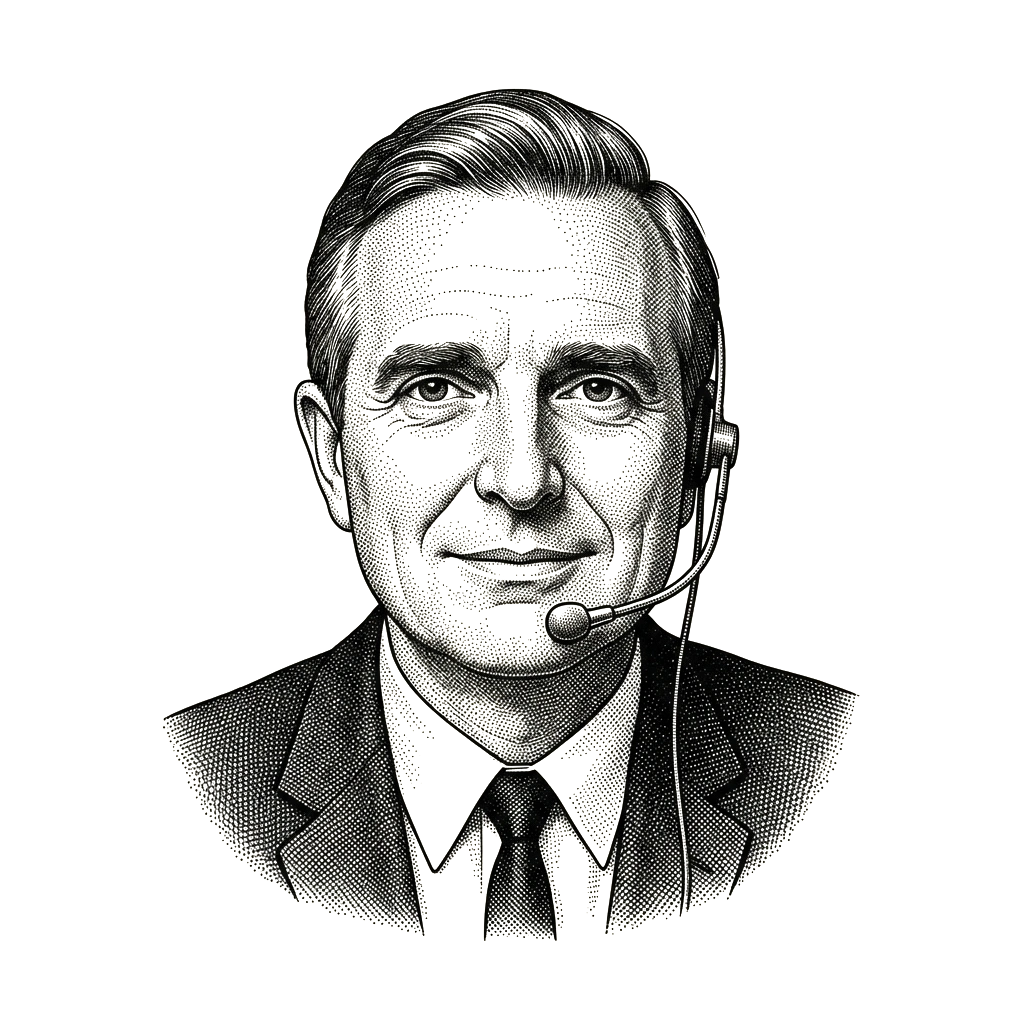
In the winter of 1950, twenty-five-year-old electrical engineer Douglas Engelbart was driving through the orchards of Santa Clara Valley toward the Ames Aeronautical Laboratory. Having recently become engaged, he looked across the four decades of his working future and realized he had no ambition beyond steady employment. Sitting in his car, Engelbart made a quiet, lifetime wager: he would dedicate his career to expanding human capacity to solve complex, urgent problems.
His reasoning was direct. Modern civilization was generating challenges—geopolitical conflict, environmental strain, technological disruption—whose scale and rate of change outpaced the biological cognitive limits of individual human beings. If humanity attempted to manage planetary systems with biological hardware shaped for local survival, catastrophe was mathematically certain.
The imperative was to amplify human problem-solving capacity before complexity overwhelmed it.
In 1950, digital computing was an industrial specialty. A computer was a building-sized batch processor: a fortress of vacuum tubes digesting decks of punched cards to calculate ballistics tables or payroll ledgers. Humans interacted with these machines at remote arm's length. An engineer submitted a card deck, waited hours for green-bar printouts, caught a misplaced punch, and submitted the deck again. The machine was conceived strictly as an automated calculator or an electronic clerk.
During World War II, however, Engelbart had served as a naval radar technician at an island outpost in the Philippines. In a quonset hut above Leyte Gulf, he had spent months servicing cathode-ray screens that converted invisible electromagnetic echoes into dynamic, radiant representations of physical space.
On that California highway, his radar memories fused with digital computing. If radar could paint moving ships on a phosphor screen in real time, a digital computer could paint symbols, concepts, and relationships. If an operator sat at a console, steering those symbols through physical controls, the computer would cease to be a batch calculator.
It would become an interactive prosthetic for the human intellect.
In October 1962, following a decade of institutional skepticism at the Stanford Research Institute (SRI), Engelbart published the foundational manifesto of interactive computing: Augmenting Human Intellect: A Conceptual Framework.
The document opened with a decisive rejection of classical artificial intelligence. At MIT and Dartmouth, computer scientists sought automation—constructing autonomous electronic minds to replace human decision-makers. Engelbart regarded machine autonomy as both an engineering distraction and a profound category error.
The goal was not automation, which displaces human agency, but augmentation, which multiplies it.
Engelbart framed the augmented mind as an integrated system he termed H-LAM/T: a Human operating within a matrix of Language, Artifacts, Methodology, and Training.
Language supplies the conceptual symbols used to construct internal models. Artifacts are the physical instruments that extend sensory and motor reach. Methodology provides the structured heuristics and procedures governing intellectual work. Training shapes the neural pathways and physical reflexes required to wield artifacts and methodologies instinctively.
A human mind stripped of this external scaffolding is biologically modest. An illiterate person handed pencil and paper cannot perform long division; an educated person with those exact tools can calculate orbital trajectories. The biological mind and its external artifacts form an indivisible, co-evolving cognitive engine.
Engelbart observed that civilization had spent centuries engineering external artifacts for muscle power—plows, steam engines, cranes—while knowledge work remained trapped in the static media of ink and paper. Paper is a passive, inert substrate. It forces nonlinear thinking into rigid, sequential pages. It resists live restructuring. It cannot dynamically re-index itself, filter out irrelevant detail, or establish immediate bidirectional links to supporting empirical evidence.
To augment human intellect, humanity needed to abandon static paper and build dynamic representational media.
On December 9, 1968, before a thousand computer scientists at the Fall Joint Computer Conference in San Francisco's Civic Auditorium, Engelbart revealed what that medium looked like. The presentation would become known as the "Mother of All Demos."
While contemporary programmers still submitted punched card decks, Engelbart sat onstage wearing a lightweight headset at an ergonomic console. In his right hand, he held a wooden box rolling on perpendicular wheels—an experimental coordinate pointer his team called a "mouse." Under his left hand rested a five-key chorded keyset.
Behind him, a twenty-two-foot screen projected video beamed over a live microwave link from an SDS 940 mainframe thirty miles away at SRI in Menlo Park.
For ninety minutes, Engelbart operated the machine with the physical fluency of a concert musician. He created a structured document—not a continuous roll of characters, but a deeply nested tree of addressable statements. With single keystrokes, he collapsed subordinate branches into a high-level outline, reordered paragraphs instantaneously, and expanded statements back to reveal supporting details.
He navigated across conceptual nodes using live hyperlinks. Clicking a citation summoned technical schematics instantly. He partitioned the screen into multiple viewports, comparing separate files side by side.
Then, to an audience sitting in breathless silence, he established a split-screen video link with his colleague Bill Paxton in Menlo Park. Paxton’s face appeared in a video viewport alongside the working text. Both men edited the identical shared document simultaneously, their dual cursors navigating the text in real time.
In ninety minutes, Engelbart publicly introduced the mouse, windowing, collaborative real-time editing, hypermedia, structured outline processing, and interactive software compilation. He had unveiled the interactive architecture of the next half-century.
Yet the history of computing contains a quiet tragedy: industry adopted Engelbart’s superficial artifacts while abandoning his deeper cognitive philosophy.
During the 1970s, researchers at Xerox PARC adopted the mouse, windows, and bitmapped screen, but translated them into the "desktop metaphor." Designed for casual office workers, this model simulated physical stationery: virtual sheets of paper, manila folders, and wastebaskets. Commercialized by Apple and Microsoft, personal computing prioritized immediate, zero-training ease over intellectual power.
Engelbart resisted this domestic reduction. He had not sought to build an electronic typewriter or a paper simulator. He had built a flight deck for knowledge workers—an instrument that demanded deliberate practice, much like learning the violin or flying an aircraft, in exchange for vast cognitive leverage.
In Engelbart’s oN-Line System (NLS), documents were addressable knowledge graphs where every paragraph possessed an immutable universal identifier. Users operated at the speed of thought, left fingers striking chorded keys to issue dense grammatical commands while the right hand steered through multidimensional concept spaces.
Modern computing delivered ubiquitous consumer appliances, but it marooned human thought inside flat documents, isolated tabs, and disposable applications. Engelbart’s true vision was infinitely more ambitious: a society whose tools, organizations, and minds co-evolve so rapidly that human collective problem-solving capacity will always outpace the complexity of the world we build.
“The better we get at getting better, the faster we will get better.”
“By 'augmenting human intellect' we mean increasing the capability of a man to approach a complex problem situation, to gain comprehension to suit his particular needs, and to derive solutions to problems.”
“If in your office, you as an intellectual worker were supplied with a computer display backed up by a computer that was alive for you all day and was instantly responsive to every action you had, how much value could you derive from that?”
- Augmenting Human Intellect: A Conceptual Framework 1962
- A Research Center for Augmenting Human Intellect (Mother of All Demos) 1968
- Toward High-Performance Organizations: A Strategic Integrating Framework 1992
- U.S. Patent 3,541,541: X-Y Position Indicator for a Display System 1970