Donald Knuth
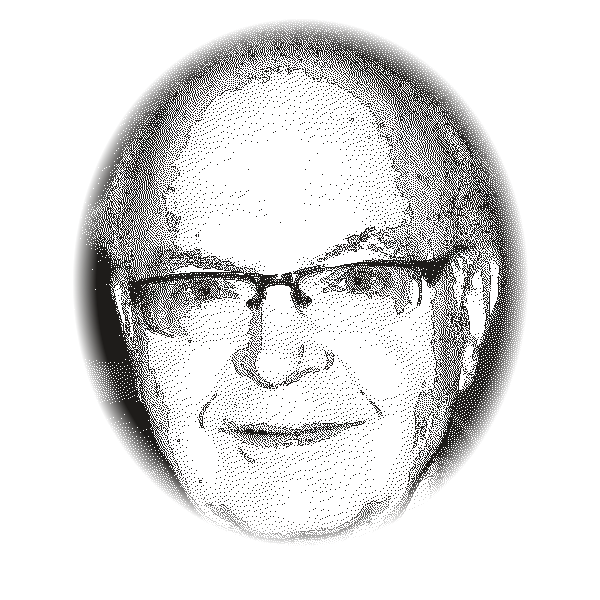
In 1962, a representative from Addison-Wesley approached a twenty-four-year-old Caltech graduate student named Donald Ervin Knuth with an offer: write a modest handbook on the design of software compilers. At the time, computing possessed no canonical textbook, no foundational canon, and no intellectual spine. The nascent discipline was an undisciplined wilderness of manufacturer manuals, IBM punch-card specifications, and folkloric trade secrets traded among technicians in machine rooms. If an engineer wanted to know how to sort a million records on magnetic tape or hash symbolic identifiers into a lookup table, they consulted a patchwork of vendor brochures or devised an ad-hoc routine from scratch.
Knuth accepted the commission. Sitting down with a yellow legal pad, he sketched what he assumed would be a single twelve-chapter volume. But as he began to write, he realized that to explain how a compiler functioned, he first had to explain how programs organized data in memory: linear lists, doubly linked rings, orthogonal trees, and dynamic heaps. To explain how to navigate those structures, he had to examine the exact mechanics of sorting and searching. And to evaluate which sorting technique was best, he discovered that contemporary computer science lacked the most elementary theoretical tool: a mathematical language to measure the quantitative performance of an algorithm before running it on a machine.
The modest handbook mutated. It swallowed Knuth's career, expanded into a projected seven-volume encyclopedia, and became The Art of Computer Programming—the Bible of computer science and the most ambitious intellectual endeavor in the history of software.
Knuth’s first profound act of seeing was the realization that computer programming was neither an empirical craft nor pure, disembodied mathematics. It was a novel discipline that he christened the Analysis of Algorithms.
Mathematicians had long studied numerical functions, but they cared primarily about existence: could a solution be computed in principle? Computer scientists, Knuth insisted, had to care about the concrete physical cost of execution. An algorithm was not an abstract idea; it was a sequence of operations that consumed precious resources—clock cycles, memory words, register transfers, and disk seeks.
To bring rigorous mathematical analysis to this mechanical reality, Knuth took a tool that Paul Bachmann and Edmund Landau had used in analytic number theory—the Big-O notation—and repurposed it as the universal currency of computation. He formalized the exact boundaries: big-O for upper bounds, big-Omega for lower bounds, and big-Theta for tight bounds. But Knuth refused to rest on crude asymptotic bounds that assumed memory was infinite. He insisted on concrete mathematics: calculating the exact expected number of machine instructions executed in the average case.
Where others were satisfied to declare that a quicksort ran in time proportional to $N \log N$, Knuth sat with pencil and paper, summing harmonic series, evaluating generating functions, and proving that an optimized Quicksort executed precisely $2(N+1)\ln N - \frac{8}{3}N + \mathcal{O}(\log N)$ comparisons. By marrying discrete combinatorics to the physical reality of the machine, Knuth transformed programming from an intuitive gamble into an exact, predictive science.
Yet as the discipline matured, academic computer science increasingly drifted into high-level abstractions, treating programming languages as ethereal mathematical calculi. Knuth vehemently resisted this disembodiment.
To anchor his analysis to reality, he invented an idealized machine: MIX, and later the RISC-based MMIX. Knuth insisted that every foundational algorithm in his treatise be implemented twice: first in clean, mathematically rigorous English, and second in the raw, unforgiving assembly language of this mythical computer.
His critics complained that teaching assembly language in an era of high-level languages was archaic and pedantic. Knuth replied that people who are more than casually interested in computers should have at least some idea of what the underlying hardware is doing. An engineer who understands only high-level abstractions is helpless when memory caches thrash, branch predictors fail, or pointers fragment memory. To Knuth, the algorithm was poetry, but it was poetry executed by physical atoms and silicon gates. One could not appreciate the architecture of the building without understanding the grain and tensile strength of the stone.
In the late 1970s, as he was preparing the second edition of Volume 2, Knuth collided with an aesthetic catastrophe.
The publishing industry had abandoned traditional hot-lead metal Monotype composition in favor of modern phototypesetting. When the proof sheets arrived from the printer, Knuth opened the package and felt physically sick. The mathematical formulas that had looked crisp, balanced, and luminous in the first edition were now clumsy, uneven, and grotesque. Fractions were misaligned, integral signs looked like drunken slurs, and the delicate elegance of classical mathematical typesetting had been eradicated by crude photographic scanning.
Unable to bear the thought of his magnum opus existing in such an ugly physical medium, Knuth made an astonishing decision. In 1977, he announced that he was taking a one-year sabbatical from The Art of Computer Programming to solve the problem of digital typography. The sabbatical lasted ten years.
Knuth did not merely write a typesetting program; he reimagined the entire craft of the printed word from mathematical first principles. He created TeX, a typesetting engine, and METAFONT, a system for designing mathematical letterforms using cubic Bézier splines.
Where previous composition systems broke lines of text greedily—packing as many words onto a line as possible and then shoving the overflow onto the next, creating unsightly gaps—Knuth formulated paragraph composition as a global optimization problem. He modeled every space between words as an elastic spring possessing a natural width, a stretch factor, and a shrink factor. He assigned a quantitative penalty—a measure of "badness"—to any line whose spaces were forced to compress or stretch beyond their ideal limits. Using dynamic programming, TeX evaluated an entire paragraph at once, finding the single unbroken sequence of line breaks that minimized total typographic badness across the entire page.
When he finished, Knuth gave TeX away to the world for free, completely in the public domain. Today, virtually every scientific paper, mathematical treatise, and physics proof published on planet Earth is set using the engine Knuth built to save his books. So complete was his engineering that TeX became one of the few pieces of complex software in history to achieve near-total bug-free stability. Knuth froze its architectural specification, declaring that subsequent bug-fix releases would simply add another decimal digit of $\pi$.
In the process of building TeX, Knuth achieved his final and most radical methodological synthesis: Literate Programming.
For decades, the computer had dictated the posture of the programmer. Programmers wrote files structured to please the compiler, inserting occasional, disjointed comments to explain their tricks to other humans. Knuth proposed turning this relationship inside out.
Instead of imagining that our main task is to instruct a computer what to do, Knuth wrote, let us concentrate rather on explaining to human beings what we want a computer to do. Under his WEB system, a computer program is written as a continuous, elegant work of literature—an essay featuring expository prose, historical context, and mathematical equations—with fragments of code woven naturally into the narrative. A pre-processor, Tangle, strips away the prose to produce optimized code for the compiler, while Weave formats the text and code into a beautifully typeset, cross-indexed book.
Donald Knuth transformed programming from an industrial chore into a humanistic art. He demonstrated that the highest intellectual achievement is not to make simple things complex, but to make profound things crystal clear. Through his monumental treatises, his mathematical tools, and his typographic devotion, he proved that code is a permanent artifact of human culture—a medium where mathematical truth, operational efficiency, and aesthetic beauty become indistinguishable.
“Premature optimization is the root of all evil (or at least most of it) in programming.”
“An algorithm must be seen to be believed.”
“Instead of imagining that our main task is to instruct a computer what to do, let us concentrate rather on explaining to human beings what we want a computer to do.”
“Science is what we understand well enough to explain to a computer. Art is everything else we do.”
“Beware of bugs in the above code; I have only proved it correct, not tried it.”
- The Art of Computer Programming, Vols. 1–4B 1968–present
- Computer Programming as an Art (Turing Award Lecture) 1974
- Big Omicron and Big Omega and Big Theta 1976
- Fast Pattern Matching in Strings (KMP Algorithm) 1977
- The TeXbook & TeX: The Program 1984–1986
- Literate Programming 1984
- Concrete Mathematics (with Graham & Patashnik) 1989