Dante Alighieri
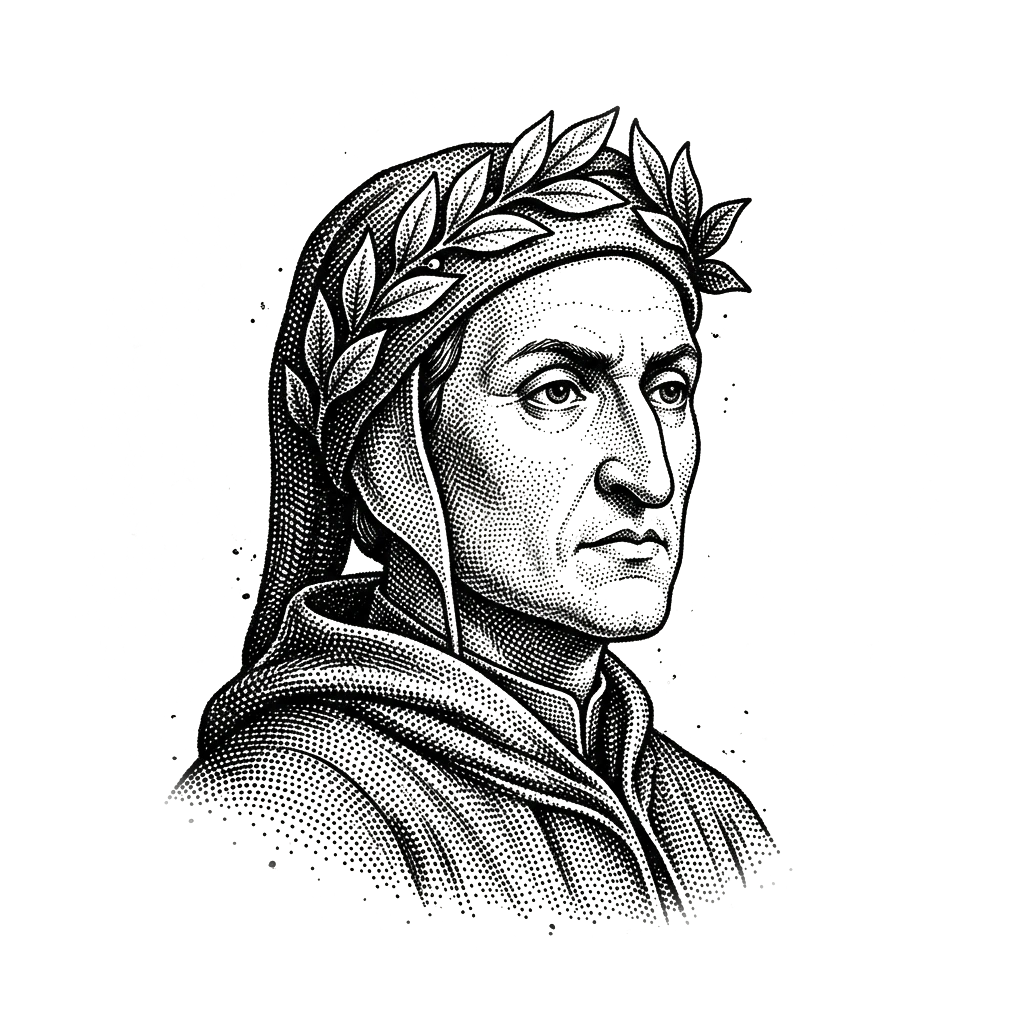
In the early spring of 1302, on the road descending the Apennines into exile, a thirty-six-year-old former prior of the Florentine Republic learned that his native city had condemned him to be burned alive at the stake should he ever dare to set foot within its walls again. Dante Alighieri had served Florence with fierce civil devotion: fighting as a cavalryman at the battle of Campaldino, serving on the Council of the Hundred, and striving as prior to pacify the fratricidal warfare between the Black and White factions of the Guelph party. Sent on an embassy to Rome to treat with Pope Boniface VIII—a pontiff whose worldly ambitions Dante despised—the poet watched in horror as the French prince Charles of Valois entered Florence, allowing the Black Guelphs to pillage the city, confiscate Dante’s home and library, and cast him into permanent vagrancy.
For the remaining nineteen years of his life, Dante was a wanderer across northern Italy, learning "how salty is the taste of another man's bread, and how hard a path it is to descend and mount another man's stairs." Stripped of political power, citizenship, and wealth, he chose not despair or political sycophancy, but an act of staggering poetic defiance. In the courts of Verona, Lucca, and Ravenna, by the dim light of tallow candles in drafty stone palaces, he began writing a three-part sacred poem in the vernacular Italian of Tuscany—a work he simply titled Commedia. In it, Dante summoned his generation, his popes, his emperors, his personal enemies, and the entire philosophical memory of Western civilization before the judgment seat of eternity.
The opening line of the Inferno is not an individual complaint, but a collective confession: Nel mezzo del cammin di nostra vita / mi ritrovai per una selva oscura—"Midway upon the journey of our life, I found myself within a dark wood, for the straightforward path had been lost." Having strayed into despair and mortal disorientation, Dante finds his path blocked by three ravenous beasts: the leopard of lust, the lion of pride, and the she-wolf of avarice. When destruction seems certain, an apparition appears: Publius Vergilius Maro, the Roman poet of the Aeneid, sent from beyond the grave by Beatrice—the woman whose earthly beauty had first ignited Dante’s spiritual awakening in the streets of Florence, and who now personifies the divine wisdom of grace.
To emerge into the light, Virgil tells Dante, the soul cannot merely walk around the mountain; it must descend directly through the core of reality. Dante’s Hell is not a random subterranean torture chamber, but an architectural monument to the logical consequences of human freedom. Following the principle of contrapasso—the precise symbolic correspondence between the sin and its eternal retribution—the damned suffer the literalized reality of what they chose on earth. The lustful, who let their reason be swept away by passion, are whirled eternally in an unceasing, howling tempest; the hypocrites walk in agonizing processions weighed down by leaden cloaks gilded on the outside; and at the frozen center of the universe, locked in the ice of Lake Cocytus, Lucifer flaps his bat-like wings, weeping tears of blood as he chews the three great betrayers: Judas, Brutus, and Cassius. Evil, for Dante, is not a grand fiery rebellion; it is the absolute, frozen petrification of love.
Climbing out of the abyss along the shaggy flank of Satan, Dante and Virgil emerge beneath the southern stars on the shores of Mount Purgatory. Where Hell is static, claustrophobic, and despairing, Purgatory is dynamic, musical, and filled with hope. Here, souls voluntarily undergo curative labor to purify the seven root inclinations of sin—pride, envy, wrath, sloth, greed, gluttony, and lust—singing Gregorian hymns and supporting one another in corporate charity. Purgatory is the realm of time and transformation: the wound of original fracture is gently healed, and the will is retuned until it desires only the Good.
At the summit of the mountain, in the Terrestrial Paradise of Eden, Virgil—representing human reason pushed to its utmost classical limit—must take his leave, because natural philosophy cannot cross the threshold of divine communion. Beatrice descends in a cloud of flowers to take the poet’s hand, cross-examining him until he weeps tears of profound contrition for having forgotten the eternal light for worldly toys. Led by Beatrice, Dante ascends through the celestial spheres of the Paradiso, where light, geometry, music, and love intensify with every step.
In the Empyrean—the transcendent realm beyond space and time—Dante beholds the Celestial Rose: the assembly of all redeemed souls arranged in a stadium of light around the central radiance of God. Guided in his final steps by the contemplative mystic Bernard of Clairvaux, Dante offers his gaze directly into the Divine Essence. In the triune circle of light, he perceives an astonishing mystery: painted within the central radiant circle is the figure of a human being. Metaphysics and theology find their ultimate resolution not in an abstract mathematical void, but in the deification of the human face through the Incarnation.
At that ultimate frontier, discursive human intellect and poetic language reach their boundary and fail: A l'alta fantasia qui mancò possa—"To the high fantasy here power failed." Yet the journey concludes not in blindness, but in total equilibrium. Dante’s will and desire are caught up into the cosmic rotation, harmonized completely with "the Love that moves the sun and the other stars" (l'amor che move il sole e l'altre stelle).
Dante completed the Paradiso in Ravenna in the late summer of 1321. Returning from a diplomatic mission to Venice across the malaria-ridden marshes of the Po delta, he was stricken with violent fever and died on September 14, at the age of fifty-six. The citizens of Ravenna buried him in the Church of San Pier Maggiore; when the repentant city of Florence later built a lavish empty monument in Santa Croce and demanded the return of his bones, Ravenna adamantly refused, keeping the exiled poet resting in the peace of the pine forests he loved.
Dante changed the history of Western literature by establishing the vernacular Italian tongue as an instrument capable of expressing the highest philosophical, political, and theological subtleties. The Commedia is the grandest cathedral ever built of words: 14,233 lines arranged in rigorous terza rima, interlocking every stanza into an unbreakable chain of rhyme. By wedding the rigor of Thomas Aquinas to the epic sweep of Virgil and the personal agony of a political exile, Dante created the supreme poem of the Middle Ages and an enduring map of the human pilgrimage from self-delusion to radiant love.
“The love that moves the sun and the other stars.”
“Midway upon the journey of our life, I found myself within a dark wood, for the straightforward path had been lost.”
“Abandon all hope, ye who enter here.”
“You shall learn how salty is the taste of another man's bread, and how hard a path it is to descend and mount another man's stairs.”
“The darkest places in hell are reserved for those who maintain their neutrality in times of moral crisis.”
- The Divine Comedy: Inferno c. 1308–1314
- The Divine Comedy: Purgatorio c. 1312–1318
- The Divine Comedy: Paradiso c. 1315–1321
- Vita Nova c. 1294
- De Monarchia c. 1312–1313