Carl von Clausewitz
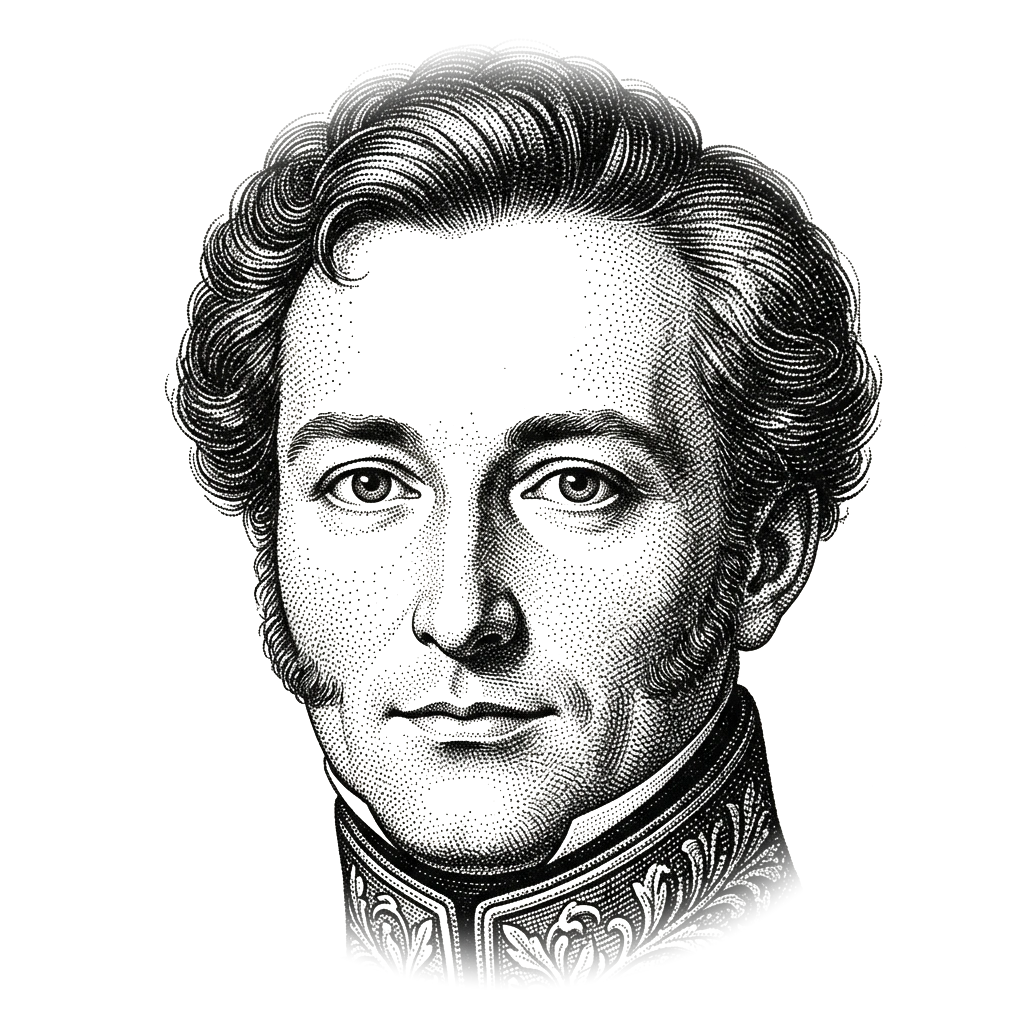
In October 1806, on the windswept plateau of Jena and in the autumn fog of Auerstedt, the proud military machine of Frederick the Great was annihilated in a single afternoon. For half a century, the Prussian army had been revered as the supreme clockwork of Europe—a rigid, geometric apparatus where soldiers were drilled into automatons who feared their officers' canes more than enemy musket balls. Yet against the swift, flexible corps of Napoleon Bonaparte and the ferocious, nationalistic energy of post-revolutionary France, that clockwork shattered into fragments. Among the retreating Prussian officers was a twenty-six-year-old captain named Carl von Clausewitz. Wounded, captured, and marched through France as a prisoner of war, Clausewitz endured the ultimate military humiliation. That catastrophic collapse burned away every illusion he possessed regarding eighteenth-century warfare. He understood that the old geometric treatises, which treated battle as an exercise in angles, supply depots, and bloodless maneuvers, were bankrupt. War was not chess; war was a clash of living wills fought in the crucible of blood, fear, and chaos.
Born into the minor Prussian nobility in Burg near Magdeburg, Clausewitz had entered the army as a twelve-year-old lance-corporal, serving in the siege of Mainz before his voice had broken. But his true intellectual awakening occurred at the newly founded Berlin War Academy under the mentorship of Gerhard von Scharnhorst. Scharnhorst taught him to view military history not as a set of mechanical recipes, but as a dynamic, philosophical inquiry. When King Frederick William III of Prussia submitted to Napoleon in 1812, agreeing to supply Prussian troops to assist the French invasion of Russia, Clausewitz’s conscience revolted. He refused to serve the conqueror of his homeland. He resigned his Prussian commission, branded a traitor by his own monarch, and rode east to enter the service of Tsar Alexander I. He fought through the carnage of Borodino in the Russian artillery redoubts and helped negotiate the historic Convention of Tauroggen, which turned the Prussian auxiliary corps against France and sparked the German War of Liberation.
Following Napoleon’s final defeat at Waterloo, Clausewitz was appointed administrative director of the Prussian Allgemeine Kriegsschule in Berlin. For twelve years, free from active field command and aided by the intellectual partnership of his brilliant wife, Countess Marie von Brühl, he dedicated his quiet hours to the composition of his magnum opus: Vom Kriege—On War.
Clausewitz’s central intellectual endeavor was to demolish the pseudo-scientific theorists of his day, such as Antoine-Henri Jomini and Heinrich von Bülow, who claimed that war could be reduced to mathematical formulas, geometric angles of operation, and foolproof tactical diagrams. Clausewitz recognized that such systems deliberately ignored the very qualities that define combat. War operates in an environment of total uncertainty, physical danger, exhaustion, and moral terror. No battle plan survives contact with reality because the adversary is not a passive object, but an active, reacting intelligence determined to frustrate one’s design.
To capture this reality, Clausewitz coined his most famous concept: Friction (Friktion). "Everything in war is very simple," he wrote, "but the simplest thing is difficult. The difficulties accumulate and end by producing a kind of friction that is inconceivable unless one has experienced war." A wagon wheel breaks in the mud; a courier is ambushed; rain drenches the gunpowder; a general receives three contradictory reconnaissance reports; soldiers cannot see through the black-powder smoke. Just as in mechanics, where friction resists every motion, so in war friction resists every strategic plan, turning what appears effortless on paper into an agonizing slog through water.
To master friction, the military leader requires not mathematical calculators, but rare moral and psychological qualities that Clausewitz grouped under the term military genius. The first is coup d'œil—the rapid, intuitive intellect that pierces through the swirling fog of war to grasp the essential truth of the battlefield in a flash of insight. The second is Entschlossenheit—resolution, the iron will to persist along a chosen course despite physical exhaustion, mounting casualties, and the paralyzing clamor of doubt.
Clausewitz distinguished between two concepts of war: absolute war and real war. Absolute war is the abstract, theoretical limit of conflict—a pure, self-escalating duel where violence, unrestrained by human friction or political compromise, accelerates to its maximum extremity of total destruction. But in physical reality, absolute war is never realized. Real war is always tempered, shaped, and bounded by historical context, domestic limitations, alliance friction, and above all, political policy.
This led directly to his most celebrated axiom: Der Krieg ist eine bloße Fortsetzung der Politik mit anderen Mitteln—war is the continuation of politics by other means. War is never an autonomous, self-justifying act of violence. It is an instrument wielded by political entities to achieve a specific political objective. "War has its own grammar," Clausewitz insisted, "but not its own logic." The moment the military grammar of destruction eclipses the political logic of the state, warfare degenerates into meaningless, catastrophic suicide.
Underpinning this philosophy was Clausewitz’s concept of the Wunderliche Dreifaltigkeit—the Remarkable Trinity. He demonstrated that every conflict is governed by three dynamic, competing gravitational centers: First, the blind natural force of primordial violence, hatred, and animosity, which belongs primarily to the passion of the people. Second, the play of chance, probability, and creative courage, which belongs to the military commander and his army. Third, the subordinate instrument of rational political purpose, which belongs to the government.
A strategy that fixes its gaze upon only one of these three elements is instantly blinded. A war fought purely by political diplomats without popular passion produces faint, indecisive skirmishes; an army unleashed without political purpose turns into a predatory monster; a public whipped into blind rage without military realism invites total catastrophe. Strategy is the perpetual, agonizing art of maintaining balance between these three unstable poles.
In 1830, when revolution erupted in Paris and Poland rose in revolt, Clausewitz was recalled to active duty as chief of staff to Field Marshal August von Gneisenau on the eastern border. While supervising an army cordon designed to contain an outbreak of Asiatic cholera sweeping out of Russia, both Gneisenau and Clausewitz were infected. Clausewitz returned to his home in Breslau, where he died suddenly on November 16, 1831, at the age of fifty-one.
He left behind heaps of unorganized notes, drafts, and crossed-out manuscripts. In an unsigned preface written before his death, he had confessed: "Should an early death interrupt my work, what is here will no doubt be called a shapeless mass of thoughts... yet the reader who seeks the truth will discover here the fruits of many years' reflection." That his masterpiece saw the light of day was the solitary achievement of his widow, Marie von Brühl. Over three agonizing years of mourning, she transcribed his handwriting, edited his text with profound scholarly rigor, and published the eight volumes of his collected works between 1832 and 1834.
Carl von Clausewitz built no empires and conquered no capitals. Yet his unfinished treatise remains the most durable intellectual anatomy of human violence ever written. He stripped war of its martial romance and exposed its terrifying mechanics: an unpredictable storm where human passion, mechanical friction, and political ambition collide, and where victory belongs not to those who possess the neatest plans, but to those who possess the fortitude to navigate the inescapable fog of reality.
“War is the continuation of politics by other means.”
“Everything in war is very simple, but the simplest thing is difficult. The difficulties accumulate and end by producing a kind of friction that is inconceivable unless one has experienced war.”
“Pursuit of an enemy after a victory is second only to the victory itself.”
“No one starts a war—or rather, no one in his senses ought to do so—without first being clear in his mind what he intends to achieve by that war and how he intends to conduct it.”
“Kind-hearted people might of course think there was some ingenious way to disarm or defeat an enemy without too much bloodshed... Pleasant as it sounds, it is a fallacy that must be exposed.”
- Bekenntnisschrift (Political Declaration of Faith) 1812
- The Campaign of 1812 in Russia 1831
- Vom Kriege (On War) 1832
- The Campaign of 1815 in France 1835
- Principles of War 1862