Alexander Fleming
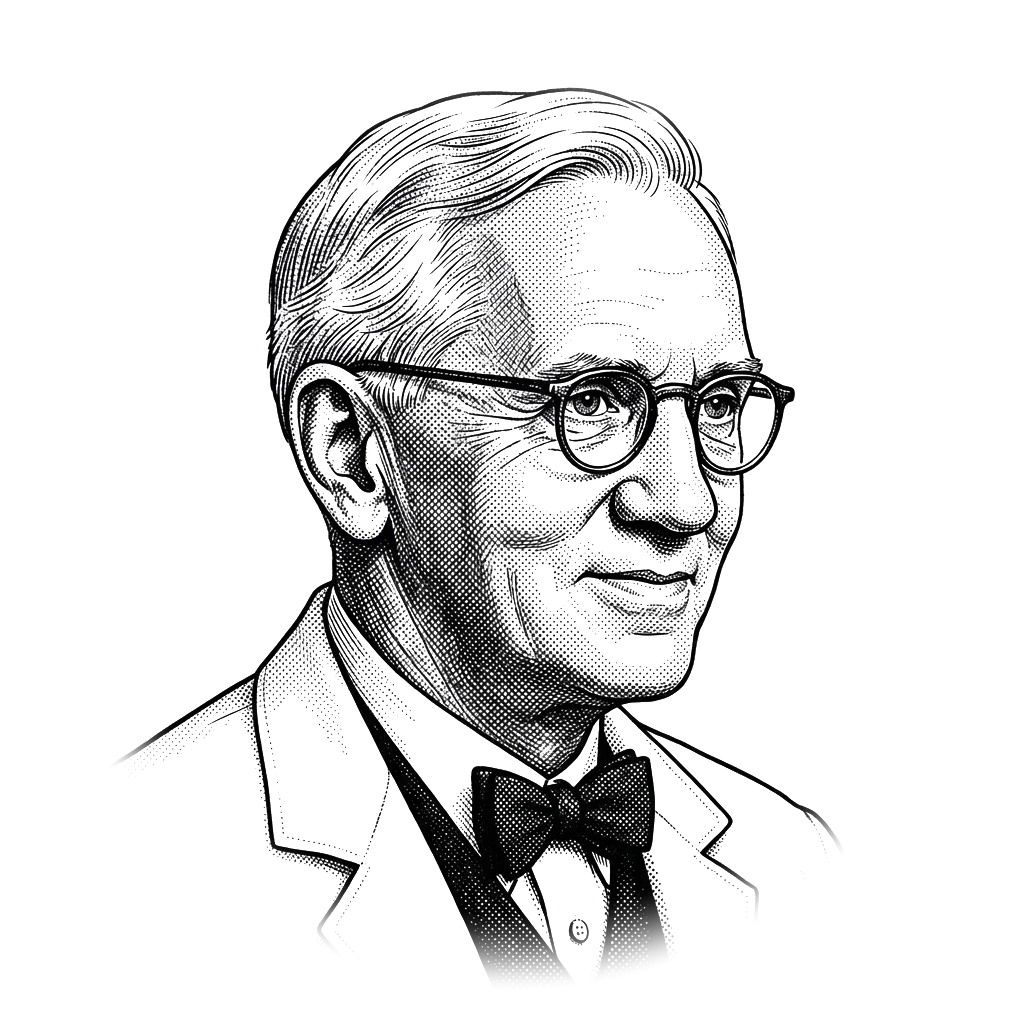
On a cool, damp morning in early September 1928, in a cluttered, disorderly second-floor laboratory at St Mary's Hospital in Paddington, London, a taciturn forty-seven-year-old Scottish bacteriologist returned from a month-long family vacation in Suffolk. Alexander Fleming was a man of few words, known among his colleagues for an extraordinary observational acuity paired with an almost legendary indifference to laboratory tidiness. Before leaving for his holiday, he had inoculated dozens of round glass Petri dishes with colonies of Staphylococcus aureus—the virulent golden bacterium responsible for boils, abscesses, wound infections, and fatal septicemia—leaving them piled in a haphazard stack on a corner of his wooden workbench near a window.
As Fleming sorted through the discarded culture plates, immersing them one by one in a tray of Lysol disinfectant, he paused over a dish that had been partially uncovered. A stray spore of mold from the damp London air had drifted onto the agar and germinated. Other bacteriologists would have cursed the contamination and scrubbed the plate clean. Fleming looked closely: around the fluffy white-and-green mold colony was a clear, transparent halo—a zone of inhibition where the previously dense, opaque bacterial colonies had dissolved and turned as translucent as drops of water. Looking up at his laboratory assistant, Fleming made the laconic, understated understatement that changed the history of medicine: "That's funny."
Born in 1881 on a remote, windswept hill farm in Ayrshire, Scotland, the seventh of eight children, Fleming had spent his youth herding sheep and observing nature across moorlands. Moving to London at thirteen, he worked as a shipping clerk for four years before a small inheritance allowed him to enter St Mary’s Hospital Medical School, where he spent his entire career. During the First World War, serving as a captain in the Royal Army Medical Corps on the Western Front in Boulogne, Fleming witnessed the horrifying slaughter inflicted by bacterial wound sepsis. Deep shrapnel and bullet wounds tore through battlefield soil laden with anaerobic bacteria, rotting the flesh of young soldiers.
Fleming watched in despair as army surgeons poured carbolic acid and chemical antiseptics into deep wounds. Through meticulous experiments, Fleming demonstrated that chemical antiseptics were worse than useless: while they failed to kill the bacteria lodged deep in cellular tissues, they actively destroyed the body’s white blood cells (leukocytes)—the immune system's primary defense against infection. The antiseptics were actually accelerating the mortality rate. From that battlefield horror, Fleming swore to find a substance that was lethal to pathogenic microbes while remaining entirely harmless to living human tissues.
In 1921, Fleming had made his first major discovery: lysozyme. Suffering from a heavy head cold, he allowed a drop of his own nasal mucus to fall into a bacterial culture dish; days later, he noticed the bacteria had dissolved. Lysozyme was a remarkable natural antimicrobial enzyme present in human tears, saliva, and mucus—the body’s first chemical shield. Yet lysozyme acted only against harmless, non-pathogenic airborne bacteria, leaving virulent pathogens untouched.
The September 1928 mold, however, was a vastly more formidable weapon. Fleming isolated the fungus, identifying it as Penicillium notatum, a rare species whose airborne spores had likely drifted upstairs from an allergy laboratory in the basement. He brewed the mold in meat broth, filtering the golden liquid he christened "penicillin." Testing the fluid against the most deadly human pathogens—streptococci, staphylococci, pneumococci, meningococci, and diphtheria bacilli—he found that even when diluted several hundred times, penicillin prevented bacterial growth. Crucially, when he injected it into rabbits and mice, it caused zero cellular toxicity; white blood cells bathed in penicillin broth continued to swim and engulf debris unimpeded.
Yet Fleming was an observational naturalist, not an organic chemist. Penicillin was an extraordinarily unstable, fragile organic molecule that degraded rapidly when exposed to air, light, or pH shifts. Fleming’s attempts to concentrate and purify the active substance failed; his crude laboratory filtrates lost their antibacterial potency within days. In 1929, Fleming published his findings in the British Journal of Experimental Pathology. The paper landed with a dead thud: virtually nobody paid attention, and Fleming, having neither the chemical staff nor the financial grants to master large-scale biochemical extraction, shelved the discovery, keeping the mold strains alive in his laboratory incubators.
A decade later, with the shadow of the Second World War descending across Europe, a team of biochemists at Oxford University led by Australian pharmacologist Howard Florey and German-Jewish refugee Ernst Chain rediscovered Fleming’s 1929 paper. Mobilizing modern biochemical techniques, Florey and Chain succeeded in freeze-drying and purifying stable penicillin crystals, testing them on mice in May 1940 and on human patients in 1941 with miraculous results. Transporting the mold to the United States in the lining of their coats to escape German bombings, Florey coordinated a monumental industrial effort with American pharmaceutical companies to mass-produce penicillin in giant deep-tank fermentation vats.
By D-Day in June 1944, millions of doses of penicillin accompanied Allied troops ashore in Normandy, virtually eradicating bacterial wound gangrene and pneumonia. In 1945, Fleming, Florey, and Chain were jointly awarded the Nobel Prize in Physiology or Medicine. Hailed overnight as a global secular saint, Fleming was knighted, honored by heads of state, and showered with adoration. Yet he remained modestly detached: "I did not invent penicillin; nature created it. I only discovered it by chance."
On March 11, 1955, Alexander Fleming died of a sudden heart attack at his London home, at the age of seventy-three, and was buried in the crypt of St Paul's Cathedral. In his Nobel acceptance speech, he had issued an uncannily prophetic warning: if penicillin is taken in inadequate doses or used casually for trivial infections, microbes will inevitably undergo selective mutation, breeding resistant strains that no antibiotic can cure. Alexander Fleming opened the antibiotic era—an era that saved hundreds of millions of lives, doubled human life expectancy, and granted our species its first decisive victory over the invisible empire of microbial disease.
“That's funny.”
“One sometimes finds what one is not looking for.”
“I did not invent penicillin; nature created it. I only discovered it by chance.”
“The unprepared mind cannot see the outstretched hand of opportunity.”
“The time may come when penicillin can be bought by anyone in the shops. Then there is the danger that the ignorant man may easily underdose himself and by exposing his microbes to non-lethal quantities of the drug make them resistant.”
- On the Antibacterial Action of Cultures of a Penicillium 1929
- On a Remarkable Bacteriolytic Element (Lysozyme Paper) 1922
- The Action of Chemical and Physiological Antiseptics in Septic Wounds 1919
- Penicillin: Its Practical Application 1946
- Nobel Lecture: Penicillin 1945